

The bill requires the public utilities commission (commission) to evaluate electrical generation and grid resilience against geomagnetic storms (evaluation) and report the findings of the evaluation to the general assembly. The bill requires each electrical utility that is subject to the jurisdiction of the North American Electric Reliability Corporation to annually submit a critical energy infrastructure information request to the federal energy regulatory commission. If the utility receives the permission, each of these electrical utilities must annually brief the general assembly on the utility's contingency action plan and any information necessary to: Evaluate the ability of and identify shortfalls to restoring electrical power operation, fuel delivery, and equipment function within specified time frames following certain types of geomagnetic storms; and Evaluate the certification of hardware and software monitoring and controlling systems for energy generation and distribution. The bill sets standards for the evaluation. Based on the evaluation, the commission shall adopt rules requiring an electrical utility to meet resiliency standards for geomagnetic storms. The rules include: Requiring the monitoring of the space weather prediction center of the national oceanic and atmospheric administration in order to isolate large power transformers and power generation from the grid; Mechanically isolating critical components if or when a coronal mass ejection is likely to cause geomagnetically induced currents; Restricting or closing fuel pipeline valves to mitigate damage in a sectional failure; Installing automatic neutral ground blocking devices in large power transformers; Ensuring that computer equipment can be mechanically isolated from the grid and sheltered from geomagnetically induced surges; Requiring all networked systems that operate electrical generation and distribution to be electronically and physically separable from the outside networks; and Requiring the cyber-certification of hardware and software that operate electrical generation and distribution. (Note: Italicized words indicate new material added to the original summary; dashes through words indicate deletions from the original summary.) (Note: This summary applies to the reengrossed version of this bill as introduced in the second house.)
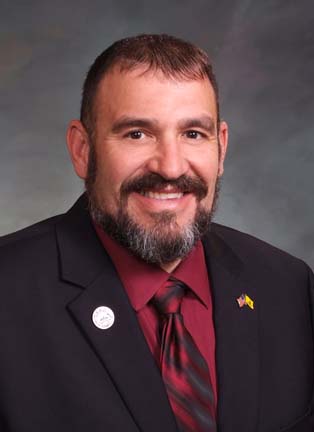
Rep. Ty Winter
Sponsored bills
The concurrent resolution submits a constitutional amendment to the voters of the state at the 2026 general election that will, if approved, add to the nonexclusive list of inalienable rights of all persons the right to direct the upbringing, education, and care of their children.(Note: This summary applies to this concurrent resolution as introduced.)
The act prohibits food processing plants from selling or offering for sale cell-cultivated meat that is misbranded as a meat product. The act also requires food processing plants to clearly label cell-cultivated meat as cell-cultivated meat. The department of public health and environment (department) is required to inspect food at a food processing plant if the department has reasonable cause to believe that: Cell-cultivated meat sold or offered for sale by the plant is misbranded as a meat product; or The plant is failing to label cell-cultivated meat as required. If, after an inspection, the department has reasonable cause to believe that a food processing plant is selling or offering for sale cell-cultivated meat that is misbranded as a meat product, or is failing to label cell-cultivated meat as required, the department may issue a stop order. Upon being issued the stop order, the food processing plant shall not sell the product or offer it for sale until the department determines whether it is misbranded or unlabeled in violation of the act. If the department determines that a food processing plant is selling or offering for sale cell-cultivated meat that is misbranded as a meat product, or is failing to label cell-cultivated meat as required, the department may issue an embargo order requiring the food processing plant to dispose of the cell-cultivated meat by means other than by sale to purchasers in Colorado. The department, the attorney general, or the district attorney in the district where cell-cultivated meat is being offered for sale or sold may petition the district court to enforce a stop order or an embargo order. The department may adopt rules as necessary to implement the act. (Note: This summary applies to this bill as enacted.)
The act clarifies that the child of an inbound active duty military member (member) who has an existing individualized education program (IEP) or existing section 504 plan is eligible for open enrollment, remote enrollment, and guaranteed matriculation. The act requires the school district, district charter school, or an institute charter school (local education provider) where the child enrolls to ensure the student receives the appropriate services and accommodations, consistent with the child's existing IEP or section 504 plan, without unreasonable delay upon enrollment. The act requires each local education provider to take reasonable steps to notify members and their families of their rights, including providing information on special education services to prevent inadvertent exclusion and to ensure members and their families are fully informed of available supports. (Note: This summary applies to this bill as enacted.)
The act requires the public utilities commission (commission) to adopt rules requiring that, unless the applicable road authority is a local government, the total costs to maintain an existing railroad crossing (total costs) are shared equally between the railroad, railroad corporation, rail fixed guideway, transit agency, or owner of the track (railroad) and the applicable road authority. If the applicable road authority is a local government, the commission must adopt rules that require the total costs to be apportioned as follows: The railroad is responsible for the costs to maintain the portion of the existing railroad crossing that is between the ends of the railroad ties; and The local government is responsible for the costs to maintain the portion of the existing railroad crossing that is outside of the ends of the railroad ties. The act applies to costs accrued on or after the effective date of the act unless the costs accrue pursuant to an agreement entered into by the parties before the effective date of the act, which agreement provides for the distribution of the costs to be shared between the parties. (Note: This summary applies to this bill as enacted.)
Under current law, each member of a board of directors of an irrigation district (board of directors) and each judge of election of an irrigation district (judge of election) receives compensation of not more than $100 per day. In addition, a contract entered into by a board of directors that involves a consideration that exceeds $250,000 but does not exceed $400,000 must be authorized and ratified in writing by no less than one-third of the electors of the irrigation district according to the number of votes cast at the last district election. A contract that exceeds $400,000 must be authorized and ratified at an election in the manner provided for the issuance of bonds. To account for inflation, the act: Increases the amount of compensation for members of a board of directors and judges of election to up to $150 per day; and Requires that, to be binding, a contract entered into by a board of directors that exceeds $400,000 but does not exceed $650,000 must be authorized and ratified in writing by no less than one-third of the electors of the irrigation district according to the number of votes cast at the last district election, and a contract that exceeds $650,000 must be authorized and ratified at an election in the manner provided for the issuance of bonds. The act requires that the dollar amounts related to compensation of members of a board of directors and judges of election, as well as those related to contracts entered into by a board of directors, must be increased for inflation every 5 years, beginning July 1, 2029. (Note: This summary applies to this bill as enacted.)
The prosecution fellowship program in the department of higher education provides money to the Colorado district attorneys' council (CDAC) to fund fellowships for persons who have recently graduated from a law school in Colorado to allow them to pursue careers as prosecutors in rural Colorado. The program, through a prosecution fellowship committee, places up to 6 fellows in rural district attorneys' offices throughout the state each year. The act changes the prosecutor fellowship program to provide fellowship funding to rural district attorneys' offices to recruit and hire new deputy district attorneys rather than selecting and placing fellows in rural district attorneys' offices. The selected offices then use the money to recruit and hire new district attorneys. The act requires the prosecution fellowship committee to determine which rural district attorneys' offices receive funding. On or before January 1, 2028, CDAC shall provide a report to the judiciary committees regarding the prosecutor fellowship program. (Note: This summary applies to this bill as enacted.)
Maddy summarySJR 25-008 designates March 3, 2025, as "Buy Colorado Day" (also called "303 Day") and March 3-10, 2025, as "Buy Colorado Week" to encourage Coloradans to support local businesses. The resolution urges residents to spend money at homegrown Colorado brands and enterprises, highlighting the state's diverse business community including restaurants, breweries, agricultural producers, and retailers. This symbolic measure has no legal force and serves as a recognition of Colorado's economic contributions, not a new policy or requirement. It directly affects all Coloradans by promoting a voluntary shift in consumer behavior toward local spending.
The act eliminates the statutory cap on the number of veterinary students permitted to attend Colorado state university at one time. The act eliminates additional financial limitations related to the professional veterinary medicine program at Colorado state university, including eliminating the university's bonding authority with respect to the veterinary medicine program. (Note: This summary applies to this bill as enacted.)
The statutory definition of "clean energy" determines which energy projects are eligible for clean energy project financing at the county and city and county level. The statutory definition of "clean energy resource" determines which energy resources may be used by a qualifying retail utility to meet the 2050 clean energy target. The act updates the 2 statutory definitions to include nuclear energy; except that, for property valuations made for tax purposes, the act exempts from the definition of "clean energy resource" nuclear energy. (Note: This summary applies to this bill as enacted.)