

The act allows, but does not require, an eligible patient to request from a manufacturer the manufacturer's individualized investigational drug, biological product, or device, which is a drug, biological product, or device that is unique and produced exclusively for use by an individual patient based on the patient's own genetic profile. The manufacturer must be operating within an institution that operates under federal rules for the protection of human subjects. An eligible patient is an individual who has: A life-threatening or severely debilitating illness, as attested to by the patient's treating physician; Considered all other treatment options currently approved by the United States food and drug administration; Received a recommendation from the patient's treating physician; Given written, informed consent for the use of the individualized investigational drug, biological product, or device; and Documentation from the treating physician that the individual meets the definition of "eligible patient". The act authorizes, but does not require, a manufacturer to make the individualized investigational drug, biological product, or device available to an eligible patient at no charge, but the manufacturer may require payment to cover the cost. If any harm is caused to the eligible patient resulting from the use of the individualized investigational drug, biological product, or device, a private right of action cannot be brought against the manufacturer or against any other individual or entity involved in the care of the eligible patient with regard to the eligible patient's use of the individualized investigational drug, biological product, or device, so long as the manufacturer, individual, or entity complied with the law and exercised reasonable care. The act prohibits disciplinary action against a health-care provider's license based on the health-care provider's recommendations regarding the use of the individualized investigational drug, biological product, or device. The act does not affect a health-care insurer's obligation under current law relating to coverage for an insured's participation in a clinical trial. (Note: This summary applies to this bill as enacted.)
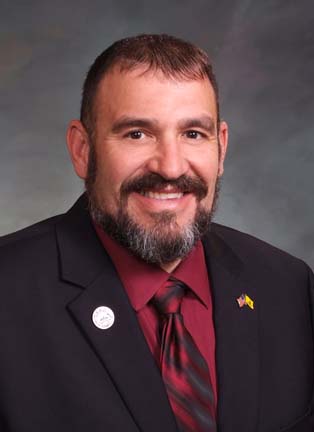
Rep. Ty Winter
Sponsored bills
Under current law, an investor-owned electric utility (utility) may apply to the public utilities commission (commission) for approval to charge certain commercial or industrial customers of the utility an economic development rate (economic development rate), which is a reduced rate offered to a commercial or industrial customer that locates or expands their operations in Colorado, that adds at least 3 megawatts of new load at a single location within the utility's service territory, and that demonstrates certain other requirements to the satisfaction of the utility (qualifying commercial or industrial customer). The act makes adjustments to the requirements for an economic development rate by: Requiring that an approved economic development rate not increase costs of electric service for other customers; Clarifying that an approved economic development rate does not relieve a utility of its obligation to achieve compliance with greenhouse gas emission reduction requirements; Authorizing a utility to apply to the commission for an expansion of the maximum duration of the economic development rate from 10 years to 25 years; Expanding the maximum load at a single location of a qualifying commercial or industrial customer for an individual project that does not require commission approval from 20 megawatts to 40 megawatts; and Updating the application process required for seeking approval of an economic development rate by requiring that the commission: Approve or deny an application within 120 days after a notice period of 14 business days after the application was filed; except that, if the load is more than 150 megawatts, the commission shall approve or deny the application within 210 days after the notice period; and Consider the broader economic benefits associated with the application for other classes of utility customers and for the surrounding community.(Note: This summary applies to this bill as enacted.)
The act amends the "Colorado Mined Land Reclamation Act" and the "Colorado Land Reclamation Act for the Extraction of Construction Materials" to: Contemplate the expedited issuance of reclamation-only permits to persons desiring to conduct reclamation-only operations after September 1, 2025, on less than 5 acres; and Update restrictions and requirements concerning the posting and forfeiture of financial warranties relating to mine reclamation projects. The act prohibits the office of mined land reclamation from issuing a reclamation-only permit to a mining operation at which: Toxic or acidic chemicals used in extractive metallurgical processing are present on site; Acid- or toxic-forming materials will be exposed or disturbed as a result of mining operations; or Uranium is developed or extracted, either by in situ leach mining or by conventional underground or open mining techniques. The act also enacts the "Interstate Mining Compact" and ratifies Colorado's membership in the associated Interstate Mining Commission. (Note: This summary applies to this bill as enacted.)
Individuals applying for hunting or fishing licenses in Colorado must also purchase a Colorado wildlife habitat stamp. The division of parks and wildlife in the department of natural resources uses the money collected from the Colorado wildlife habitat stamp for the benefit of wildlife habitat or access to wildlife habitat in the state. The Colorado wildlife habitat stamp program (program) is scheduled to repeal, subject to a sunset review by the department of regulatory agencies, on July 1, 2027. The act continues the program indefinitely. (Note: This summary applies to this bill as enacted.)
The act creates the future of severance taxes and water funding task force (task force). The department of natural resources is required to contract with a third party to conduct a study on severance taxes and water funding and develop recommendations for ways to continue funding water needs and energy impact grants in the face of decreasing severance tax revenue (study). The study must focus on identifying ways to alleviate the need to transfer revenues derived from severance taxes to the general fund and to replace severance tax revenue that was previously transferred to the general fund. The purpose of the task force is to work with the third party to conduct the study and develop recommendations. No later than January 15, 2026, the third party must submit a draft report, detailing the results of the study and any recommendations, to the department of natural resources and the task force for review. The task force is required to provide input on the draft report. No later than July 15, 2026, the third party must submit a final report, which incorporates the input of the task force, to the water resources and agriculture review committee (committee). The task force must present the final report to the committee during the 2026 legislative interim. The act changes the manner in which a credit allowed against severance tax in taxable years commencing January 1, 2026, but prior to January 1, 2028, is calculated. For the 2025-26 state fiscal year, $198,592 is appropriated from the severance tax operational fund to the department of natural resources to implement the act. (Note: This summary applies to this bill as enacted.)
The bill increases the membership of the public utilities commission from 3 to 5, with 2 of the commissioners representing the state at large and 3 representing one district each. The 3 districts are defined to include named counties, with one consisting of the Denver metro area, one of the western region of the state, and one of the eastern region of the state.(Note: This summary applies to this bill as introduced.)
For construction of multifamily, attached housing of 2 or more units, the act creates the multifamily construction incentive program (program). A builder may chose to participate in the program by: Providing a warranty that covers any defect and damage at no cost to the homeowner for specified periods; Having a third-party inspection performed on the property; and Recording a notice of election to participate in the program in the real property records before the property is offered for sale. For construction defect claims brought for the construction of housing for which the builder is a participant in the program, the act: Requires a claimant to file a certificate of review with the complaint, if the complaint is against an architect or engineer; Limits actions to claims that have resulted in: Actual damage to real or personal property; actual loss of the use of real or personal property; actual bodily injury or wrongful death; an unreasonable reduction in the capability of, or an actual failure of, a building component to perform an intended function or purpose; or an unreasonable risk of bodily injury or death to, or a threat to the life, health, or safety of, the occupants of the residential property; and Requires that a construction professional must send or deliver to the claimant an offer to settle the claim or a written response that identifies the standards that apply to the claim and explains why the defect does not require repair. For all construction defect claims, the act: Establishes a claimant's duty to mitigate an alleged construction defect and specifies how a claimant may satisfy this duty and the consequences to a claimant that fails to satisfy this duty; Requires a construction professional who is the defendant in a construction defect action to submit specified information to the claimant; Prohibits an insurer from cancelling, denying, or reducing coverage based on any claim for benefits covered by an existing liability insurance policy issued to a construction professional based on the construction professional's offer to repair or settle a construction defect claim; Tolls the statute of limitations or repose during a claimant's mitigation of an alleged construction defect; Increases the percentage of owners that an executive board of a unit owners' association (executive board) must obtain approval from before initiating a construction defect claim on behalf of the owners from a majority to 65%; and Requires an executive board that is successful in a construction defect claim or settlement to first use the net monetary damages or net proceeds received as a result of the claim to repair the construction defect. The act requires a local government to establish a fast-track approval process for an application for for-sale multifamily condominium projects in order to qualify for assistance from the state affordable housing fund. (Note: This summary applies to this bill as enacted.)
Maddy summarySJR 25-019 is a joint resolution that recognizes April 10, 2025, as "Home Education Day" in Colorado. It aims to honor, thank, and celebrate home educators and their home-educated children in the state.
Maddy summaryHJR 25-1028 designates Friday, April 25, 2025, as "Sportsmen's Day" in Colorado. This resolution aims to recognize the contributions of Colorado's sportsmen and women to conservation efforts and the state's economy. It also encourages members of the General Assembly to join the Colorado Legislative Sportsmen's Caucus and urges public and private institutions to work with the caucus.
Maddy summaryHouse Joint Resolution 25-1027 designates a specific portion of Colorado State Highway 1 in Larimer County, from East County Road 60 to Interstate 25, as the "Commissioner Lew Gaiter III Memorial Highway." It authorizes the Colorado Department of Transportation (CDOT) to accept donations for the initial placement of signs and to explore a cooperative agreement with Larimer County for sign maintenance.