

Each county in the state is categorized for purposes of establishing the salaries of elected officers in the county. The statutory salary amounts are adjusted every 2 years for inflation and take effect for terms commencing after any change is made. The act changes the category of Cheyenne county from V-D to V-C, the category of Dolores county from V-C to V-D, the category of Lake county from IV-B to IV-A, and the category of Pitkin county from II-B to I-A. The category changes will increase Cheyenne county official salaries as follows:County commissioner salary increases from $61,236 to $67,360;County sheriff salary increases from $68,646 to $75,511;County treasurer, assessor, and clerk salary increases from $61,236 to $67,360; andPart-time county coroner salary increases from $13,841 to $15,225. The category changes will decrease Dolores county official salaries as follows:County commissioner salary decreases from $67,360 to $61,236;County sheriff salary decreases from $75,511 to $68,646;County treasurer, assessor, and clerk salary decreases from $67,360 to $61,236; andPart-time county coroner salary decreases from $15,225 to $13,841. The category changes will increase Lake county official salaries as follows:County commissioner salary increases from $83,382 to $90,330;County sheriff salary increases from $111,735 to $121,046;County treasurer, assessor, and clerk salary increases from $83,382 to $90,330;Part-time county coroner salary increases from $37,077 to $40,167; andFull-time county coroner salary increases from $83,382 to $90,330. Pitkin county is a home rule county that may set the compensation for its officers and employees. The category changes may increase Pitkin county official salaries as follows:County commissioner salary increases from $121,634 to $158,669;County sheriff salary increases from $147,135 to $201,926;County treasurer, assessor, and clerk salary increases from $121,634 to $158,669; andFull-time county coroner salary increases from $121,634 to $158,669.(Note: This summary applies to this bill as enacted.)
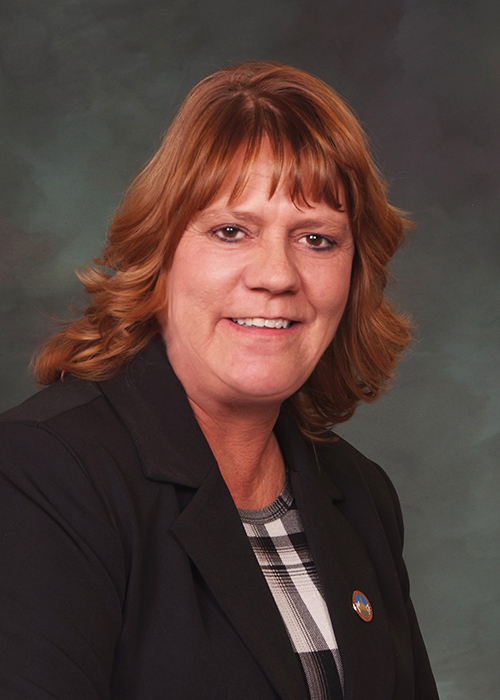
Rep. Tisha Mauro
Sponsored bills
The act requires the secretary of state to refer a ballot issue at the November 2026 general election to seek voter approval for the state, beginning in the 2026-27 state fiscal year, to retain and spend an amount of state revenue equal to the amount of state public K-12 education funding in excess of the limitation on state fiscal year spending and to increase state public K-12 education funding by up to 2% per year for 10 years. The act directs legislative council staff to determine the amount of state public K-12 education funding and describes how legislative council staff will make that determination. The act creates a positive factor to increase state public K-12 education funding. The amount of the positive factor compounds annually for 10 years. The positive factor for the 2026-27 budget year is 2% of the program foundation calculated for the 2025-26 budget year. For the 2027-28 through 2034-35 budget years, it is the sum of 2% of the prior year's program foundation plus the prior year's positive factor. For the 2035-36 budget year and beyond, it is the sum of 2% of the 2034-35 program foundation plus the 2034-35 positive factor. A district's share of the positive factor is calculated proportionally based on the district's total program under the new school finance formula relative to the statewide total program. A district may only use its positive factor funding for increasing teacher pay, improving teacher retention, lowering class sizes, and increasing access to career and technical courses. For the 2026-27 state fiscal year, the children's account consists of an amount of money equal to the amount of state revenues that the state retains for a given fiscal year pursuant to voter approval of the act. For state fiscal years commencing on or after July 1, 2027, the account consists of that same amount minus an amount equal to the total dollar amount of warrants issued by the state treasurer to reimburse local governments for property tax exemptions. Money in the account must first be spent to pay districts their positive factor, then any remaining funds are appropriated for disability services and school services and to increase annual contact hours, and finally to programs prioritizing child care and full-day preschool. The act directs the state auditor to conduct and publish a report on excess state revenues for each state fiscal year that the state retains and spends state revenues in excess of the limitation on state fiscal year spending. That report must include descriptions of:The amount of state revenues that the state retained and spent that would otherwise have been in excess of the limitation on state fiscal year spending; andHow the state expended the state revenues that the state retained and spent that would otherwise have been in excess of the limitation on state fiscal year spending. Beginning August 1, 2027, the act requires each local education provider to post, online for free public access in a format that can be downloaded and sorted, its actual expenditures of any positive factor received. Lastly, the act updates provisions regarding the expanded earned income tax credit, the family affordability tax credit, and the affordable housing financing fund to ensure that voter approval of the act does not adversely impact those programs.(Note: This summary applies to this bill as enacted.)
When a catalytic converter mechanically fails or is stolen from a motor vehicle, current rules of the air quality control commission require the replacement to comply with the rules of the California air resources board. The bill creates a temporary exception (exception) that allows an individual to use a replacement catalytic converter that complies with the standards established by rules of the United States environmental protection agency if:In the case of the theft of a catalytic converter, the theft has been reported to a law enforcement agency; andThe owner or operator of the motor vehicle has made a reasonable effort to obtain the required replacement catalytic converter and has been unable to obtain the replacement catalytic converter.The exception is repealed, effective July 1, 2028.The bill prohibits a motor vehicle repair facility or any employee or contract laborer of the facility from repairing or replacing a catalytic converter that has failed or been stolen without first informing the customer about available state programs to replace an internal combustion vehicle with a zero-emission alternative.(Note: This summary applies to this bill as introduced.)
Maddy summaryThis bill is a Senate Joint Resolution that formally recognizes the Colorado Mining Association for its 150th anniversary in 2026. It highlights the organization's historical significance and its role in supporting Colorado's mining industry, which contributes billions to the state's economy and supports tens of thousands of jobs. The resolution acknowledges the association's partnerships with state and federal agencies in promoting safety, environmental stewardship, and responsible mineral development. This measure does not change any laws or policies but serves as an official acknowledgment of the association's contributions to Colorado's history and economy.
The bill creates the large employer health-care support enterprise (enterprise) to impose, assess, and collect the large employer health-care support fee (enterprise fee) in the amount of $2,300 for each supported worker for the calendar year in an amount determined by the enterprise board (enterprise board) that reflects the costs of the services provided by the enterprise . A worker who is receiving medical assistance benefits under the state medical assistance program, except for a worker eligible for medical assistance benefits based on disability, is a supported worker (supported worker). An employer is subject to the enterprise fee if the employer is a large employer, which is defined in the bill as an employer that has 500 or more supported workers (large employer). An employer is exempted from paying the enterprise fee if the employer:Provides affordable health coverage to all workers working 20 or more hours per week or 80 or more hours per month;Is a franchisee of the employer;Is a nonprofit employer;Is a public employer; orHas a collective bargaining agreement with its employees that includes health-care coverage. The business purpose s of the enterprise are to use enterprise fee revenue to help large employers retain supported workers who are not provided employer-sponsored affordable health coverage by using enterprise fee revenue to:Help finance the costs for medical assistance benefits for large employers' supported workers ; and Provide reimbursement grants to large employers for some or all of an employer's costs incurred for allowing a worker to buy into an employer-sponsored health benefit plan, should the employer choose to participate in the worker buy-in program created in the bill.This These business service s reduce s lost productivity due to worker illness and training costs to replace workers who may otherwise seek employment that provides affordable health coverage. Starting with a review of the 2027 calendar year, the department of health care policy and financing (HCPF) every employer that employed 500 or more workers in the state shall prepare an annual employer report on or before January 31, 2028, and on or before the same date each year thereafter, that includes information about the employer's employees, including the employee's name, date of birth, hours worked, and dates of employment for the preceding calendar year. An employer may seek an exemption from the requirement to file the annual employer report by demonstrating that it provides affordable health coverage to all workers working 20 or more hours per week or 80 or more hours per month. Upon receipt of the annual employer report, the enterprise shall determine whether an employer is a large employer and shall issue a report by March of the following same calendar year that identifies large employers by their number of supported workers for the preceding calendar year and impose the enterprise fee on each large employer . An employer may contest the employer's identification as a large employer. Once identified, a large employer shall either pay the enterprise fee for each of the large employer's supported workers or demonstrate that it provides will offer affordable health coverage to all workers working 20 or more hours per week or 80 or more hours per month. The enterprise may adjust the amount of the enterprise fee to reflect the cost of the services, for inflation, or for other reasons. A large employer commits a petty offense and is subject to a civil penalty for The enterprise shall contract with the department of revenue to collect and enforce the payment of the enterprise fee on behalf of the enterprise, including the failure to provide information necessary to calculate the enterprise fee or to either timely pay the enterprise fee or demonstrate that the large employer offers affordable health coverage as specified in the bill. The department of revenue may collect interest and penalties and institute collection actions on behalf of the enterprise. Enterprise revenue is used to support the pay for payment of medical assistance benefits for working-age adults under the state medical assistance program, and to increase reimbursement rates for ensure access to health-care providers providing medical assistance program services, to ensure worker access to medical services and to pay for large employer reimbursement grants under the worker buy-in program for large employers that pay the enterprise fee. The enterprise is governed by the enterprise board, and the enterprise board shall report annually to the general assembly on the enterprise revenue and the enterprise's use of the enterprise revenue in support of large employers. If the enterprise determines that the enterprise to would receive more than $100 million dollars in its first 5 fiscal years, the state treasurer shall credit the additional fee revenue to the large employer fee cash fund created in the state treasury for administration by HCPF, and that fee revenue is subject to the state fiscal year spending limit imposed by section 20 of article X of the state constitution and the excess revenues cap. The money in the large employer fee cash fund shall be used by HCPF to pay for costs for medical assistance benefits to support large employers' supported workers enterprise shall reduce the amount of the enterprise fee.(Note: Italicized words indicate new material added to the original summary; dashes through words indicate deletions from the original summary.)(Note: This summary applies to the reengrossed version of this bill as introduced in the second house.)
The act declares emergency medical services as an essential service in the state and an integral part of the state's health-care infrastructure. The act also declares that emergency medical service providers, whether responding on duty or as a volunteer and regardless of location, provide essential services when providing emergency ambulance services and nonemergency ambulance services. The act also updates certain definitions related to emergency medical services, including the addition of a definition of 'out-of-hospital services', which term is defined to mean the furnishing of necessary health-care goods and services outside of a hospital setting but does not include prehospital setting transports. The act clarifies that an off-duty emergency medical service provider is not obligated to respond to the scene of a medical emergency or provide emergency medical services.(Note: This summary applies to this bill as enacted.)
Beginning January 1, 2027, the act requires an agricultural employer to pay certain agricultural employees overtime pay for time worked in excess of 56 hours in a workweek. The act also increases penalties for an agricultural employer who commits wage theft and repeals the authority of the director of the division of labor standards and statistics to adopt rules concerning overtime pay for agricultural employees.(Note: This summary applies to this bill as enacted.)
The water quality control division (division) administers a program to test for and remediate water quality issues for mobile home parks (program). The program tests for water quality issues that pose a risk to not only health or safety but also the welfare of park residents. The act authorizes the division to require remediation of welfare-related water quality violations. One of the requirements of the program is for the park owner to certify that the park owner has made certain water-quality-related notices to park residents. The act authorizes the division to issue an order requiring the park owner to comply with the park resident notice certification requirement. Under the program, the park owner is prohibited from imposing the cost of compliance with certain remediation-related requirements on park residents. The act authorizes a park owner who is also a park resident to bear this cost. The program authorizes the division to issue orders requiring the park owner to perform additional water testing, perform temporary measures necessary to address acute health risks, make additional reports to the division, create a remediation plan, implement a remediation plan, or respond to the division in connection with a remediation plan. The act clarifies that a park owner may ask for a hearing only regarding the orders that concern remediation plans. The act also clarifies that:The division has authority to enforce the requirements of the program; andThe division has authority to issue cease-and-desist orders to address violations related to the program, regardless of whether the issues are related to water quality violations. The act also provides that:An additional monthly penalty of up to $5,000 for a continuing violation may be imposed for the first 30 days of noncompliance; andA park owner is not entitled to an administrative hearing to contest an imposed civil penalty but may seek judicial review.(Note: This summary applies to this bill as enacted.)
Existing law specifies that an individual must be a certified death investigator or forensic pathologist to be eligible to hold the office of county coroner in a county with a population greater than 150,000. The act changes this requirement to apply in a county with a population greater than 300,000. The act also requires a county coroner to disclose, on the coroner's website, their financial interest in businesses regulated by their office, including a mortuary, funeral home, crematory, embalming service, or other death-care business. A coroner who has disclosed a financial interest shall not participate in an official action that would directly and specifically affect the business in which the coroner has a financial interest. The act does not prohibit a coroner or candidate for coroner from operating a death-care business.(Note: This summary applies to this bill as enacted.)
Maddy summaryThis bill proposes that Colorado lawmakers consider adding guaranteed lifetime income options to the state public employees' retirement defined contribution plan and voluntary savings plans. The measure aims to ensure public employees have access to a reliable income stream in retirement, similar to what is already available in the state's traditional defined benefit plan. By allowing workers to choose options that provide lifetime payouts, the bill seeks to improve retirement security and financial confidence for over 226,000 active public employees. The resolution encourages the General Assembly to study how these new options could help workers retire with dignity while maintaining the portability of their savings.