The act repeals a requirement that investigative reports be kept confidential and replaces it with a grant of rule-making authority to make ongoing investigations and security information confidential. The confidentiality rules must not make final reports of investigations confidential and must require the timely release of information if public knowledge of the information would protect the public safety, health, or welfare. (Note: This summary applies to this bill as enacted.)
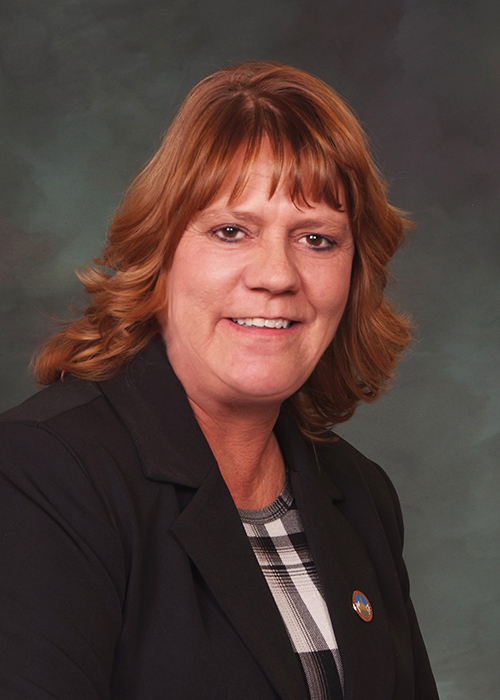
Rep. Tisha Mauro
Sponsored bills
Maddy summarySJR 25-011 is a symbolic resolution passed by the Colorado General Assembly to recognize the 19th annual Latino/a Advocacy Day 2025. It honors the contributions of Latinas and Latinos to Colorado's political engagement and their advocacy for equitable policies addressing systemic inequities in health, housing, education, and economic opportunity. The resolution directs copies to the event organizers, the Colorado Organization for Latina Opportunity and Reproductive Rights (COLOR) and Voces Unidas de las Montañas, and expresses the legislature's commitment to creating a Colorado that works for all residents regardless of immigration status. As a commemorative resolution, it has no legal effect but serves as a formal acknowledgment of community advocacy efforts.
Maddy summaryThis is a ceremonial resolution designating March 17, 2025, as "Colorado FFA Day." It recognizes the Future Farmers of America (FFA) organization's role in supporting agricultural education and youth development in Colorado. The resolution directly affects Colorado FFA members, educators, and supporters by formally honoring their contributions through this annual recognition. It does not create new laws or policy changes, as it is a symbolic gesture celebrating the organization's work.
Sections 1, 2, 3, and 4 of the act prohibit making, distributing, advertising, selling, promoting, completing, altering, or producing or causing to be made, distributed, advertised, sold, promoted, completed, altered, or produced a document that simulates or closely resembles an official document related to the administration of the motor vehicle or identification statutes (vehicular document piracy). A person does not commit vehicular document piracy if the person received the express written permission of the department of revenue (department). A violation is punishable by a fine of not more than $1,000. Sections 5 and 6 make the "Uniform Power of Attorney Act" apply to the motor vehicle statutes. Section 7 repeals the requirement that a military service-connected disability be permanent in order for a veteran to be eligible to register a motor vehicle without paying fees. Section 7 also repeals the license plates issued to foreign governments, consuls, or other official representatives of a foreign government. Section 8 repeals the Navy SEAL special license plate and the North American aerospace defense command commemorative special license plate, and section 9 repeals the "Alive at Twenty-five" special license plate. Under current law, a minor who is under 18 years of age must submit a log showing the minor drove at least 50 hours with a driving supervisor to be issued a driver's license. Section 10 authorizes any responsible adult to sign the log. Section 11 corrects a provision that describes a minor as being 21 years of age or older. Section 12 repeals a provision that incorrectly states the length of time a person must agree to register a vehicle after moving to Colorado. Under current law, the department may require a person to obtain a written medical opinion from certain medical professionals concerning medical criteria for driver licensing. Section 13 authorizes an advanced practice registered nurse to issue such an opinion. Section 14 authorizes the department to round fee increases to the nearest dollar. Under current law, a person who is not lawfully present may, to obtain an identification document, use an identifying document issued by an agency of the United States government or its contractors or subcontractors in accordance with rules adopted by the department, but this provision is scheduled to take effect on January 1, 2027. Section 15 changes this effective date to the earlier of January 1, 2027, or when the department is able to implement it. Section 16 authorizes the use of a mobile driver's license, which is an official electronic extension of a department-issued physical identification document, to verify age or identity. The provider of a mobile driver's license must comply with the standards adopted by the department by rule. The department is given rule-making authority to approve and implement mobile driver's licenses. Section 16 takes effect January 1, 2026. Section 17 authorizes the motor vehicle investigations unit (unit) to cancel, deny, or deny the issuance or reissuance of an official document upon determining that the person was not entitled to the issuance of the official document for: Failure to give the required or correct information in an application or for committing fraud in making the application or in submitting any proof for the application; or Permitting an unlawful or fraudulent use of the official document or for being convicted of an offense involving misuse of the official document. If the unit cancels, denies, or denies the issuance or reissuance of an official document, the affected person may request a hearing. (Note: This summary applies to this bill as enacted.)

Maddy summaryThis joint resolution declares February 28, 2025, as Rare Disease Day in Colorado to raise awareness about rare diseases. It directly affects Colorado residents living with rare diseases - over 500,000 people - and their families, recognizing the challenges they face, including high medical costs and limited treatments. The resolution makes no new policy changes but symbolically honors those impacted by urging the state to "show our stripes" in solidarity. It references national statistics (e.g., 1 in 10 Americans affected) and the "zebra" awareness symbol for rare conditions, without creating any legal obligations or funding.
Under current law, certain evidence of a victim's prior or subsequent sexual conduct is presumed irrelevant and inadmissible in a civil proceeding, but there is an exception for evidence of the victim's prior or subsequent sexual conduct with the defendant. The act eliminates this exception. The act prohibits the admission of evidence of the victim's manner of dress, hairstyle, mode or manner of speech, or lifestyle as evidence of the victim's consent, credibility, or the existence or extent of damages or harm. The party moving to admit evidence presumed irrelevant is required to raise the issue at a pretrial conference and make a prima facie showing that the evidence is relevant for an admissible reason and that discovery is likely to rebut the presumption of inadmissibility. The court is required to allow the nonmoving party to object. If the court allows discovery, the court must issue a protective order that limits the scope of discovery to relevant issues and protect against unwarranted, irrelevant, or overly broad discovery into the alleged victim's sexual conduct or history. (Note: This summary applies to this bill as enacted.)

The act requires a board of county commissioners, a governing body of a municipality, or a regional building department operating through an intergovernmental agreement with a board of county commissioners or governing body of a municipality that adopts or substantially amends a building code or updates a building code with a succeeding version of the international building code to ensure that the building code meets or exceeds the accessibility standards in the International Building Code, and the adopted accessibility standards cannot provide less protection than what is required by the federal "Americans with Disabilities Act of 1990". However, this requirement does not apply when energy-efficient building codes are adopted, nor does it apply to one- and 2-family dwellings and townhomes that comply with either the International Residential Code or a local building code whose accessibility standards are equivalent to the standards in the International Residential Code. The act requires the division of fire prevention and control within the department of public safety to ensure that, when certain building codes pertaining to public school and health facilities are substantially amended, the codes meet or exceed accessibility standards in the International Building Code. The act also requires the state housing board to ensure that, when the uniform construction and maintenance standards for hotels, motels, and multiple dwellings in jurisdictions with no local building code are substantially amended, the standards meet or exceed the accessibility standards in the International Building Code. The act also requires the state housing board to ensure that, when the recommendations for uniform housing standards and building codes to the general assembly and local governments are substantially amended, the codes meet or exceed the accessibility standards in the International Building Code. (Note: This summary applies to this bill as enacted.)
The bill requires the water quality control commission, on or before January 1, 2027, to issue written guidance specific to the development of the daily maximum amount of a pollutant from all sources that is allowed to enter state waters so that an applicable water quality standard is met (total maximum daily load). The bill also requires the division of administration in the department of public health and environment, on and after January 1, 2028, to determine a total maximum daily load for state waters using credible data.(Note: This summary applies to this bill as introduced.)
Maddy summaryHJR 25-1018 is a Colorado legislative resolution recognizing the service of Latina and Latino veterans who have served in the U.S. Armed Forces. It formally commends their contributions across military conflicts from the Revolutionary War through modern operations, highlighting historical units like the "Borinqueneers" and the American GI Forum. The resolution does not create new policies, benefits, or legal obligations - instead, it serves as a symbolic gesture of appreciation. A copy will be sent to the American GI Forum of Colorado, as specified in the resolution.
Maddy summaryThis House Joint Resolution (HJR 25-1017) is a ceremonial resolution honoring the historical legacy of the 10th Mountain Division, a U.S. Army unit that trained at Camp Hale in Colorado during World War II. It recognizes the division’s combat service in the Italian Alps, its postwar conservation efforts by veterans through the 10th Mountain Division Hut Association, and President Biden’s 2022 designation of Camp Hale as a national monument. The resolution expresses the Colorado General Assembly’s appreciation for the division’s bravery and its enduring connection to Colorado’s history and landscape. As a symbolic gesture, it does not create new laws or obligations but serves to memorialize the unit’s contributions.