

The act requires the state auditor to conduct or cause to be conducted performance audits (audits) of the air pollution control division in the department of public health and environment and the division of unemployment insurance in the department of labor and employment (divisions). The audits will determine whether each of the divisions effectively and efficiently performs and fulfills its statutory obligations. In addition, as part of the audits, the state auditor is required to: Determine whether a division complies with statute and its statutory purpose; Assess the impact of a division's processes on providing access to program benefits and, for the labor and employment division audit only, identify any division processes that may be unnecessary, unreasonable, or cause delays; Determine whether a division's staffing and funding levels are sufficient for it to efficiently and effectively perform its statutory duties and responsibilities, which, in for the air pollution control division audit only, must include assessment of how funding or staffing changes made at the state level might impact local governments; and Determine whether a division requested and was appropriated additional resources and whether the approval or denial of such a request impacted program implementation and timing of implementation. The initial audit of the air pollution control division must begin and be completed in calendar year 2026, with an additional audit occurring in calendar year 2031. The initial audit of the division of unemployment insurance must begin and be completed in calendar year 2027, with an additional audit occurring in calendar year 2032. Upon completion of an audit, the state auditor is required to submit a written audit report to the legislative audit committee. (Note: This summary applies to this bill as enacted.)
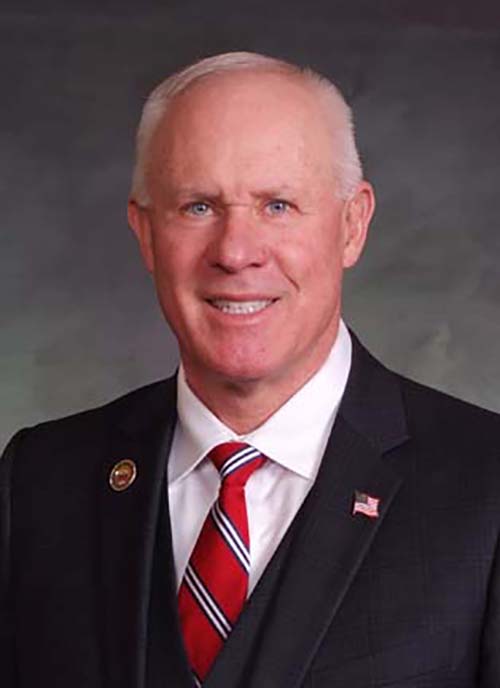
Rep. Tony Hartsook
Sponsored bills
The act incorporates the federal "Uniform Code of Military Justice" (federal code) into the "Colorado Code of Military Justice" (state code), including specifically the punitive articles and general article of the federal code, which describe punishable offenses, and the statute of limitations that applies to charges brought pursuant to the state code. The act repeals sections of the state code that are duplicative of the incorporated federal code. Additionally, the act: Applies the state code to a member of the state military forces (member) at all times, except when the member is ordered to active federal service pursuant to title 10 of the United States Code; Clarifies a commanding officer's authority to impose nonjudicial punishment under the state code; Makes changes to the procedures that govern courts-martial, the punitive authority of courts-martial, and the review of the decisions of courts-martial; and If concurrent civilian and military jurisdiction exists over the same offense and a district attorney has filed felony charges against a member for the offense, requires the state military forces to defer felony prosecution of the member to the district attorney.(Note: This summary applies to this bill as enacted.)
For vinous liquor alcohol shipper licenses, once those licenses are issued by the state, the act removes the requirement that a driver delivering vinous liquors on behalf of an alcohol beverage shipper licensee ensure that the individual accepting delivery is the individual intended to receive the product and instead requires only that the driver delivering the vinous liquor ensure that the individual accepting delivery is not under twenty-one years of age or visibly intoxicated. (Note: This summary applies to this bill as enacted.)
The act allows regulators of the following professions and occupations to require an applicant for a license, certification, or registration to submit to a fingerprint-based criminal history record check (fingerprint-based record check): Audiologists; Certified midwives; Cremationists; Dental hygienists; Dentists; Embalmers; Funeral directors; Licensed professional counselors; Mortuary science practitioners; Natural reductionists; Occupational therapists; Occupational therapy assistants; Physician assistants; Social workers; and Speech-language pathologists. An applicant submitting to a fingerprint-based record check must pay the costs associated with the fingerprint-based record check. If an applicant's fingerprint-based record check reveals a record of arrest without a disposition, the applicant must submit to a name-based judicial record check. A local government entity is authorized to perform a fingerprint-based record check when an ordinance or resolution requires an individual to submit to a fingerprint-based record check. The act also clarifies who is eligible to submit to, who is eligible to receive records from, and the type of records an entity may receive from a fingerprint-based record check and aligns state law with federal bureau of investigation requirements. (Note: This summary applies to this bill as enacted.)
Current law limits to 10 years the time a school district can lease district property not needed for its purposes. The act allows a school district to lease district property for any term of years for purposes of a solar field, energy storage system, or affordable housing. If a board of education of a school district leases or rents property for the purposes of an affordable housing project, the board of education shall develop a policy that defines affordable housing for the project. (Note: This summary applies to this bill as enacted.)
The act authorizes the director (director) of the division of professions and occupations in the department of regulatory agencies (division) to license dietitians and nutritionists if they meet the requirements specified by the act and the rules adopted by the director pursuant to the act. On and after September 1, 2026, an individual is prohibited from engaging in or offering to provide medical nutrition therapy unless the individual is licensed by the director. The act creates the dietetics and nutrition advisory committee in the division, which is responsible for advising the director in the regulation of medical nutrition therapy and the implementation of the act. An individual who desires to practice as a dietitian must file with the director: An application for a license; Proof of completion of educational requirements and supervised practice experience; and Proof of compliance with examination requirements or proof of holding a valid, current registration with the Commission on Dietetic Registration. An individual who desires to practice as a nutritionist must file with the director: An application for a license; Proof of completion of educational requirements and supervised practice experience; and Proof of compliance with examination requirements. Until September 1, 2028, the director may waive the examination requirement and may grant a nutritionist license to an applicant who meets specified criteria. The director may deny or refuse to renew a license, suspend or revoke a license, or impose probationary conditions on a license. The director may also issue warnings to or seek injunctive relief against a licensee or applicant for licensure who has engaged in specified grounds for discipline or unprofessional conduct. The director may issue a provisional license to practice as a dietitian or a nutritionist upon the filing of an application with the appropriate fees, submission of evidence of successful completion of the educational and supervised practice requirements, and submission of evidence that the individual has applied to take the required licensing examination. The act exempts specified individuals from the licensing requirements established by the act. An individual who practices or offers or attempts to practice as a dietitian or nutritionist without being licensed pursuant to the act and who is not exempted from licensure commits a class 2 misdemeanor. The director shall adopt rules as necessary to implement the act. The act is scheduled for repeal on September 1, 2035. Before the repeal, the functions of the director in regulating dietitians and nutritionists are scheduled for review in accordance with the sunset law. For the 2025-26 state fiscal year, the act appropriates $100,584 from the division of professions and occupations cash fund to the department of regulatory agencies to implement the act. VETOED by Governor 5/23/2025(Note: This summary applies to this bill as enacted.)
Beginning with the 2027-28 school year, the act requires each individual career and academic plan (ICAP) to include a requirement that, during the student's graduation year, the student has exposure to federal financial aid eligibility tools and net price calculators and practices filling out a free application for federal student aid or the Colorado application for state financial aid, unless the student or student's parent or legal guardian affirmatively declines to practice filling out the application or authorized school personnel determines it is not feasible for the student to practice filling out an application. The act requires each school district board of education to incorporate all the financial literacy standards into a course that is required for high school graduation. The act authorizes the department of education (department) to seek, accept, and expend gifts, grants, or donations for the purpose of supporting educators in implementing a financial literacy course. For the 2025-26 state fiscal year, the act appropriates $210,389 to the department for distribution to school districts to support implementation of a financial literacy course and the ICAP requirement. The act requires the department to distribute money to school districts that do not currently offer a course based on a formula determined by the department, which may include determining eligibility based on attestations from school districts. For the 2025-26 state fiscal year, the act appropriates $9,611 to the department of higher education for use by the Colorado commission on higher education and higher education special purpose programs for administration. (Note: This summary applies to this bill as enacted.)
Under current law, life care institutions provide life and health support services to resident seniors who reside at the life care institution through the help of independent living arrangements, assisted living, or skilled nursing. The act allows life care institutions to provide community-based continuing care services to seniors in their homes and other services that benefit individuals who are awaiting admission to a life care institution. (Note: This summary applies to this bill as enacted.)
Current law requires a motor vehicle to be designed for operation on a highway to be covered by the "Uniform Motor Vehicle Law", which governs driver's licenses, registrations, and traffic regulation. The bill authorizes the owner of a surplus military vehicle to register the vehicle and be issued a license plate. If the vehicle is registered, it may be driven on the road but must comply with the registration provisions. The driver's license provisions and the traffic regulations apply to these vehicles.(Note: This summary applies to this bill as introduced.)
For construction of multifamily, attached housing of 2 or more units, the act creates the multifamily construction incentive program (program). A builder may chose to participate in the program by: Providing a warranty that covers any defect and damage at no cost to the homeowner for specified periods; Having a third-party inspection performed on the property; and Recording a notice of election to participate in the program in the real property records before the property is offered for sale. For construction defect claims brought for the construction of housing for which the builder is a participant in the program, the act: Requires a claimant to file a certificate of review with the complaint, if the complaint is against an architect or engineer; Limits actions to claims that have resulted in: Actual damage to real or personal property; actual loss of the use of real or personal property; actual bodily injury or wrongful death; an unreasonable reduction in the capability of, or an actual failure of, a building component to perform an intended function or purpose; or an unreasonable risk of bodily injury or death to, or a threat to the life, health, or safety of, the occupants of the residential property; and Requires that a construction professional must send or deliver to the claimant an offer to settle the claim or a written response that identifies the standards that apply to the claim and explains why the defect does not require repair. For all construction defect claims, the act: Establishes a claimant's duty to mitigate an alleged construction defect and specifies how a claimant may satisfy this duty and the consequences to a claimant that fails to satisfy this duty; Requires a construction professional who is the defendant in a construction defect action to submit specified information to the claimant; Prohibits an insurer from cancelling, denying, or reducing coverage based on any claim for benefits covered by an existing liability insurance policy issued to a construction professional based on the construction professional's offer to repair or settle a construction defect claim; Tolls the statute of limitations or repose during a claimant's mitigation of an alleged construction defect; Increases the percentage of owners that an executive board of a unit owners' association (executive board) must obtain approval from before initiating a construction defect claim on behalf of the owners from a majority to 65%; and Requires an executive board that is successful in a construction defect claim or settlement to first use the net monetary damages or net proceeds received as a result of the claim to repair the construction defect. The act requires a local government to establish a fast-track approval process for an application for for-sale multifamily condominium projects in order to qualify for assistance from the state affordable housing fund. (Note: This summary applies to this bill as enacted.)