

Maddy summarySJR 25-008 designates March 3, 2025, as "Buy Colorado Day" (also called "303 Day") and March 3-10, 2025, as "Buy Colorado Week" to encourage Coloradans to support local businesses. The resolution urges residents to spend money at homegrown Colorado brands and enterprises, highlighting the state's diverse business community including restaurants, breweries, agricultural producers, and retailers. This symbolic measure has no legal force and serves as a recognition of Colorado's economic contributions, not a new policy or requirement. It directly affects all Coloradans by promoting a voluntary shift in consumer behavior toward local spending.
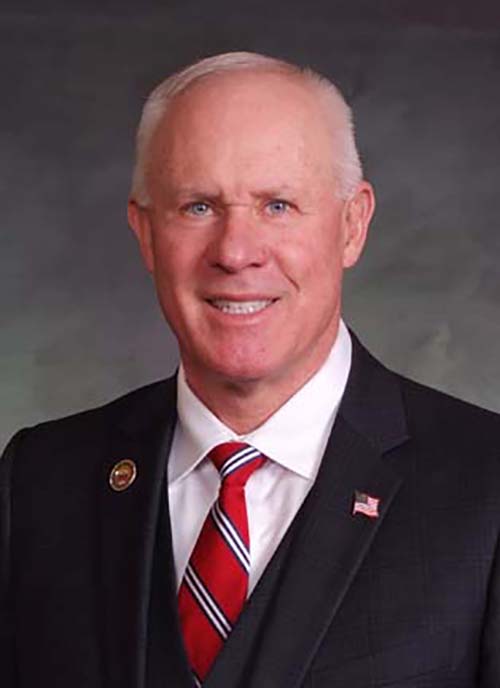
Rep. Tony Hartsook
Sponsored bills
Maddy summarySJR 25-018 recognizes April 2025 as Sexual Assault Awareness Month and designates April 30, 2025, as Colorado Denim Day. The resolution symbolically supports the annual Denim Day observance, which began in Colorado in 2013, to raise awareness about sexual violence and honor the work of organizations like the Colorado Coalition Against Sexual Assault (CCASA). It highlights ongoing challenges such as evidence kit backlogs and the need for survivor support services, without creating new laws or funding. This is a ceremonial resolution, not a policy change, aligning Colorado with the global Denim Day movement that uses wearing jeans to protest attitudes condoning sexual assault.
The act makes it legal to prescribe, dispense, distribute, possess, use, and market in Colorado a prescription medicine that contains crystalline polymorph psilocybin upon the medicine's approval by the United States food and drug administration. (Note: This summary applies to this bill as enacted.)
Maddy summaryThis is a ceremonial resolution designating March 17, 2025, as "Colorado FFA Day." It recognizes the Future Farmers of America (FFA) organization's role in supporting agricultural education and youth development in Colorado. The resolution directly affects Colorado FFA members, educators, and supporters by formally honoring their contributions through this annual recognition. It does not create new laws or policy changes, as it is a symbolic gesture celebrating the organization's work.
Current law makes it a felony to assault an emergency medical care provider while they are performing emergency medical care. The bill expands the statute to make it a felony to assault an emergency medical care provider while they are providing any function related to medical care. The bill lowers the mental state required for conviction from intentionally causes bodily injury to knowingly causes bodily injury for the crime of preventing certain public servants from performing a lawful duty. Current case law holds that the general assembly has not clarified whether second degree assault by strangulation could be charged as crime of violence subject to mandatory incarceration. The bill clarifies that strangulation by means of a deadly weapon, including a person's body parts, may be charged as crime of violence subject to mandatory incarceration. The bill requires the prosecution to allege and prove beyond a reasonable doubt that the defendant used a deadly weapon while committing second degree assault by strangulation. (Note: This summary applies to this bill as introduced.)
Maddy summaryThis joint resolution declares February 28, 2025, as Rare Disease Day in Colorado to raise awareness about rare diseases. It directly affects Colorado residents living with rare diseases - over 500,000 people - and their families, recognizing the challenges they face, including high medical costs and limited treatments. The resolution makes no new policy changes but symbolically honors those impacted by urging the state to "show our stripes" in solidarity. It references national statistics (e.g., 1 in 10 Americans affected) and the "zebra" awareness symbol for rare conditions, without creating any legal obligations or funding.
Under current law, certain evidence of a victim's prior or subsequent sexual conduct is presumed irrelevant and inadmissible in a civil proceeding, but there is an exception for evidence of the victim's prior or subsequent sexual conduct with the defendant. The act eliminates this exception. The act prohibits the admission of evidence of the victim's manner of dress, hairstyle, mode or manner of speech, or lifestyle as evidence of the victim's consent, credibility, or the existence or extent of damages or harm. The party moving to admit evidence presumed irrelevant is required to raise the issue at a pretrial conference and make a prima facie showing that the evidence is relevant for an admissible reason and that discovery is likely to rebut the presumption of inadmissibility. The court is required to allow the nonmoving party to object. If the court allows discovery, the court must issue a protective order that limits the scope of discovery to relevant issues and protect against unwarranted, irrelevant, or overly broad discovery into the alleged victim's sexual conduct or history. (Note: This summary applies to this bill as enacted.)
The bill creates the graduate medical education grant program (grant program) in the health facilities and emergency medical services division (division) within the department of public health and environment (department). The purpose of the grant program is to support the establishment of accredited residency programs at health-care facilities in Colorado that have never had a physician resident training program in order to expand physician training capacity and address the state's physician workforce shortage. The division shall engage stakeholders, including representatives from for-profit and not-for-profit medical schools, to recommend criteria for grant eligibility and other aspects of the grant award and reporting process. The department may seek, accept, and expend gifts, grants, or donations from private or public sources for purposes related to the grant program. The bill requires the department to include information about the grant program's role in creating new medical residency programs in the department's "SMART Act" hearings. (Note: This summary applies to this bill as introduced.)
Maddy summaryHJR 25-1018 is a Colorado legislative resolution recognizing the service of Latina and Latino veterans who have served in the U.S. Armed Forces. It formally commends their contributions across military conflicts from the Revolutionary War through modern operations, highlighting historical units like the "Borinqueneers" and the American GI Forum. The resolution does not create new policies, benefits, or legal obligations - instead, it serves as a symbolic gesture of appreciation. A copy will be sent to the American GI Forum of Colorado, as specified in the resolution.
Maddy summaryThis House Joint Resolution (HJR 25-1017) is a ceremonial resolution honoring the historical legacy of the 10th Mountain Division, a U.S. Army unit that trained at Camp Hale in Colorado during World War II. It recognizes the division’s combat service in the Italian Alps, its postwar conservation efforts by veterans through the 10th Mountain Division Hut Association, and President Biden’s 2022 designation of Camp Hale as a national monument. The resolution expresses the Colorado General Assembly’s appreciation for the division’s bravery and its enduring connection to Colorado’s history and landscape. As a symbolic gesture, it does not create new laws or obligations but serves to memorialize the unit’s contributions.