March 31 is currently known as 'Cesar Chavez Day' and may be voluntarily observed as a state legal holiday. The act repeals 'Cesar Chavez Day' and changes this voluntary legal holiday for March 31, 2026, and March 31, 2027, to instead be known as 'Farm Workers Day'.(Note: This summary applies to this bill as enacted.)
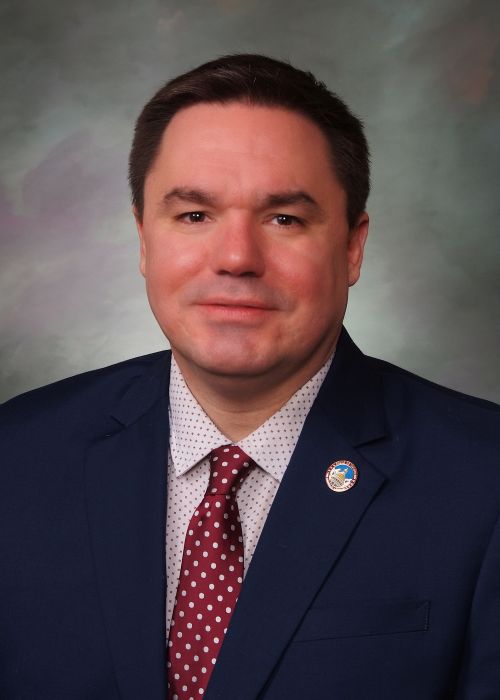
Rep. Chad Clifford
Sponsored bills
Maddy summaryThis House Resolution establishes March 31, 2026, as Farm Workers Day in Colorado to honor the contributions of agricultural workers to the state's economy and food supply. The measure recognizes that farm workers make up a significant portion of Colorado's rural workforce, including many immigrant and Latina women who face unique challenges in the industry. The resolution acknowledges the historical efforts of farm worker organizations that fought for better pay, safety, and union rights, while celebrating the dignity and hard work of those who grow and harvest food. Copies of the resolution will be sent to state officials and the UFW Foundation to commemorate this observance.
Maddy summaryThis House Resolution recognizes Earth Day and the International Day of Zero Waste while reaffirming Colorado's commitment to environmental stewardship. It encourages citizens, businesses, and organizations to participate in sustainability events on March 30 and April 22, 2026, and to adopt waste-reducing practices in their daily lives. The resolution also calls for the state to evaluate its own operations for greater efficiency and sustainability, though it does not create new laws or funding.
The act requires operators of certain websites, online services, online applications, or mobile applications (covered platforms) to ensure that each covered platform provides a streamlined process to allow Colorado law enforcement agencies to contact the covered platform at all times. The process must, at a minimum, make available a staffed hotline for Colorado law enforcement agencies for the purposes of:Receiving and responding to questions about search warrants;Acknowledging the receipt of a search warrant within 8 hours after receipt; andProviding status updates on search warrant compliance to a requesting Colorado law enforcement agency. An operator must comply with a search warrant within 72 hours after receiving the search warrant if certain conditions apply. A court may reasonably extend this time if the court makes a written finding that the operator or covered platform has shown good cause for the extension and that an extension would not cause an adverse result. The failure of an operator or a covered platform to comply with the requirements of a court-ordered search warrant supports a finding of contempt of court. The attorney general or a district attorney with jurisdiction may enforce the act.(Note: This summary applies to this bill as enacted.)
The act amends the law and adds new provisions to law relating to access to vaccines as follows: For the cervical cancer vaccine: (Sections 3 and 14)Updates insurance coverage statutes to refer to the vaccine as the human papillomavirus vaccine, rather than the cervical cancer vaccine; Recognizes coverage for both women and men;Authorizes the commissioner of insurance to adopt coverage rules for the vaccine if the advisory committee on immunization practices to the centers for disease control in the federal department of health and human services (ACIP) no longer recommends the vaccine; andUpdates language in the cervical cancer immunization program to define the cervical cancer vaccine as the human papillomavirus vaccine and to refer in the program to underinsured minors, rather than just uninsured female minors, since both male and female minors receive the vaccine; Under Colorado law, a naturopathic doctor must provide a parent or legal guardian with a copy of the most recent schedule of immunizations recommended by the ACIP. The act removes references to ACIP and requires a naturopathic doctor to refer patients to a schedule of immunizations established by rule of the state board of health (board of health) (Sections 4 and 5); The act authorizes pharmacists to exercise independent prescriptive authority for vaccines and requires the state board of pharmacy to review and repeal record-keeping rules for vaccines (Sections 6 and 7); In the context of vaccines required for school entry, updates vaccine-related liability limitation provisions to limit liability for injuries if the vaccine was administered to a child of any age according to the schedule of immunizations established by the board of health or to ACIP's schedule referenced in Colorado law (Section 8); The act also does the following:Directs the board of health, in adopting rules addressing which vaccines are to be administered to infants, to consider the recommendations of ACIP, as well as the recommendations of the American Academy of Pediatrics and other similar entities (Section 9);Removes the prohibition on the use of state money for infant immunization programs if the state does not receive federal money for the infant immunization programs, and requires any additional general fund money for the programs to be appropriated through the annual state budget process or emergency supplemental process (Section 10);For claims brought on or before January 30, 2029, adds pharmacies, manufacturers, and wholesalers to liability limitation provisions for hospitals, clinics, and other providers relating to the handling, storage, and distribution of vaccines for infants. Manufacturer and wholesaler liability limitation provisions are removed from the law for claims brought on or after January 31, 2029 (Section 11).Authorizes the department of public health and environment to consider vaccines adopted by the board of health by rule, recommendations of the American Academy of Pediatrics and other similar entities, in addition to ACIP, in recommending the purchase of vaccines, sending notifications concerning overdue vaccines and vaccine-preventable disease outbreaks, and when considering equivalent vaccines (Section 12). The act creates the 'Adult Immunization Act' (act), which applies to individuals at least eighteen years old. A person that administers a vaccine or other immunizing agent to an adult is not liable for civil damages for injury or death of an adult caused by a vaccine or immunizing agent if:The vaccine or immunizing agent was administered according to the schedule of immunizations establish by the board of health by rule, after considering recommendations from ACIP, the American Academy of Pediatrics, and other similar entities;There were no medical contraindications; and The vaccine or immunizing agent was administered in accordance with generally accepted clinical methods. For claims brought on or before January 30, 2029, against a hospital, clinic, pharmacy, manufacturer, wholesaler, or provider arising from injuries resulting from the handling, storage, or distribution of vaccines, there is no liability unless the injuries are the result of the negligent failure of an employee of the hospital, clinic, pharmacy, or manufacturer, wholesaler, or provider to conform to recognized standards to protect public health. Manufacturer and wholesaler liability protections are removed from the law for claims brought on or after January 31, 2029 (Section 15). The act authorizes the department of health care policy and financing to purchase for the children's basic health plan vaccines that are recommended by the American Academy of Pediatrics and other similar entities, in addition to those recommended by ACIP (Section 16).(Note: This summary applies to this bill as enacted.)

Maddy summaryThis bill is a House Joint Resolution that formally recognizes Latino/a Advocacy Day in Colorado, an annual event celebrating two decades of Latino/a community engagement in state policy-making. The resolution honors the contributions of Latinas and Latinos to Colorado's political history and acknowledges participants who travel to the state capitol to advocate for equitable treatment of Latino/a communities. It directs copies of the resolution to the organizations that convene the event, the Colorado Organization for Latina Opportunity and Reproductive Rights and Voces Unidas de las Montanas. The measure does not create new laws or policies but serves as a ceremonial acknowledgment of the Latino/a community's role in Colorado's democracy.
Maddy summaryThis bill officially designates a specific section of Arapahoe Road in Boulder County, Colorado, as the "Road of Remembrance" to honor local World War I veterans. It authorizes the Colorado Department of Transportation to accept donations for placing commemorative signs along the road and to explore agreements with Boulder County for maintaining those signs. The legislation also acknowledges the historical significance of the nearby stone pillars, known as the Gateway, which were originally built in 1928 to mark the entrance to a planned memorial roadway that was never fully completed.
The act discontinues the annual transfers from the state education fund to the Colorado teacher of the year fund for the Colorado teacher of the year program and to the early literacy fund for specified purposes in support of the 'Colorado READ Act'. The Colorado teacher of the year fund and the early literacy fund are repealed, effective September 1, 2027. The act permits the general assembly to appropriate money from the state education fund for the Colorado teacher of the year program and requires the general assembly to annually appropriate at least $34 million from the state education fund for the same specified purposes in support of the 'Colorado READ Act'.(Note: This summary applies to this bill as enacted.)

Compared to what was anticipated when appropriations were established in the 2025 regular legislative session for the 2025-26 budget year, the general assembly finds that for the 2025-26 budget year the actual funded pupil count and the at-risk pupil count are lower than anticipated; the local share of total program funding is higher than anticipated; and therefore, the general assembly intends to decrease the state share of districts' total program funding by $103,472,508 for the 2025-26 budget year. Under current law, there are 2 total program formulas to finance public schools, commonly referred to as the old formula and the new formula. For the 2025-26 budget year, a district's total program is the greater of:The district's total program amount for the 2024-25 budget year; orThe amount calculated for the 2025-26 budget year under the old formula plus an amount equal to 15% of the difference between the amounts calculated between the old formula and the new formula. The act clarifies that for the 2025-26 budget year, if the calculation under the new formula is less than the calculation under the old formula, then that district's total program for the 2025-26 budget year is the greater of:The district's total program amount for the 2024-25 budget year; orThe amount calculated for the 2025-26 budget year under the old formula. The act reduces appropriations to the department of education for the 2025-26 budget year by $103,472,508.(Note: This summary applies to this bill as enacted.)
Colorado imposes 3 charges on all retail sales of prepaid wireless telecommunications services: A prepaid wireless 911 charge, a prepaid wireless 988 charge, and a prepaid wireless telephone disability access (TDA) charge, which, effective January 1, 2026, replaced the former telecommunications relay service charge. The act makes the following modifications to the laws implementing the 3 prepaid wireless telecommunications services:Corrects erroneous cross references in connection with the prepaid wireless telecommunications services;Modifies the definition of 'prepaid wireless telecommunications service' (prepaid wireless definition) in the statute that implements the prepaid wireless 911 charge to include a wireless telecommunications service that is paid in advance, sold in predetermined units of time or money that decline with use or provides unlimited use of the service for a fixed time, and allows a user to make 911 calls. In addition, the act harmonizes the prepaid wireless definition for all 3 of the prepaid wireless telecommunication services.Adds providers of prepaid wireless telecommunications services (providers) to the definition of 'retail transaction' and to surcharge remittance procedures for the prepaid wireless 911 charge;Includes the prepaid wireless 988 charge in the list of taxes or fees that are administered by the department of revenue (department); Consistent with the treatment of confidential tax information regarding the prepaid wireless 911 charge, allows the department to disclose confidential tax information regarding the prepaid wireless TDA charge and the prepaid wireless 988 charge to their respective enterprises and to the public utilities commission;Consistent with the requirement for electronic filing and payment for the prepaid wireless 911 charge and the TDA charge, allows the department to require electronic filing and payment for the prepaid wireless 988 charge;Consistent with the prepaid wireless 911 charge, clarifies that telecommunications services that are not subject to the prepaid wireless TDA charge are subject to other TDA charges imposed by law and makes the same clarification regarding the prepaid wireless 988 charge; andConsistent with the prepaid wireless 911 charge, imposes the prepaid wireless 988 charge on providers that use federally supported services to provide free prepaid wireless telecommunications services.(Note: This summary applies to this bill as enacted.)