

The act changes state law to reflect changes to federal law that expand the authority of states, counties, and tribal governments to enter into good neighbor agreements with the federal government to carry out recreation and improvement services on land by:Specifying that the Colorado state forest service may enter into good neighbor authority agreements with the United States department of the interior, the United States department of agriculture, or any agency of the United States department of the interior or United States department of agriculture; andClarifying that the Colorado state forest service is required to conduct, or contract with one or more entities to conduct, demonstration projects that utilize Colorado's good neighbor authority to implement forest management projects that improve forest health, resilience, wildlife habitat, or outdoor recreation opportunities.(Note: This summary applies to this bill as enacted.)
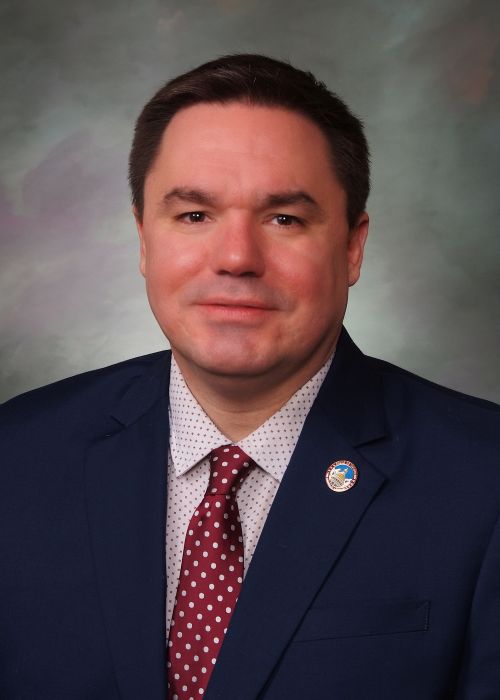
Rep. Chad Clifford
Sponsored bills
The act establishes civil immunity for a board member, staff member, or volunteer of a child advocacy center that arises from the performance of the board member's, staff member's, or volunteer's duties if the board member's, staff member's, or volunteer's acts are in good faith. The act allows certain entities to share information under certain circumstances that is relevant to the protection of a child that is the subject of a child maltreatment case.(Note: This summary applies to this bill as enacted.)
The act implements the recommendation of the department of regulatory agencies' 2025 sunset review and report on the business intelligence center advisory board (advisory board) by repealing the advisory board.(Note: This summary applies to this bill as enacted.)
The act prohibits a person from:Identifying an agricultural product as being produced in the state when selling, marketing, advertising, or distributing the product unless the product is grown in the state; andUsing the Colorado proud designation or logo unless authorized by the department of agriculture. A violation of these prohibitions constitutes a deceptive trade practice. There is no private right of action to enforce a violation of the prohibitions.(Note: This summary applies to this bill as enacted.)
The fire and police pension association (association) provides disability retirement and survivor benefits (disability and survivor benefits) for eligible members of the association (members) who become disabled or die. The act recodifies and reorganizes the disability and survivor benefits statutes, removes outdated provisions, and clarifies ambiguous language. In addition, the act makes the following modifications to the disability and survivor benefits statutes:Removes the current requirement that the association require every member who applies for disability retirement benefits to have 3 independent medical exams and instead authorizes the board of the association (board) to appoint a medical advisor to assess the needs of each applicant for disability retirement benefits;Authorizes the board to adopt rules to streamline the appeal process for disability retirement benefit applicants who are denied benefits;Allows the association to require a member who is occupationally disabled to participate in a rehabilitation and retraining program to help the member gain additional skills and knowledge so the member can earn a wage doing a job other than being a police officer or firefighter;Clarifies that a member who is a total disability retirement benefit recipient will begin receiving a cost of living adjustment when the member starts receiving a total disability retirement benefit;Clarifies eligibility for a member to apply for disability retirement benefits; Repeals the statute that makes an employer liable for the payment of disability retirement benefits if a member's disability existed at the commencement of employment, the employment was not ordered by a court, and the employer failed to require the member to complete and file a health history form prior to commencing employment; andRequires members to fill out a health history form, which notifies the association of any preexisting health conditions, prior to employment. The act does not change the amounts of disability retirement and survivor benefits or the length of time a member must be employed to be eligible for a benefit, nor does it require additional money from the state, employers, or members.(Note: This summary applies to this bill as enacted.)
The act includes approved facility schools in the definition of 'employer' for purposes of the public employees' retirement association (PERA) and allows an approved facility school to apply to the PERA board to affiliate with PERA.(Note: This summary applies to this bill as enacted.)
The act authorizes an occupational therapist to perform dry needling on and after September 1, 2027, if the occupational therapist:Has the knowledge, skill, ability, and documented competency to perform the act;Has successfully completed a dry needling course of study that meets supervisorial, educational, and clinical prerequisites to be established by rule; andObtains a written informed consent from each patient for dry needling, including information concerning the potential benefits and risks of dry needling and a statement that the occupational therapist performing dry needling is not an acupuncturist. The act requires the director of the division of professions and occupations within the department of regulatory agencies to adopt rules to implement the authorization for an occupational therapist to perform dry needling. At a minimum, the rules must establish requirements for dry needling performed by an occupational therapist that are equivalent to the requirements in rules adopted by the state physical therapy board for dry needling performed by a physical therapist.(Note: This summary applies to this bill as enacted.)
The bill makes street takeovers, coordinated street takeovers, racing and drag racing, and stunt driving (prohibited motor vehicle activities) illegal on highways and roadways. More specifically, the bill states that a person shall not:Intentionally engage in a prohibited motor vehicle activity;Coordinate or facilitate an event the person should reasonably know is a street takeover, a race or drag race, or stunt driving;Ride as a passenger in a motor vehicle the person should reasonably know is participating in a street takeover, a race or drag race, or stunt driving;Intentionally cause the movement of traffic to slow, stop, or be impeded in any way because of a street takeover, a race or drag race, or stunt driving;Drive a motor vehicle to carry fuel for a motor vehicle the person should reasonably know is involved in a street takeover, a race or drag race, or stunt driving; orKnowingly be a spectator to a race, drag race, or street takeover prohibited by the bill. The bill imposes penalties for a person that engages in a prohibited motor vehicle activity. The bill also imposes penalties for a person that engages in a prohibited motor vehicle activity and then eludes or attempts to elude a peace officer. Lastly, the bill states when and how a peace officer may, or a presiding court may issue an order to, impound, immobilize, or seize a motor vehicle involved in a prohibited motor vehicle activity.(Note: This summary applies to this bill as introduced.)
Maddy summaryThis bill urges the Colorado Department of Agriculture and the Colorado Farmers Market Association to maintain and strengthen their partnership to support farmers' market managers across the state. It recognizes that most market managers are volunteers who need expertise, training, and resources to handle tasks like event planning, food safety, and vendor coordination. The resolution aims to help sustain local farmers' markets that provide fresh produce to communities and support small-scale producers who rely on these venues for sales.
Maddy summaryHJR 1017 is a joint resolution urging the federal government to fulfill its obligations under the 1986 Colorado Ute Indian Water Rights Settlement Agreement. It specifically calls for action to address infrastructure gaps affecting two tribes: the Southern Ute and Ute Mountain Ute Tribes, who have settled water rights but cannot access or use them due to missing pipelines (e.g., from Lake Nighthorse) and deteriorating irrigation systems (like the PRIIP, requiring $126 million in repairs). The resolution highlights federal failures to fund operations, maintain infrastructure, and enable tribes to utilize their legally secured water for agriculture, municipal use, and economic development. As a procedural resolution, it does not create new law but formally requests federal action to resolve these longstanding barriers.