Maddy summaryThis bill establishes a joint committee of five legislators to inform the Governor that the current legislative session is about to end. The committee, composed of three House members and two Senate members, will also ask the Governor if he has any final messages for the assembly. Although the bill was introduced in 2026, it was ultimately not passed as the Senate laid it on the table. Its primary function is a procedural step to ensure proper communication between the legislature and the executive branch at the conclusion of a session.
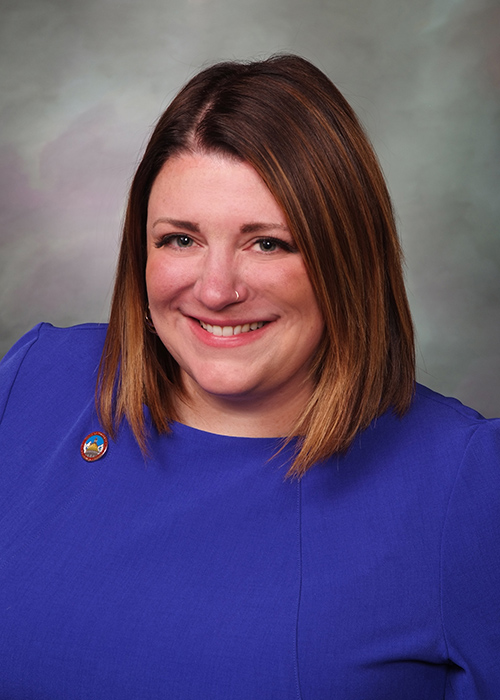
Rep. Jenny Willford
Sponsored bills
The act requires the secretary of state to refer a ballot issue at the November 2026 general election to seek voter approval for the state, beginning in the 2026-27 state fiscal year, to retain and spend an amount of state revenue equal to the amount of state public K-12 education funding in excess of the limitation on state fiscal year spending and to increase state public K-12 education funding by up to 2% per year for 10 years. The act directs legislative council staff to determine the amount of state public K-12 education funding and describes how legislative council staff will make that determination. The act creates a positive factor to increase state public K-12 education funding. The amount of the positive factor compounds annually for 10 years. The positive factor for the 2026-27 budget year is 2% of the program foundation calculated for the 2025-26 budget year. For the 2027-28 through 2034-35 budget years, it is the sum of 2% of the prior year's program foundation plus the prior year's positive factor. For the 2035-36 budget year and beyond, it is the sum of 2% of the 2034-35 program foundation plus the 2034-35 positive factor. A district's share of the positive factor is calculated proportionally based on the district's total program under the new school finance formula relative to the statewide total program. A district may only use its positive factor funding for increasing teacher pay, improving teacher retention, lowering class sizes, and increasing access to career and technical courses. For the 2026-27 state fiscal year, the children's account consists of an amount of money equal to the amount of state revenues that the state retains for a given fiscal year pursuant to voter approval of the act. For state fiscal years commencing on or after July 1, 2027, the account consists of that same amount minus an amount equal to the total dollar amount of warrants issued by the state treasurer to reimburse local governments for property tax exemptions. Money in the account must first be spent to pay districts their positive factor, then any remaining funds are appropriated for disability services and school services and to increase annual contact hours, and finally to programs prioritizing child care and full-day preschool. The act directs the state auditor to conduct and publish a report on excess state revenues for each state fiscal year that the state retains and spends state revenues in excess of the limitation on state fiscal year spending. That report must include descriptions of:The amount of state revenues that the state retained and spent that would otherwise have been in excess of the limitation on state fiscal year spending; andHow the state expended the state revenues that the state retained and spent that would otherwise have been in excess of the limitation on state fiscal year spending. Beginning August 1, 2027, the act requires each local education provider to post, online for free public access in a format that can be downloaded and sorted, its actual expenditures of any positive factor received. Lastly, the act updates provisions regarding the expanded earned income tax credit, the family affordability tax credit, and the affordable housing financing fund to ensure that voter approval of the act does not adversely impact those programs.(Note: This summary applies to this bill as enacted.)
The act renames the Representative Hugh McKean Colorado youth advisory council review committee as the Representative Hugh McKean and Senator Faith Winter Colorado youth advisory council review committee.(Note: This summary applies to this bill as enacted.)
The act requires a licensee, nurse, or certified midwife who performs a medical forensic examination to inform the victim-survivor about how to determine when the testing related to the examination is complete and how to obtain the results and records. The act subjects a cause of action against a person arising from any protected statement by a victim-survivor to a special motion to dismiss unless the court determines that the plaintiff has established that there is a reasonable likelihood that the plaintiff will prevail on the claim. The act makes a predispute arbitration agreement and predispute joint-action waiver void and unenforceable upon request of an individual who alleges conduct that results in a sexual harassment dispute or a sexual misconduct dispute or upon request of a named representative of a joint action, class action, or collective action that results in a sexual harassment dispute or a sexual misconduct dispute. The act requires a judge to allow a forensic scientist to testify remotely in a criminal proceeding if a party requests and both parties consent to the remote testimony. The act authorizes the court to order that the testimony of a victim-survivor of domestic violence, unlawful sexual behavior, stalking, human trafficking for involuntary servitude, or human trafficking for sexual servitude be taken in a room other than the courtroom and be televised by closed-circuit television in the courtroom under certain circumstances. The act requires peace officer annual in-service training programs to include a 2-hour training to improve a peace officer's understanding of the impact of trauma on victim-survivors of crimes and the optimal way for a peace officer to respond to victim-survivors who are experiencing trauma and includes trauma-informed investigation and response training as a permissible use of peace officer training and support fund money. The act renames the Colorado sexual assault forensic medical evidence review board as the Colorado sexual assault response review board and adds 4 members to the board.(Note: This summary applies to this bill as enacted.)
The bill prohibits a transportation network company (TNC) from retaining more than 20% of a consumer fare paid for a driver's completion of a transportation task through the TNC's digital platform. 'Consumer fare' is defined in the bill as the amount a consumer pays for a transportation task, excluding tips, and pass-throughs such as payments for tolls, taxes, airport fees, and payments for a certified driver support organization . The amount that a TNC excludes from a consumer fare payment for a certified driver support organization must not exceed the per-task amount determined by rule and must be remitted to the certified driver support organization. Pass-throughs must be paid to the driver. A TNC is also not allowed to impose a fee on a TNC driver unless the amount of the fee plus the amount that the TNC retains from a consumer fare does not exceed 20% of the consumer fare. The bill adds disclosures regarding airport fees, pass-throughs, taxes, and payments for a driver support organization to be added to periodic disclosures TNCs make to the division of labor standards and statistics in the department of labor and employment and changes the frequency of the disclosures from semi-annual reporting to annual reporting. Finally, the bill applies the same process to complaints against TNCs concerning violations of disclosure and deactivation policy requirements as the process that is applied to wage complaints.(Note: Italicized words indicate new material added to the original summary; dashes through words indicate deletions from the original summary.)(Note: This summary applies to the reengrossed version of this bill as introduced in the second house.)

The act makes changes and clarifications in the provisions related to the department of early childhood (department). The act:Eliminates the scheduled repeal of licensing exemptions for certain in-home child care arrangements in which the children are related to the caregiver, are siblings, or number fewer than five;Updates provisions related to early care and education provider reimbursement for services performed before final eligibility determinations in the Colorado child care assistance program;Lowers the age limit for children served by the early childhood mental health consultation program from 8 years old to 6 years old and adjusts that program's reporting requirements;Clarifies the sources of money appropriated to the universal preschool program;Requires the department to keep confidential identifying records and facts regarding children and their relatives;Clarifies that child care facilities approved, certified, or licensed by tribal governments are exempt from the department's licensing rules; andAdjusts the membership requirements and duties of the early childhood leadership commission and subcommittee membership requirements for the rules advisory council.(Note: This summary applies to this bill as enacted.)
Beginning on July 1, 2027 January 1, 2028 , the bill requires a building with an indoor restroom that is open to the public, including to customers or public visitors, and that does not include private offices or workspaces that are but that is not in a private office or workspace that is generally not open to customers or public visitors (restroom accessible to the public), to have safe, sanitary, and convenient baby diaper changing tables (baby diaper changing station) as follows:At least one baby diaper changing station in each gender-specific one restroom designated for each gender on each floor;At least one baby diaper changing station in a non-gendered single-stall restroom on each floor; orAt least one baby diaper changing station in a non-gendered multi-stall restroom on each floor. The owner or manager of a building with a restroom accessible to the public is required to ensure that each baby diaper changing station is cleaned with the same frequency as the restroom in which it is located and maintained, repaired, and replaced as necessary to ensure safety and ease of use. Beginning on July 1, 2027, for each restroom accessible to the public with a baby diaper changing station, the owner or manager of a building is required to display: A pictogram, void of gender, at or near the restroom accessible to the public that indicates the presence of a baby diaper changing station; and Signage, at or near the entrance to the building, indicating the location of each restroom accessible to the public and each baby diaper changing station in the building. Providing a baby diaper changing station in a restroom accessible to the public and providing the corresponding signage is not required if: a local building permitting entity or building inspector determines thatThe installation of a baby diaper changing station in a restroom accessible to the public would result in a failure to comply with applicable building standards governing the right of access for individuals with disabilities or the 'Americans with Disabilities Act of 1990' , or if the building is a certified historic structure; The building is owned or managed by a state department or state agency, state institution of higher education, a county, a city and county, or a municipality; The building is owned by an employer with 25 or fewer employees that generates no more than $3.5 million in annual gross income and the building has an occupancy of fewer than 25 people; or A portion of the building is occupied by a business that does not admit individuals who are under 21 years old, but only with respect to that portion of the building.(Note: Italicized words indicate new material added to the original summary; dashes through words indicate deletions from the original summary.)(Note: This summary applies to the reengrossed version of this bill as introduced in the second house.)

The act requires measures to improve equity in maternal health, including:Requiring the Colorado medical board to consider, as part of its stakeholder process for continuing medical education, a requirement that a physician complete continuing medical education on cultural competence and equity in maternal care;Requiring the state board of nursing rules relating to continuing education to include rules relating to health-care provider attention to cultural competence and equity in providing health-care services;Authorizing the department of public health and environment (CDPHE), subject to available appropriations, to provide a health survey to additional birthing parents, beyond those currently surveyed, and to compile the data if surveyed;Requiring a health facility that provides labor and childbirth services to make available to a birthing parent and a birthing parent's companion, electronically or in writing, a statement on respectful labor and childbirth regarding rights and components, including freedom from harm, privacy and confidentiality, informed consent, and allowing a birthing parent to have a birthing companion present at the birth, and to make available information, including telephone contact information, for the appropriate state or federal agency to receive a complaint alleging discrimination in labor and childbirth services;Subject to available federal grant funding for the maternal health task force (task force) established by CDPHE, ensuring that the maternal health task force includes at least one advocate representing populations with the worst maternal mortality outcomes in the state; andBeginning October 1, 2026, with respect to CDPHE's Colorado maternal mortality review committee, changing the reporting to the general assembly every 3 years concerning maternal health outcomes and equity from July to October and requiring the reporting of certain maternal health outcomes for populations known to have the worst maternal mortality outcomes in the state.(Note: This summary applies to this bill as enacted.)
The act prohibits a person who possesses a record or report (record) of child abuse or neglect from releasing identifying data or information contained in the record to a person who is not authorized to receive the information or data. The act clarifies what constitutes identifying data in a record. The act adds an assigned designee of a person named in a record who is acting on the person's behalf as a person who may have access to child abuse or neglect records if the assigned designee presents a valid release of information signed by an authorized person. The act allows a person named in a record as an alleged abused or neglected child who is in possession of a record in which they are named or, with the person's consent, the person's attorney or guardian ad litem, to disclose and make use of the record, including for the purpose of litigation or to obtain treatment or services. Except as expressly authorized in law, a criminal defendant may only access a record after an in camera review by the court in which the court finds that access to the record is necessary for the resolution of an issue. The act requires each county department of human or social services to establish and submit to the state department of human services a process current and former clients may use to obtain access to their case records. The act repeals the penalties associated with a person who improperly releases or willfully permits or encourages the release of data or information contained in the records to a person not permitted to access the information and makes it a petty offense for the department of education or a school district, charter school, or nonpublic school to release data or information contained in a record to a person not permitted to access the information.(Note: This summary applies to this bill as enacted.)
The act defines 3-dimensional printing to mean additive and subtractive manufacturing. The act prohibits knowingly manufacturing or producing a potentially functioning firearm, unfinished frame or receiver, large-capacity magazine, or rapid-fire device (firearm or firearm component) by 3-dimensional printing. The prohibition does not apply to a federally licensed firearm manufacturer, an instructor or student of an accredited gunsmithing program, or an institution that operates an accredited gunsmithing program. Unlawful 3-dimensional printing of a firearm or firearm component is a class 1 misdemeanor; except that a second or subsequent offense is a class 5 felony. The prohibitions in the act only apply to potentially functional firearms and firearm components.(Note: This summary applies to this bill as enacted.)