

The act amends provisions relating to the Colorado opportunity scholarship initiative (COSI), including: Removing the definition of "tuition assistance" and replacing it with a definition for "financial assistance", which is tied to cost of attendance, and making amendments throughout to reflect the changed terms; Removing the statutory restriction that not more than 10% of money in the COSI fund in any fiscal year may be awarded to state agencies and nonprofit organizations for student success and support services and for other services, and the requirement that a certain percentage of the money awarded for student success and support services and for other services be awarded to nongovernmental entities; Changing the current provision that, to the extent practicable, scholarships must be equally distributed between students who are eligible for federal PELL grants and students within a certain range of income. Instead, the act requires scholarships to be equitably distributed between students with an expected family contribution, as defined in the act, of less than 100% of the annual federal PELL grant award and students with an expected family contribution between 100% and 250% of the annual federal PELL grant award. Removing references to obsolete reports and requirements. The act amends provisions relating to the payment of administrative expenses by authorizing the department of higher education to spend from the COSI fund an amount equal to not more than 7.5% of total expenditures from the fund for the prior fiscal year unless the general assembly modifies the percentage in the annual budget act. (Note: This summary applies to this bill as enacted.)
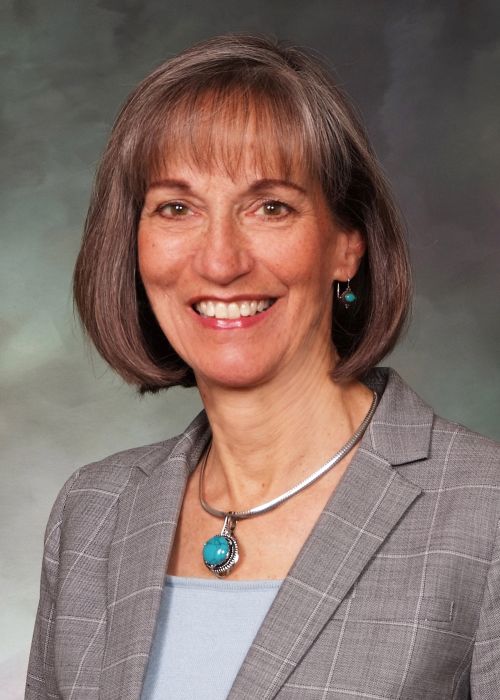
Rep. Tammy Story
Sponsored bills
Instead of the international symbol of accessibility icon of a character in a wheelchair, any required accessibility signage in a facility must depict an accessible icon with a more dynamic character who leans forward in the wheelchair and who shows a sense of movement. This requirement applies to the construction, acquisition, or substantial renovation of any facility that contains 5,000 or more gross square feet, undertaken on and after the date the state architect obtains approval from the United States department of justice that, on a statewide basis, the accessible icon provides equal or greater access to persons with disabilities and is thus an equivalent facilitation under the federal "Americans with Disabilities Act of 1990". The state architect is required, with assistance from the Colorado advisory council for persons with disabilities, to seek this approval no later than January 1, 2021. (Note: This summary applies to this bill as enacted.)
Accountability - local accountability system grant program - supplemental performance report - alternative format - evaluation - reporting - appropriation. The act creates the local accountability system grant program (grant program) in the department of education (department) to provide grant money to local education providers that adopt local accountability systems to supplement the state accountability system. A local accountability system may include additional measures for determining achievement of the state performance indicators and additional indicators of student success, but the measures do not affect the accreditation rating assigned to a school district or the type of plan that a school must adopt. A local education provider may use grant money to work with one or more accountability system partners, which may be public or private institutions of higher education or private nonprofit entities. The department shall review applications and recommend to the state board of education (state board) the applicants that may receive a grant and the amount of the grant. The state board shall award the grants subject to available appropriations. The department may also accept and expend gifts, grants, and donations for the grant program and the summary evaluation report. A local education provider that adopts a local accountability system may submit to the department a supplemental performance report that includes information collected through the local accountability system. The local education provider may also use an alternative format for the type of performance plan that the local education provider is required to implement. The department must post the supplemental performance reports and alternatively formatted plans on the department's data portal. Starting no later than July 15, 2020, the department must convene an annual meeting of the local education providers that implement local accountability systems to share information. Beginning January 15, 2021, the department shall submit an annual report to the state board and the education committees of the general assembly concerning implementation of local accountability systems and implementation of the grant program. The department shall also post the report on its website and, upon request of a local education provider, provide information concerning the measures implemented through local accountability systems. Starting in the third year of the grant program, the department must contract with an external evaluator to prepare an annual summary evaluation report of the implementation of the local accountability systems that receive grants. The department must include the summary evaluation in the annual report. For the 2019-20 fiscal year, the act appropriates $493,097 from the general fund to the department of education to implement the local accountability system grant program. (Note: This summary applies to this bill as enacted.) Read More
Electric utilities - solar energy - community solar gardens - allowable size and location - standards for construction and installation of components. The act amends the current statute authorizing the creation of community solar gardens (CSGs) by: Increasing the maximum size of a CSG from 2 megawatts to 5 megawatts, with the option for the public utilities commission (PUC) to authorize construction of a CSG up to 10 megawatts beginning July 1, 2023; Removing the requirement that a CSG subscriber's identified physical location be in the same county as, or a county adjacent to, that of the CSG, while retaining the requirement that it be within the service territory of the same investor-owned utility; and Requiring all photovoltaic electrical work on a CSG of greater than 2 megawatts to be supervised by a licensed master electrician, licensed journeyman electrician, or licensed residential wireman, and comply with all applicable electrical codes and standards. If an investor-owned utility owns all or part of a CSG, the utility is required to use either its own employees or a contractor whose employees have access to specified apprenticeship programs to operate and maintain the CSG. Beginning in 2020, all photovoltaic electrical work for installations of at least 300 kilowatts must be performed by a licensed master electrician, licensed journeyman electrician, licensed residential wireman, or properly supervised electrical apprentices and must comply with all applicable electrical codes and standards. The PUC shall determine the conditions under which a subscriber to a CSG may choose to retain or sell the renewable energy credits attributable to the subscriber's participation in the CSG. Section 4 of the act is contingent upon House Bill 19-1172 becoming law. (Note: This summary applies to this bill as enacted.) Read More
County - county treasurer to serve as public trustee. Public trustees for Class 2 counties (Adams, Arapahoe, Boulder, Douglas, El Paso, Jefferson, Larimer, Mesa, Pueblo, and Weld) are currently appointed by the governor. Commencing July 1, 2020, the act specifies that the county treasurer for each Class 2 county will serve as the public trustee for the county. The county treasurer is required to create a transition plan for assuming the new duties of the public trustee. The county treasurer is authorized to consider incorporating staff of the appointed trustee's office, including the prior public trustee, into the treasurer's office.(Note: This summary applies to this bill as enacted.) Read More
Community colleges and occupational education - earned construction industry registered apprenticeship program credit - transfer to college credit - working group - appropriation. The chief administrative officer of the Colorado community college system, or his or her designee, is required to convene a working group to determine the most efficient and appropriate manner in which to facilitate the transfer of earned construction industry registered apprenticeship program credit to college credit. If possible, the chief administrative officer is required to include representatives from varying community colleges, area technical schools, local district colleges, relevant 4-year institutions that grant bachelor degrees, applicable union and nonunion labor organizations, and other interested parties. The working group will meet during the interim following the first regular session of the seventy-second general assembly and is required to consider specified issues, solicit input from subject matter experts, and submit to the general assembly its recommendations for the most efficient and appropriate manner in which to facilitate the transfer of earned construction industry registered apprenticeship program credit to college credit, including any recommendations for necessary legislation. The money appropriated for purposes of the working group is exempt from the matching requirement for student financial assistance. In addition, the department of higher education is required to enter into a fee-for-service contract for the purposes of the working group. For the 2019-20 state fiscal year, $15,000 is appropriated to the department of higher education from the general fund. (Note: This summary applies to this bill as enacted.) Read More
Advisory council for parent involvement in education - continuation - appropriation. The act continues the state advisory council for parent involvement in education ("council") for five years. The act changes the number of persons appointed to the council from 5 parents to one parent from each congressional district. The council is scheduled for a sunset review prior to repeal in September 2024. The act appropriates $2,000 to the department of education from the general fund for accountability and improvement planning. (Note: This summary applies to this bill as enacted.) Read More
Medicaid - 1115 demonstration waiver - criminal or juvenile justice system prevention - mental health institute admission criteria - community behavioral health safety net system - appropriation. The act requires the department of health care policy and financing (state department) to develop measurable outcomes to monitor efforts to prevent medicaid recipients from becoming involved in the criminal or juvenile justice system. The act requires the state department to work collaboratively with managed care entities to create incentives for behavioral health providers to accept medicaid recipients with severe behavioral health disorders. The act requires the state department to determine if seeking a 1115 demonstration waiver is the necessary response to ensure inpatient services are available to individuals with a serious mental illness. If the state department determines it is not appropriate, the state department shall submit a report to the general assembly with the state department's reasoning and an alternative plan and proposed timeline for the implementation of the alternative plan. The act requires the state department to develop and implement admission criteria to the mental health institutes at Pueblo and Fort Logan. The act creates a community behavioral health safety net system (safety net system) and requires the department of human services, in collaboration with the state department, to conduct the following activities: Define what constitutes a high-intensity behavioral health treatment program (treatment program), determine what an adequate network of high-intensity behavioral health treatment services includes, and identify existing treatment programs; Develop an implementation plan to increase the number of treatment programs in the state; Identify an advisory body to assist the department in creating a comprehensive proposal to strengthen and expand the safety net system; Develop a comprehensive proposal to strengthen and expand the safety net system that provides behavioral health services for individuals with severe behavioral health disorders; Implement the comprehensive proposal and the funding model no later than January 1, 2024; and Provide an annual report from January 1, 2022, until July 1, 2024, on the safety net system to the public through the annual SMART Act hearing. The act appropriates $75,000 to the department of health care policy and financing from the general fund. (Note: This summary applies to this bill as enacted.) Read More