

Maddy summaryThis bill, titled the Failed Bank Executives Clawback Act, would give the Federal Deposit Insurance Corporation and federal regulators the authority to recover compensation from executives and other high-level personnel at banks that have failed. It directly affects directors, officers, controlling stockholders, and other individuals found primarily responsible for a bank's failure at institutions with over $10 billion in assets. The law would require these individuals to return bonuses, stock awards, and other compensation received in the three years before the bank's insolvency or resolution, with recovered funds going into the Deposit Insurance Fund. Additionally, the bill clarifies the Corporation's authority to take over certain financial companies regardless of how the takeover process was initiated.
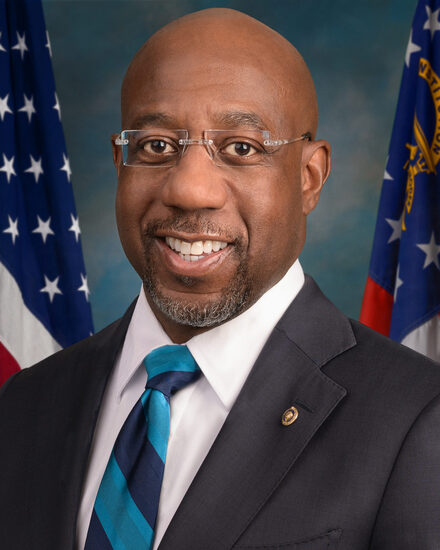
Sen. Raphael G. Warnock
Sponsored bills
Reclaim Trade Powers Act This bill repeals the statute that directs the President to take certain actions, such as imposing a tariff of up to 15% for up to 150 days on articles imported into the United States, when necessary to address large and serious U.S. balance-of-payments deficits or certain other situations that present fundamental international payments problems.
Maddy summaryThis bill would require the U.S. Treasury to produce and sell three types of commemorative coins honoring firefighters and the National Fallen Firefighters Memorial. The legislation authorizes the minting of up to 50,000 $5 gold coins, 400,000 $1 silver coins, and 750,000 half-dollar coins, all featuring designs that recognize firefighter service and sacrifice. All coins would be legal tender, but they would be sold at a price that covers production costs plus a surcharge, with the surcharge funds going to the National Fallen Firefighters Foundation. The coins would only be available for purchase during a one-year window starting in 2029, and the Treasury must ensure the program does not result in a net cost to the federal government.
Living Donor Protection Act of 2025 This bill prohibits life insurance, disability insurance, and long-term insurance carriers from denying or otherwise restricting coverage for living organ donors. Specifically, carriers may not deny, cancel, vary premiums, or otherwise impose conditions on policies based on an individual's status as a living organ donor. The bill also expressly specifies that recovery from organ-donation surgery constitutes a serious health condition that entitles eligible employees to job-protected medical leave. In addition, the Department of Health and Human Services must update educational materials on living organ donation to include information about the benefits and risks of living organ donation and the impact of donation on insurance access, particularly with respect to the bill's changes.
Maddy summaryThis bill establishes a temporary interagency task force to study how to speed up disaster relief funding from the federal government. The task force would include senior officials from multiple federal agencies, four state governors, and four county commissioners who have experienced various types of major disasters in recent years. Its main job is to review current disaster recovery programs, identify delays in funding delivery, and make recommendations to improve how quickly money reaches affected communities. The task force must submit detailed reports to Congress within one year and again within 180 days after that, then it will end 90 days after the final report is submitted.
Maddy summaryThis bill, known as the DISCLOSE Act of 2026, strengthens campaign finance transparency by requiring corporations, labor organizations, Super PACs, and other entities to disclose more information about their spending and funding sources. It closes loopholes that allow foreign nationals to contribute to U.S. elections by expanding disclosure requirements and prohibiting foreign money in ballot initiatives and referenda. The legislation also mandates that certain advertisements include lists of top funders and requires reporting of spending related to federal judicial nominations. Additionally, it streamlines administrative processes for challenging campaign finance laws and ensures coordination between the Federal Election Commission and financial authorities to enforce these rules.
Maddy summaryThis bill would transition Puerto Rico from its current nutrition assistance block grant system to the federal Supplemental Nutrition Assistance Program (SNAP), aligning it with how other U.S. states receive food aid. The legislation requires Puerto Rico to submit an operational plan within 180 days, with the Department of Agriculture providing technical assistance and approval or feedback on the plan. During a five-year transition period, Puerto Rico would continue receiving consolidated block grant funds while gradually shifting to SNAP, with annual reports tracking funding adjustments needed for the change. Once the transition is complete, Puerto Rico would be formally recognized as a state for SNAP purposes and would receive funding based on the same cost-of-living adjustments applied to other states.
Maddy summaryThis resolution designates February 21-28, 2026, as "National FFA Week" to honor the National FFA Organization’s work in agricultural education. It recognizes FFA’s role in developing leadership and career skills for students (with over 1 million members nationally) and celebrates the 50th anniversary of Alaska’s State FFA Association, which has 19 chapters and 493 members. As a symbolic resolution, it has no legal effect but formally expresses Senate support for FFA’s mission.
Maddy summaryThis bill amends the Community Development Banking and Financial Institutions Act of 1994 to require the Treasury Secretary to testify annually before Congress about the Fund's operations. It also strengthens the CDFI Bond Guarantee Program by adjusting guarantee limits and extending the program's authorization period. Additionally, the bill expands capital assistance options for community development financial institutions and creates a new lending program specifically for Native community development financial institutions to support homeownership in Tribal and Native communities.
Maddy summarySRES 615 is a Senate resolution celebrating Black History Month, acknowledging the historical contributions of African Americans to U.S. society across fields like civil rights, arts, science, and leadership. The resolution encourages all citizens to reflect on this history as part of the nation's ongoing journey toward equality, without creating new laws or policies. It specifically recognizes figures such as Frederick Douglass, Maya Angelou, and Rosa Parks, and emphasizes the importance of Black History Month in February as a time for communal learning and inspiration. This ceremonial resolution was introduced by multiple senators and passed unanimously by the Senate in 2026.