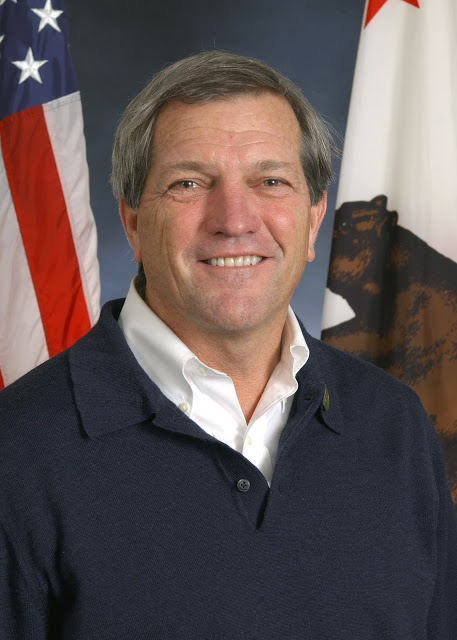
Photo of Mark DeSaulnier
D California Senate · District 7

Sen. Mark DeSaulnier

Compare
Total votes
20,889
all sessions
Attendance
78%
3,963 missed
Lower than 98% of chamber peers
With party
99%
of cast votes
Higher than 95% of chamber peers
Bipartisan score
0%
crosses aisle rarely
Lower than 98% of chamber peers
Sponsored
635
bills & resolutions
Lower than 100% of chamber peers
Committees
0
assignments
635 bills and resolutions

Sponsored bills

Total
635
Primary
191
Co-sponsor
444
This page
635
matching current filters
Primary SCR 8
Signed into law · California Senate · Lead sponsor
Relative to Prescription Drug Abuse Awareness Month.

This measure would proclaim the month of March, each year, as Prescription Drug Abuse Awareness Month and encourage all citizens to participate in prevention programs and activities and to pledge to "Spread the Word ... One Pill Can Kill."

Signed into law May 8, 2013 0 co-sponsors
Co-sponsor SCR 15
Signed into law · California Senate · Co-sponsor
Financial Aid and Literacy Month.

This measure would declare April 2013 as Financial Aid and Literacy Month to raise public awareness about the need for increased financial literacy.

Signed into law May 8, 2013 1 co-sponsor
Co-sponsor SB 140
Signed into law · California Senate · Co-sponsor
Firearms: prohibited persons.

Existing law establishes the Dealers' Record of Sale Special Account in the General Fund with moneys in the account available upon appropriation by the Legislature. Existing law requires the Attorney General to establish and maintain an online database to be known as the Prohibited Armed Persons File, sometimes referred to as the Armed Prohibited Persons System, to cross-reference persons who have ownership or possession of a firearm with those who are prohibited from owning or possessing a firearm. This bill would appropriate $24,000,000 from the Dealers' Record of Sale Special Account to the Department of Justice to address the backlog in the Armed Prohibited Persons System, thereby making an appropriation. The bill would require the department to report to the Joint Legislative Budget Committee regarding ways the backlog in the Armed Prohibited Persons System has been reduced or eliminated, as specified. The bill would make related findings and declarations. This bill would declare that it is to take effect immediately as an urgency statute.

Signed into law May 1, 2013 1 co-sponsor
Co-sponsor SJR 2
Signed into law · California Senate · Co-sponsor
Relative to violence against women.

This measure would call on the United States Congress to pass the Violence Against Women Reauthorization Act of 2013, Senate Bill No. 47, authored by Senator Leahy, and ensure the sustainability of vital programs designed to keep women and families safe from violence and abuse.

Signed into law Feb 28, 2013 1 co-sponsor
Primary SB 878
Vetoed · California Senate · Lead sponsor
Office of the Transportation Inspector General.

Existing law creates various state transportation agencies, including the Department of Transportation and the High-Speed Rail Authority, with specified powers and duties. Existing law provides for the allocation of state transportation funds, including fuel tax revenues allocated from the Highway Users Tax Account, to various transportation purposes. Existing law provides funding for transportation capital improvement projects undertaken by the department or regional or local transportation agencies. This bill would create the Office of the Transportation Inspector General in state government as an independent office that would not be a subdivision of any other government entity, to ensure that all state, regional, and local agencies expending state transportation funds are operating efficiently, effectively, and in compliance with federal and state laws. The bill would provide for the Governor to appoint the Inspector General for a 6-year term, subject to confirmation by the Senate, and would provide that the Transportation Inspector General may not be removed from office during the term except for good cause. The bill would specify certain duties and responsibilities of the Transportation Inspector General, would require an annual report to the Legislature and Governor, and would provide for funding the office, to the extent possible, from federal transportation funds, with other necessary funding to be made available in proportion to the activities of the office from the Highway Users Tax Account and an account from which high-speed rail activities may be funded.

Vetoed Sep 30, 2012 0 co-sponsors
Co-sponsor SB 411
Vetoed · California Senate · Co-sponsor
Home Care Services Act of 2012.

Existing law provides for the In-Home Supportive Services (IHSS) program, a county-administered program under which qualified aged, blind, and disabled persons receive services enabling them to remain in their own homes. The IHSS program includes various eligibility requirements for individuals who provide services to recipients under the program. Under existing law, a private provider of in-home care services is not subject to the requirements of the IHSS program. Existing law provides for the licensing and regulation of various community care facilities by the State Department of Social Services. This bill would enact the Home Care Services Act of 2012, which would provide, on and after July 1, 2013, for the licensure and regulation of home care organizations, as defined, by the State Department of Social Services, and the certification of home care aides. The bill would exclude specified entities from the definition of a home care organization. The bill would impose various licensure requirements on a home care organization. The bill would also impose a civil penalty on an individual or entity that operates a home care organization without a license, except as specified. The bill would require a home care organization to provide a client with specified information before arranging for the provision of home care services, as defined, to that client, including, but not limited to, the types and hours of available home care services, and the extent to which payment may be expected from specified sources. In addition, this bill would require a home care organization, among other things, to distribute to the client its advance directive policy and provide a written notice to the client of certain rights. The bill would also prohibit a home care organization from hiring an individual as a home care aide unless that individual meets certain requirements, including, but not limited to, demonstrating that he or she has specified language skills and providing proof of certification as a home care aide as specified. The bill would require certain employment agencies to maintain liability insurance, as specified, and ensure that any person it refers to provide home care services has been certified prior to the referral. This bill would require background clearances for home care aides, as prescribed, and would set forth specific duties of the home care organization, the department, and the Department of Justice in this regard. The bill would require home care aides to demonstrate they are free of active tuberculosis. The bill would also require a home care organization to conduct regular evaluations of its home care aides, as specified. The bill would require the department to impose various fees to be deposited in the Home Care Organization and Home Care Aide Fund to be created by this bill. This bill, in addition, would prescribe enforcement procedures, fines, and penalties for violations of the act by a home care organization or a home care aide and violations of specified requirements by an employment agency, as defined.


Vetoed Sep 30, 2012 1 co-sponsor
Co-sponsor SB 970
Vetoed · California Senate · Co-sponsor
Health Care Reform Eligibility, Enrollment, and Retention Planning Act: coordination with other programs.

Existing law, the Health Care Reform Eligibility, Enrollment, and Retention Planning Act, requires the State Department of Health Care Services, in consultation with specified entities, to establish standardized single, accessible application forms and related renewal procedures for state health subsidy programs, as defined, in accordance with specified requirements. This bill would provide for the transmittal to a county human services department of information about an applicant initially applying for, or renewing, health care coverage using the single state application developed pursuant to the act, if the applicant consents to have his or her application information used to simultaneously initiate applications for CalWORKs and CalFresh, for initiation of the application. This bill would authorize the Secretary of California Health and Human Services to phase in implementation of these provisions under certain circumstances. The bill would require the California Health and Human Services Agency to convene a workgroup of human services and health care advocates, legislative staff, and other specified representatives, to consider the feasibility, costs, and benefits of integrating application and renewal processes for additional human services and work support programs with the single state application described in the bill, and to provide, by July 1, 2013, specified details regarding the workgroup to the appropriate fiscal and policy committees of the Legislature. This bill would require that the functionality necessary to implement the cross-application process be achieved by the expiration of a specified federal waiver. This bill would provide that those provisions would become inoperative under certain circumstances. By imposing new duties on counties, this bill would impose a state-mandated local program. The California Constitution requires the state to reimburse local agencies and school districts for certain costs mandated by the state. Statutory provisions establish procedures for making that reimbursement. This bill would provide that, if the Commission on State Mandates determines that the bill contains costs mandated by the state, reimbursement for those costs shall be made pursuant to these statutory provisions.

Vetoed Sep 30, 2012 1 co-sponsor
Primary SB 1117
Vetoed · California Senate · Lead sponsor
Passenger rail: planning.

Existing law creates the California Transportation Commission, with various powers and duties relating to the programming and allocation of certain funds available for transportation capital improvement projects and various other transportation policy matters, and authorizes the commission to develop guidelines for preparation of regional transportation plans. Existing law creates the Department of Transportation with various powers and duties relating to the state highway system and other transportation modes, including the authority to contract for conventional rail passenger service. Existing law requires the department to prepare a 10-year State Rail Plan on a biennial basis, with both passenger and freight rail elements. Existing law creates the High-Speed Rail Authority to develop and implement a high-speed rail system in the state, with specified powers and duties, including preparation of a business plan on a biennial basis. Existing law, pursuant to the Safe, Reliable High-Speed Passenger Train Bond Act for the 21st Century, provides for the issuance of $9.95 billion in general obligation bonds for high-speed rail and related purposes. This bill would require the California Transportation Commission to include in its guidelines for regional transportation plans policy direction regarding the integration of all passenger rail services into a coordinated system with emphasis on intermodal facilities and cost-effective rail services, as specified. The bill would revise the requirements for the 10-year state rail plan prepared by the department to require the plan to be consistent with the federal Passenger Rail Investment and Improvement Act of 2008 and to contain various passenger and freight rail elements, including, among other things, plans for a comprehensive and integrated statewide rail system, a statement of the state's passenger rail service objectives, and identification of improvements that have utility both for freight and passenger rail services. The bill would delete the requirement that the state rail plan be prepared on a biennial basis. The bill would require the department to submit a draft plan under these new requirements for review and comment to the commission and authority by December 1, 2015, and would require public hearings on the plan. The bill would require the final plan to be approved by the Secretary of Business, Transportation and Housing by March 1, 2016, and then to be submitted to the Legislature, Governor, and various state agencies. The bill would require the plan to be updated at least every 5 years. This bill would also impose certain requirements on the High-Speed Rail Authority with regard to implementation of blended systems by the authority, including preparation of a plan in that regard, by December 31, 2013, which would be incorporated into the authority's business plan and would be required to be consistent with any written agreements with 3rd parties operating or hosting connecting passenger rail services, as specified.

Vetoed Sep 29, 2012 0 co-sponsors
Co-sponsor SB 955
Signed into law · California Senate · Co-sponsor
Public employees' retirement: pension fund management.

Existing law establishes the Public Employees' Retirement System and the State Teachers' Retirement System. These systems provide defined pension benefits to public employees based on age, service credit, and final compensation. The California Constitution confers upon the retirement boards of public retirement systems plenary authority and fiduciary responsibility for the investment of moneys of those systems. This bill would authorize these public retirement system boards, consistent with their fiduciary duties and the standard for prudent investment, to prioritize investment in an in-state infrastructure project over a comparable out-of-state infrastructure project.

Signed into law Sep 29, 2012 1 co-sponsor
Showing 121 to 130 of 635 bills
Previous 1 12 13 14 64 Next