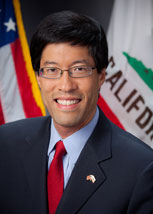
Photo of Richard Pan
D California Senate · District 6

Sen. Richard Pan

Compare
Total votes
26,098
all sessions
Attendance
98%
456 missed
Near the chamber average
With party
99%
of cast votes
Near the chamber average
Bipartisan score
0%
crosses aisle rarely
Lower than 77% of chamber peers
Sponsored
951
bills & resolutions
Lower than 83% of chamber peers
Committees
0
assignments
951 bills and resolutions

Sponsored bills

Total
951
Primary
341
Co-sponsor
610
This page
951
matching current filters
Primary AB 944
died · California House · Lead sponsor
Education finance.

Existing law establishes the public school system in this state, and, among other things, provides for the establishment of school districts throughout the state and for their provision of instruction at the public elementary and secondary schools they operate and maintain. Existing law establishes a public school funding system that includes, among other elements, the provision of funding to local educational agencies through state apportionments, the proceeds of property taxes collected at the local level, and other sources. This bill would state the intent of the Legislature to enact legislation relating to education finance.

died Feb 1, 2012 0 co-sponsors
Primary AB 548
died · California House · Lead sponsor
County budgets: requests to the administrative officer or auditor.

Existing law requires each county official in charge of a budget unit, on or before June 10 of each year, to provide the administrative officer or the auditor an itemized request detailing the estimate of financing sources, financing uses, and any other matter required by the county board of supervisors. This bill would make a technical, nonsubstantive change to this law.

died Feb 1, 2012 0 co-sponsors
Primary AB 1218
Failed · California House · Lead sponsor
Income taxes: disallowance of deductions: advertising: tobacco.

The Personal Income Tax Law and Corporation Tax Law allow deductions for various expenditures in computing taxable or net income, including, with certain exceptions, all ordinary and necessary expenses paid or incurred during the taxable and income year in carrying on any trade or business. This bill would provide under both laws that a deduction shall not be allowed for specified expenses paid or incurred to advertise, as defined, the sale, use, or consumption of cigarettes or other tobacco products. This bill would include a change in state statute that would result in a taxpayer paying a higher tax within the meaning of Section 3 of Article XIII A of the California Constitution, and thus would require for passage the approval of 23 of the membership of each house of the Legislature. This bill would take effect immediately as a tax levy.

Failed Feb 1, 2012 0 co-sponsors
Primary AB 672
died · California House · Lead sponsor
Emergency medical services.

Existing law establishes the Emergency Medical Services System and the Prehospital Emergency Medical Care Personnel Act, which governs local emergency medical service systems. This bill would make technical, nonsubstantive changes to the act.

died Feb 1, 2012 0 co-sponsors
Primary AB 788
Failed · California House · Lead sponsor
Health insurance.

Existing law provides for the regulation of health insurers by the Department of Insurance. Existing law requires the Insurance Commissioner, on or before January 1, 2004, to promulgate regulations meeting specified standards applicable to health insurers that contract with providers for alternative rates. Existing law requires the department to report to specified committees of the Legislature on March 1, 2003, and March 1, 2004, regarding the implementation of the regulations. This bill would delete the provisions requiring the department to report to the Legislature on those dates.

Failed Feb 1, 2012 0 co-sponsors
Co-sponsor ACR 87
Passed · California House · Co-sponsor
Relative to Martin Luther King, Jr. Day.

This measure would designate that January 16, 2012, be observed as the official memorial of the late Rev. Dr. Martin Luther King, Jr.'s birth, commemorate Martin Luther King, Jr. Day, the work of Dr. Martin Luther King, Jr., and the Civil Rights Movement in changing public policy in California and in the United States of America.

Passed Jan 17, 2012 1 co-sponsor
Primary AB 688
Signed into law · California House · Lead sponsor
Food and drugs: sale.

The Sherman Food, Drug, and Cosmetic Law contains various provisions regarding the contents, packaging, labeling, and advertising of food, drugs, and cosmetics. The California Retail Food Code provides for the regulation of health and sanitation standards for retail food facilities, as defined, by the State Department of Public Health. Under existing law, local health agencies are primarily responsible for enforcing the California Retail Food Code. A violation of any of these provisions is punishable as a misdemeanor. This bill would prohibit a retailer from selling or offering for sale after the expiration date an over-the-counter drug, as defined. The bill would also prohibit a retail food facility from selling or offering for sale after the "use by" date infant formula or baby food that is required to have this date on its packaging pursuant to federal law. This bill would make a violation of its provisions an infraction, punishable by a fine of not more than $10 per day, calculated as prescribed. This bill would also authorize the department or an enforcement agency, as specified, to assess administrative penalties on a retailer who violates these provisions in the amount of $10 per day for each item sold or offered for sale in violation of these provisions, in addition to other penalties authorized by law. By creating new crimes and imposing additional duties on local officials, this bill would create a state-mandated local program. The California Constitution requires the state to reimburse local agencies and school districts for certain costs mandated by the state. Statutory provisions establish procedures for making that reimbursement. This bill would provide that with regard to certain mandates no reimbursement is required by this act for a specified reason. With regard to any other mandates, this bill would provide that, if the Commission on State Mandates determines that the bill contains costs so mandated by the state, reimbursement for those costs shall be made pursuant to the statutory provisions noted above.

Signed into law Oct 9, 2011 0 co-sponsors
Co-sponsor AB 131
Signed into law · California House · Co-sponsor
Student financial aid.

(1) The Donahoe Higher Education Act sets forth, among other things, the missions and functions of California's public and independent segments of higher education, and their respective institutions of higher education. Provisions of the act apply to the University of California only to the extent that the Regents of the University of California, by appropriate resolution, act to make a provision applicable. Existing law requires that a student, other than a nonimmigrant alien, as defined, who has attended high school in California for 3 or more years, who has graduated from a California high school or attained the equivalent thereof, who has registered at or attends an accredited institution of higher education in California not earlier than the fall semester or quarter of the 2001–02 academic year, and who, if he or she is an alien without lawful immigration status, has filed a prescribed affidavit is exempt from paying nonresident tuition at the California Community Colleges and the California State University. This bill would amend the Donahoe Higher Education Act, as of January 1, 2013, to require the Trustees of the California State University and the Board of Governors of the California Community Colleges, and to request the regents, to establish procedures and forms that enable students who are exempt from paying nonresident tuition under the above-described provision, or who meet equivalent requirements adopted by the regents, to apply for, and participate in, all student aid programs administered by these segments to the full extent permitted by federal law, except as provided. This provision would apply to the University of California only if the regents, by appropriate resolution, act to make it applicable. This bill would provide that students who are exempt from paying nonresident tuition under the above provision, or who meet equivalent requirements adopted by the regents, are eligible to apply for, and participate in, any student financial aid program administered by the State of California to the full extent permitted by federal law. This bill would require the Student Aid Commission to establish procedures and forms that enable those students who are exempt from paying nonresident tuition under the above provision to apply for, and participate in, all student financial aid programs administered by the State of California to the full extent permitted by federal law. This bill would prohibit students who are exempt from paying nonresident tuition under the provision described above from being eligible for Competitive Cal Grant A and B Awards unless specified conditions are met. The bill would make these provisions operative as of January 1, 2013. (2) Existing federal law requires that a state may provide that an alien who is not lawfully present in the United States is eligible for any state or local public benefit for which that alien would otherwise be ineligible under a specified federal law only through enactment of a state law that affirmatively provides for that eligibility. This bill would find and declare that the amendments to the Donahoe Higher Education Act described above are state laws within the meaning of this federal provision. (3) Existing law establishes the California Community Colleges under the administration of the Board of Governors of the California Community Colleges. Existing law authorizes the establishment of community college districts under the administration of community college governing boards, and authorizes these districts to provide instruction, for prescribed fees, at community college campuses throughout the state. Existing law authorizes the waiver of these fees for, among others, students who are eligible under income standards established by the board of governors. This bill, as of January 1, 2013, would require community college districts to waive the fees of students who are exempt from nonresident tuition under the provision described in (1) above, and who otherwise qualify for a waiver under this provision, under regulations and procedures adopted by the board of governors. Because the bill would impose new duties on community college districts with respect to determining eligibility for fee waivers, the bill would constitute a state-mandated local program. (4) The California Constitution requires the state to reimburse local agencies and school districts for certain costs mandated by the state. Statutory provisions establish procedures for making that reimbursement. This bill would provide that, if the Commission on State Mandates determines that the bill contains costs mandated by the state, reimbursement for those costs shall be made pursuant to these statutory provisions.


Signed into law Oct 8, 2011 1 co-sponsor
Primary AB 1168
Signed into law · California House · Lead sponsor
Workers' compensation: vocational expert fee schedule.

Existing law establishes a workers' compensation system, administered by the Administrative Director of the Division of Workers' Compensation, to compensate an employee for injuries sustained in the course of his or her employment. Existing law requires the administrative director, after public hearings, to adopt and revise periodically official fee schedules that establish reasonable maximum fees paid for, among other things, medical services, medicines, and medical supplies. Existing law authorizes the Workers' Compensation Appeals Board to determine and allow certain expenses as liens against any award of compensation. This bill would require, on or before January 1, 2013, the administrative director to adopt, after public hearings, a fee schedule that establishes reasonable hourly fees paid for services provided by vocational experts. This bill would prohibit a vocational expert from being paid, and prohibit the appeals board from allowing, vocational expert fees in excess of those that are reasonable, actual, and necessary.

Signed into law Oct 7, 2011 0 co-sponsors
Showing 871 to 880 of 951 bills
Previous 1 87 88 89 96 Next