

Existing law provides for the licensure and regulation by the State Department of Social Services of crisis nurseries. Crisis nurseries are nonprofit corporations that care for and supervise children under 6 years of age who are voluntarily placed in the crisis nursery by a parent or legal guardian due to a family crisis or stressful situation for no more than 30 days. This bill, until January 1, 2018, would require the department to implement a 2-year pilot project in the County of Sacramento and the County of Yolo to conduct a study of the relationship between crisis respite care and incidents of reported child abuse in those counties, and report the results of the study to the Legislature. The bill would make the implementation of this pilot project contingent upon all of the crisis nurseries in those counties voluntarily participating in the project and providing funding for 12 of the cost of the project.
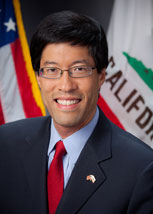
Sponsored bills
Existing law supports economic development in cities throughout the state. This bill would state the intent of the Legislature to enact legislation to encourage economic development in the downtown area of the City of Sacramento through a partnership between the state, the City of Sacramento, and the federal government.
Existing law, the California Beverage Container Recycling and Litter Reduction Act, requires that every beverage container sold or offered for sale in this state have a minimum refund value. Existing law imposes specified reporting requirements on certain parties, including manufacturers and processors in connection with the act. This bill would, on and after January 1, 2017, require every manufacturer of a beverage sold in a plastic beverage container to demonstrate to the Department of Resources Recycling and Recovery that each type of plastic beverage container sold in this state contains, on average, not less than 10 percent postfilled material. Existing law requires the department to calculate a processing fee and a processing payment for any type of empty beverage container with a refund value less than the cost of recycling in accordance with a specified formula. The department is prohibited from imposing a processing fee on certain plastic beverage containers labeled with a "1" called PET beverage containers, if a willing purchaser offers to purchase empty PET containers at a voluntary artificial scrap value that is equal to the processing fee, as specified. This bill would delete the provisions prohibiting the department from imposing a processing fee on PET beverage containers for which there is such a willing purchaser. Existing law requires the department to reduce the processing fee paid by beverage manufacturers based on the recycling rate of the container, subject to specified requirements and the availability of funds. This bill would prohibit the department from reducing the processing fee requirements for any beverage manufacturer for any beverage container sold in the state unless the beverage manufacturer demonstrates to the department that the beverage container is manufactured at a facility that meets or exceeds a certain percentage of recycled content, regardless of whether the container is manufactured in the state.
Existing law provides various sources of funding for transportation projects. This bill would appropriate $10 million from the General Fund to the Downtown/Riverfront Streetcar Project, connecting Sacramento to West Sacramento, for use in funding the development of the project.
Existing law, the Bronzan-McCorquodale Act, contains provisions governing the operation and financing of community mental health services for the mentally disordered in every county through locally administered and locally controlled community mental health programs. This bill would make a technical, nonsubstantive change to those provisions.
Existing law establishes the California Community Colleges, under the administration of the Board of Governors of the California Community Colleges, as one of the segments of public postsecondary education in this state. Existing law establishes community college districts, administered by governing boards, throughout the state, and authorizes these districts to provide instruction to students at the community college campuses maintained by the districts. Existing law authorizes the employment of community college faculty and establishes certain rights for these employees. This bill would require community college districts to report to the board of governors, by March 31, 2016, the total number of full-time equivalent faculty (FTEF) attributable to part-time temporary faculty and to contract or regular faculty while working on overload assignments during the period of July 1, 2014, to June 30, 2015, inclusive. Effective July 1, 2016, the bill would require that reported number to become that district's maximum allowable number of FTEF that may be staffed by part-time temporary faculty and by contract or regular faculty while working on overload assignments until the district's full-time faculty percentage is greater than or equal to 75%. Upon reaching the 75% threshold, the bill would require a district to maintain a full-time faculty percentage of 75% or higher, or not exceed the district's previously calculated maximum allowable number of FTEF that may be staffed by part-time temporary faculty and by contract or regular faculty while working on overload assignments. The bill would require the governing board to determine if a district has failed to comply with the above requirements, and, if so, to designate a specified amount of the district's apportionment or apportionments that would be required to be deposited in the county treasury, but unavailable to the district. The bill would authorize a district to submit an application for an exemption from the requirements of the bill in cases of serious hardship, as specified. Upon receipt of the exemption application, the bill would require the governing board to grant exemptions, as specified. The bill would require the amount exempted to be immediately available for expenditure by the governing board and the amount not exempted to be returned to the State School Fund. The bill would require the board of governors to enforce the requirements of the bill and would authorize them to adopt necessary rules and regulations. This bill would prohibit a district from assigning a person hired as a contract faculty member after July 1, 2016, to teach any overload assignment in excess of the equivalent of a full-time teaching load until the person achieves tenured status as a regular faculty member. By placing additional requirements on community college districts, this bill would impose a state-mandated local program. The California Constitution requires the state to reimburse local agencies and school districts for certain costs mandated by the state. Statutory provisions establish procedures for making that reimbursement. This bill would provide that, if the Commission on State Mandates determines that the bill contains costs mandated by the state, reimbursement for those costs shall be made pursuant to these statutory provisions.
Existing law, the Public Employees' Retirement Law establishes the Public Employees' Retirement System for the purpose of providing pension benefits to specified public employees. This bill would make a technical, nonsubstantive change to the provision that names that law.
The Cigarette and Tobacco Products Tax Law, the violation of which is a crime, imposes a tax of $0.87 per package of 20 cigarettes on every distributor of cigarettes and a tax on the wholesale cost of tobacco products distributed at a tax rate that is equivalent to the combined rate of all taxes imposed on cigarettes, and at a rate equivalent to $0.50 per pack cigarette tax. Revenues from taxes imposed under this law are deposited in specified accounts. These taxes are inclusive of the taxes imposed under the Tobacco Tax and Health Protection Act of 1988 (Proposition 99) and the California Children and Families Act of 1998 (Proposition 10) . This bill would require moneys collected and deposited in the California Tobacco Tax Act of 2015 Fund from an additional tax to be imposed on the distribution of cigarettes, a related floor stock tax, and a cigarette indicia adjustment tax to be transferred from that fund to the California Children and Families Trust Fund, which is a continuously appropriated fund, thereby making an appropriation, the Cigarette and Tobacco Products Surtax Fund, the Breast Cancer Fund, and the General Fund, as necessary to offset revenue decreases to those funds directly resulting from additional taxes to be imposed. This bill would also make funds of accounts in the California Tobacco Tax Act of 2015 Fund available to specified state entities upon appropriation by the Legislature to supplement tobacco prevention and control programs, to improve existing programs to provide quality and access to health care programs for families and children, and to supplement funding for the enforcement of laws that regulate the distribution and sale of cigarettes and other tobacco products, as specified. This bill would require the Department of Justice, the State Department of Public Health, the State Department of Education, the State Department of Health Care Services, and would request the Regents of the University of California, annually to publish an accounting of moneys received from the fund on their respective Internet Web sites. This bill would become operative only if SB 591 of the 2015–16 Regular Session is also enacted and takes effect on or before January 1, 2016. This bill would declare that it is to take effect immediately as an urgency statute.
(1) Existing federal law, the Federal Food, Drug, and Cosmetic Act, regulates, among other things, the quality and packaging of foods introduced or delivered for introduction into interstate commerce and generally prohibits the misbranding of food. Existing federal law, the Nutrition Labeling and Education Act of 1990, governs state and local labeling requirements, including those that characterize the relationship of any nutrient specified in the labeling of food to a disease or health-related condition. Existing state law, the Sherman Food, Drug, and Cosmetic Law, generally regulates misbranded food and provides that any food is misbranded if its labeling does not conform with the requirements for nutrient content or health claims as set forth in the Federal Food, Drug, and Cosmetic Act and the regulations adopted pursuant to that federal act. Existing law requires that a food facility, as defined, make prescribed disclosures and warnings to consumers, as specified. A violation of these provisions is a crime. Existing state law, the Pupil Nutrition, Health, and Achievement Act of 2001, also requires the sale of only certain beverages to pupils at schools. The beverages that may be sold include fruit-based and vegetable-based drinks, drinking water with no added sweetener, milk, and in middle and high schools, an electrolyte replacement beverage if those beverages meet certain nutritional requirements. This bill would establish the Sugar-Sweetened Beverages Safety Warning Act, which would prohibit a person from distributing, selling, or offering for sale a sugar-sweetened beverage in a sealed beverage container, or a multipack of sugar-sweetened beverages, in this state unless the beverage container or multipack bears a safety warning, as prescribed. The bill also would require every person who owns, leases, or otherwise legally controls the premises where a vending machine or beverage dispensing machine is located, or where a sugar-sweetened beverage is sold in an unsealed container to place a specified safety warning in certain locations, including on the exterior of any vending machine that includes a sugar-sweetened beverage for sale. (2) Under existing law, the State Department of Public Health, upon the request of a health officer, as defined, may authorize the local health department of a city, county, city and county, or local health district to enforce the provisions of the Sherman Food, Drug, and Cosmetic Law. Existing law authorizes the State Department of Public Health to assess a civil penalty against any person in an amount not to exceed $1,000 per day, except as specified. Existing law authorizes the Attorney General or any district attorney, on behalf of the State Department of Public Health, to bring an action in a superior court to grant a temporary or permanent injunction restraining a person from violating any provision of the Sherman Food, Drug, and Cosmetic Law. This bill, commencing July 1, 2016, would provide that any violation of the provisions described in (1) above, or regulations adopted pursuant to those provisions, is punishable by a civil penalty of not less than $50, but no greater than $500. This bill would also create the Sugar-Sweetened Beverages Safety Warning Fund for the receipt of all moneys collected for violations of those provisions. The bill would allocate moneys in this fund, upon appropriation by the Legislature, to the department for the purpose of enforcing those provisions. The bill would make legislative findings and declarations relating to the consumption of sugar-sweetened beverages, obesity, and dental disease.
The California Constitution authorizes the Legislature to classify personal property for differential taxation or for exemption by means of a statute approved by a 23 vote of the membership of each house. This bill would, pursuant to this constitutional authorization, on and after July 1, 2016, to before July 1, 2026, impose a tax on every qualified renter for the privilege of renting qualified heavy equipment in this state at the rate of 0.75% of the rental price from the renting of qualified heavy equipment. This bill would require a qualified renter to pay and remit the tax, as provided. This bill would provide that this tax shall be in lieu of any personal property tax on qualified heavy equipment. This bill would require the tax to be administered by the State Board of Equalization and to be collected pursuant to the procedures set forth in the Fee Collection Procedures Law. This bill would require all revenues, interest, penalties, and other amounts, less refunds and the board's costs of administration, derived from the imposition of the tax to be deposited in the General Fund. Existing property tax law requires the county auditor, in each fiscal year, to allocate property tax revenue to local jurisdictions in accordance with specified formulas and procedures, and generally requires that each jurisdiction be allocated an amount equal to the total of the amount of revenue allocated to that jurisdiction in the prior fiscal year, subject to certain modifications, and that jurisdiction's portion of the annual tax increment, as defined. Existing property tax law also reduces the amounts of ad valorem property tax revenue that would otherwise be annually allocated to the county, cities, and special districts pursuant to these general allocation requirements by requiring, for purposes of determining property tax revenue allocations in each county for the 1992–93 and 1993–94 fiscal years, that the amounts of property tax revenue deemed allocated in the prior fiscal year to the county, cities, and special districts be reduced in accordance with certain formulas. It requires that the revenues not allocated to the county, cities, and special districts as a result of these reductions be transferred to the Educational Revenue Augmentation Fund in that county for allocation to school districts, community college districts, and the county office of education. This bill would, for the 2016–17 fiscal year to the 2025–26 fiscal year, inclusive, require the county auditor to increase the total amount of ad valorem property tax revenue that is otherwise required to be allocated among the county and each city and special district in the county by the qualified heavy equipment reimbursement amount, as defined, and to commensurately decrease the amount of ad valorem property tax revenue that is otherwise required to be allocated to the county Educational Revenue Augmentation Fund and, if necessary, the amount of those revenues otherwise required to be allocated to school districts, as specified, by the qualified heavy equipment reimbursement amount. By expanding the application of the Fee Collection Procedures Law, the violation of which is a crime, and by imposing new duties upon local officials in the allocation of ad valorem property tax revenues, this bill would impose a state-mandated local program. The California Constitution requires the state to reimburse local agencies and school districts for certain costs mandated by the state. Statutory provisions establish procedures for making that reimbursement. This bill would provide that with regard to certain mandates no reimbursement is required by this act for a specified reason. With regard to any other mandates, this bill would provide that, if the Commission on State Mandates determines that the bill contains costs so mandated by the state, reimbursement for those costs shall be made pursuant to the statutory provisions noted above. Section 2229 of the Revenue and Taxation Code requires the Legislature to reimburse local agencies annually for certain property tax revenues lost as a result of any exemption or classification of property for purposes of ad valorem property taxation. This bill would provide that, notwithstanding Section 2229 of the Revenue and Taxation Code, no appropriation is made and the state shall not reimburse local agencies for property tax revenues lost by them pursuant to the bill.