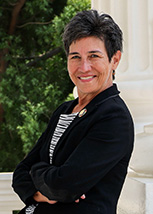
This measure would congratulate the California Commission on the Status of Women and Girls on the celebration of its 50th anniversary, and recognize and commend the commission for its various contributions and accomplishments.
Sponsored bills
This measure would urge the Congress of the United States to support H.R. 167, the federal Wildfire Disaster Funding Act, in order to provide a long-term, stable source of funding for federal agencies to conduct the necessary fuels management on national forest lands, while retaining resources to suppress catastrophic wildfires.
This measure would urge the Congress of the United States to enact legislation allowing immigrants to serve in the military if they are eligible under the President's Executive Order for Deferred Action for Childhood Arrivals or Executive Order for Deferred Action for Parents of Americans and Lawful Permanent Residents.
The Toxics in Packaging Prevention Act generally prohibits a manufacturer or supplier from offering for sale or for promotional purposes in this state a package or packaging component that includes intentionally introduced lead, mercury, cadmium, or hexavalent chromium in the package or in a packaging component. The act exempted from this prohibition, until January 1, 2010, a package or a packaging component if the manufacturer or supplier complied with specific documentation requirements and the package or packaging component did not contain any intentionally introduced lead, mercury, cadmium, or hexavalent chromium, but exceeded a specific maximum concentration level because of the addition of a recycled material. This bill would provide a similar exemption, until January 1, 2019, for a glass beverage, food, or drink container. The bill would require the Department of Toxic Substances Control to evaluate the packaging of glass beverage, food, and drink containers, as specified, to determine if lead, mercury, cadmium, or hexavalent chromium is present in glass beverage, food, or drink containers sold in California. If the department determines that these metals are present, the bill would require the department to also evaluate whether and under what circumstances those metals can leach from the glass containers into the food or beverage and whether the presence of the metals in the glass containers presents a risk to human health and the environment. The bill would authorize the department to request any information and collect any samples necessary for the evaluations from glass manufacturers or feedstock or raw material suppliers in the state that are subject to the act, and would require the department to provide the results of the evaluations to the Legislature by January 1, 2018. The bill would authorize the department to adopt regulations, pursuant to existing authority, based on these evaluations. The bill would authorize the department to seek reimbursement from the glass manufacturers and feedstock and raw material suppliers to cover the reasonable costs directly related to collecting glass samples, reviewing and processing those samples, analyzing the samples, disseminating certain information, and implementing any regulations that are developed as a result of the evaluations. The bill would delete obsolete provisions and would make conforming changes.

The Psychology Licensing Law provides for the licensure and regulation of psychologists by the Board of Psychology and makes a violation of its provisions a misdemeanor. Existing law prohibits a person from engaging in the practice of psychology or representing himself or herself to be a psychologist without a license, except as specified. Existing law provides that a person, including, but not limited to, a person who holds a valid and current credential as a school psychologist issued by the State Department of Education, is not restricted or prevented from conducting activities of a psychological nature or the use of the official title of his or her position, provided that person is performing those activities as part of the duties for which he or she was employed, is performing those activities solely within the confines of or under the jurisdiction of the organization in which he or she is employed, and does not offer to render or render psychological services, as specified, to the public for a fee over and above the salary he or she receives for the performance of his or her official duties with the organization. This bill would revise and recast those provisions, including modifying those permissive provisions to not restrict or prevent from conducting activities of a psychological nature, or the use of the official title of his or her position, a person who holds a valid and current credential as a school psychologist issued by the Commission on Teacher Credentialing. The bill would similarly not so restrict or prevent a person employed in a position as a psychologist or psychological assistant by one of specified entities from conducting research and disseminating his or her research findings and scientific information. The bill would also not so restrict or prevent a person with specified education and training employed as prescribed by a nonprofit community agency that receives a certain percentage of financial support from governmental organizations for the purpose of training and providing services. The bill would require those persons to be registered by the agency with the board at the time of employment and identify such a person in the setting as a "registered psychologist." The bill would exempt those registered psychologists from licensure for a maximum period of 30 months from the date of registration. Existing law also provides that the licensing law does not restrict or prevent activities of a psychological nature on the part of a person who is a salaried employee of an accredited or approved academic institution, public school, or governmental agency, provided that, among other restrictions, the person does not offer services to the public for a fee or provide direct health or mental health services. This bill would instead provide that the licensing law does not restrict the practice of psychology on the part of a person who is a salaried employee of an accredited or approved academic institution, public school, or governmental agency, in accordance with specified restrictions. The bill would delete the existing restrictions on offering services to the public for a fee and on providing direct health or mental health services. The bill would additionally require such an employee to primarily be gaining the supervised professional experience required for licensure, as specified, in order to practice psychology without a license. That exemption would apply to an individual employee for a cumulative total of 5 years of employment after January 1, 2016.
Existing law allows a person who has been subjected to gender violence to bring a civil action for damages against any responsible party and defines gender violence for this purpose as a crime of violence motivated by the gender of the victim or a physical intrusion or invasion of a sexual nature, as specified. The Unruh Civil Rights Act prohibits discrimination based on a person's sex, race, religion, or sexual orientation, among others, and specifies that sex includes gender, which includes a person's gender identity and gender expression. This bill, for the purposes of the former provision, would specify that gender has the same meaning as in the Unruh Civil Rights Act. The bill would also allow a person who has been subject to sexual orientation violence, as defined, to bring a civil action for damages against any responsible party under provisions identical to those for gender violence.
Existing law authorizes the Fair Political Practices Commission, upon mutual agreement between the Commission and the Board of Supervisors of the County of San Bernardino, to have primary responsibility for the impartial, effective administration, implementation, and enforcement of a local campaign finance reform ordinance of the County of San Bernardino, as specified. This bill would authorize the Commission and the City Council of the City of Stockton to also enter into such an agreement, as specified. The bill would require, if an agreement is entered into, that the Commission report specified information to the Legislature regarding the performance of that agreement on or before January 1, 2019. The bill would repeal its provisions on January 1, 2020. This bill would make legislative findings and declarations as to the necessity of a special statute for the City of Stockton. The Political Reform Act of 1974, an initiative measure, provides that the Legislature may amend the act to further the act's purposes upon a 23 vote of each house and compliance with specified procedural requirements. This bill would declare that it furthers the purposes of the act.
Existing law provides for the regulation of secondhand dealers, as defined. Existing law makes it unlawful for a person to engage in the business of a secondhand dealer without a license issued by the chief of police, the sheriff, or, where appropriate, the police commission. Existing law requires a secondhand dealer or coin dealer, as defined, to report, as specified, to the chief of police or sheriff all secondhand "tangible personal property," as defined, purchased, taken in trade, taken in pawn, accepted for sale on consignment, or accepted for auctioning. Existing law requires the report to include, among other things, the identification of the intended seller or pledger of the property, verified by the person taking the information by reasonably relying on specified documents, and a complete and reasonably accurate description of serialized property, including, but not limited to, the serial number of that property. A violation of these provisions where a person knows or should have known that a violation was being committed is a misdemeanor. This bill would permit the person verifying the identification of the seller or pledger to use technology to obtain information and verify identity remotely. The bill would authorize specified unique identifying numbers to be used as the serial number reported for handheld electronic devices, as defined, and would require the report to the chief of police or sheriff to be updated within 10 days with these unique identifying numbers if they were not available when the report was submitted. Because a violation of this requirement under certain circumstances would be a crime, this bill would impose a state-mandated local program. The California Constitution requires the state to reimburse local agencies and school districts for certain costs mandated by the state. Statutory provisions establish procedures for making that reimbursement. This bill would provide that no reimbursement is required by this act for a specified reason.
This measure would proclaim April 14, 2015, as Equal Pay Day in recognition of the need to eliminate the gender gap in earnings by women and to promote policies to ensure equal pay for all.
This measure would designate a portion of State Highway Route 44 in the City of Redding as the Richard "Dick" Dickerson Memorial Highway. The measure would also request the Department of Transportation to determine the cost of appropriate signs showing this special designation and, upon receiving donations from nonstate sources covering that cost, to erect those signs.