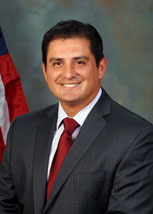
Photo of Ben Hueso
D California Senate · District 40

Sen. Ben Hueso

Compare
Total votes
23,049
all sessions
Attendance
95%
899 missed
Higher than 86% of chamber peers
With party
99%
of cast votes
Near the chamber average
Bipartisan score
0%
crosses aisle rarely
Near the chamber average
Sponsored
741
bills & resolutions
Near the chamber average
Committees
0
assignments
741 bills and resolutions

Sponsored bills

Total
741
Primary
265
Co-sponsor
476
This page
741
matching current filters
Co-sponsor SCR 64
Signed into law · California Senate · Co-sponsor
Relative to Vicente Fernández Day.

This measure would declare that the Legislature honors the life and legacy of Vicente Fernández, and would proclaim February 17, 2022, as Vicente Fernández Day, a day of remembrance and education to ensure that all Californians honor and remember the cultural voice of generations.

Signed into law Aug 19, 2022 1 co-sponsor
Co-sponsor AB 2465
Passed · California House · Co-sponsor
Pupil instruction: third-grade literacy: literacy grant program.

Existing law requires the adopted course of study for grades 1 to 6, inclusive, to include certain areas of study, including English, mathematics, social sciences, science, visual and performing arts, health, and physical education, as specified. Existing law requires the study of English to include knowledge of and appreciation for literature and the language, as well as the skills of speaking, reading, listening, spelling, handwriting, and composition. This bill would create the Family and Community Literacy: Supporting Literacy and Biliteracy in Schools, Families, and Communities Grant Program for the purpose of supporting the goal of all of California's pupils reading at grade level by third grade and engaging families at every stage of that process. The bill would require the department to award competitive grants from the California Family Literacy Innovation Project to local educational agencies, as provided. This bill would establish the California Family Literacy Innovation Project, under the administration of the department, in order to support community literacy and educational enrichment by supporting local educational agencies to engage families to improve literacy and biliteracy outcomes. The bill would require the department to award grants of up to $1,900,000 each to at least 25 local educational agencies that conduct a needs assessment and analysis, and design an evidence-based Family Literacy and Biliteracy Innovation Plan, as provided. The bill would require grant recipients to provide annual progress reports to the department, and would require the department to contract with an external evaluator to develop a final report and evaluate program effectiveness, as provided. This bill would make the implementation of its provisions contingent upon an appropriation by the Legislature in the annual Budget Act or another statute.

Passed Aug 11, 2022 1 co-sponsor
Co-sponsor AB 1961
Passed · California House · Co-sponsor
Affordable housing: Department of Housing and Community Development.

Existing law establishes the Department of Housing and Community Development in the Business, Consumer Services, and Housing Agency and makes the department responsible for administering various housing programs throughout the state, including, among others, the Multifamily Housing Program, the Housing for a Healthy California Program, and the California Emergency Solutions Grants Program. This bill would require the department to create an online database of affordable housing listings, information, and applications, as provided. The bill would authorize the department to contract with one or more vendors to carry out this requirement. The bill would also require the department to cooperate and coordinate with relevant stakeholders, including specified public and private parties, and local, state, and federal governmental entities. The bill would make these provisions operable only upon appropriation by the Legislature, and would require the department to make the database accessible no later than 24 months after the appropriation. By expanding the duties of local governments this bill would impose a state-mandated local program. The California Constitution requires the state to reimburse local agencies and school districts for certain costs mandated by the state. Statutory provisions establish procedures for making that reimbursement. This bill would provide that, if the Commission on State Mandates determines that the bill contains costs mandated by the state, reimbursement for those costs shall be made pursuant to the statutory provisions noted above.


Passed Aug 11, 2022 1 co-sponsor
Primary SB 1169
Passed · California Senate · Lead sponsor
Toll road projects: study.

Existing law establishes the Transportation Agency, which consists of various departments and state entities, including the California Transportation Commission and the Department of Transportation. This bill would require the commission to conduct a study on the state's toll roads regarding their impacts on toll users and nearby communities, as specified. The bill would require the study to be conducted in consultation with the authorized regional transportation agency and impacted local agencies. The bill would require the study to be submitted to the Senate Transportation Committee and the Assembly Transportation Committee on or before January 1, 2025.

Passed Aug 11, 2022 0 co-sponsors
Primary SB 1105
Passed · California Senate · Lead sponsor
San Diego Regional Equitable and Environmentally Friendly Affordable Housing Agency.

Existing law provides for the establishment of various special districts that may support and finance housing development, including affordable housing special beneficiary districts that are authorized to promote affordable housing development with certain property tax revenues that a city or county would otherwise be entitled to receive. Existing law, the San Francisco Bay Area Regional Housing Finance Act, establishes the Bay Area Housing Finance Agency to raise, administer, and allocate funding for affordable housing in the San Francisco Bay area, as defined, and provide technical assistance at a regional level for tenant protection, affordable housing preservation, and new affordable housing production. This bill, the San Diego Regional Equitable and Environmentally Friendly Housing Act, would establish the San Diego Regional Equitable and Environmentally Friendly Affordable Housing Agency and would state that the agency's purpose is to increase the supply of equitable and environmentally friendly housing in the County of San Diego by providing for significantly enhanced funding and technical assistance across the regional level for equitable and environmentally friendly housing projects and programs, equitable housing preservation, and rental protection programs, as specified. The bill would require a board composed of 6 voting members who are primary or alternate members of the San Diego Association of Governments, as specified, to govern the agency. This bill would authorize the agency to, among other things, incur and issue indebtedness, place various measures on the ballot in the County of San Diego and its incorporated cities to raise and allocate funds, in accordance with applicable constitutional requirements, and to issue general obligation bonds secured by the levy of ad valorem property taxes, for purposes of producing and preserving equitable and environmentally friendly housing and supporting rental protection activities, as specified. Among the funding measures, the bill would authorize the agency to impose a parcel tax, a gross receipts business license tax, a special business tax, specified special taxes on real property, and a commercial linkage fee, as defined. The bill would also authorize local jurisdictions within San Diego County to impose a special documentary transfer tax, as specified, and authorize those local jurisdictions to remit proceeds of the tax to the agency to support the purposes of the agency. The bill would require that revenue generated by the agency pursuant to these provisions be used for specified housing purposes and require the agency to distribute those funds in accordance with specified requirements and subject to a specified priority. The bill would require the board to provide for regular financial audits of the agency's accounts and records and to provide for financial reports. The bill would require a development proponent for a development funded by the agency pursuant to these provisions to require, in contracts with construction contractors, that certain wage and labor standards will be met, including a requirement that all construction workers be paid at least the general prevailing rate of wages, as specified. The bill would require a development proponent to certify to the agency that those standards will be met in project construction. By expanding the crime of perjury, the bill would impose a state-mandated local program. The bill would also prohibit the agency from placing a measure on the ballot to raise revenue for the agency unless the agency has entered into a countywide project labor agreement with the San Diego County Building and Construction Trades Council, as specified. The bill would include findings that changes proposed by this bill address a matter of statewide concern rather than a municipal affair and, therefore, apply to all cities in the County of San Diego, including charter cities. This bill would make legislative findings and declarations as to the necessity of a special statute for the County of San Diego. By adding to the duties of local officials with respect to elections procedures for revenue measures on behalf of the agency, this bill would impose a state-mandated local program. The California Constitution requires the state to reimburse local agencies and school districts for certain costs mandated by the state. Statutory provisions establish procedures for making that reimbursement. This bill would provide that with regard to certain mandates no reimbursement is required by this act for a specified reason. With regard to any other mandates, this bill would provide that, if the Commission on State Mandates determines that the bill contains costs so mandated by the state, reimbursement for those costs shall be made pursuant to the statutory provisions noted above.
Passed Aug 11, 2022 0 co-sponsors
Co-sponsor SB 1481
Passed · California Senate · Co-sponsor
Preschools, child daycare facilities, and Trustline providers: meals.

Existing federal law establishes the Child and Adult Care Food Program (CACFP) to provide aid to childcare institutions and family or group daycare homes for the provision of nutritious foods that contribute to the wellness, healthy growth, and development of young children. Existing law, the California Child Day Care Facilities Act, administered by the State Department of Social Services, provides for the licensure and regulation of child daycare facilities, as defined. Existing law requires childhood nutrition training for certain licensees, and requires that training to include information about reimbursement rates for the CACFP. Existing law generally prohibits a person, firm, partnership, association, or corporation from operating, establishing, managing, conducting, or maintaining a child daycare facility in this state without a current valid license. Existing law requires the department to establish and continuously update a trustline registry of persons who provide childcare and who are not required to be licensed. Under existing law, a provider who is registered pursuant to these provisions is known as a Trustline provider. Existing law, the Early Education Act, requires the Superintendent of Public Instruction, to, among other things, provide an inclusive and cost-effective preschool program, and declares the policy of the state that no child shall be hungry while in attendance in a preschool facility and that preschool programs have an obligation to provide for the nutritional needs of children in attendance. Existing law requires a school district or county superintendent of schools maintaining a kindergarten or any of grades 1 to 12, inclusive, to provide a needy pupil with one nutritionally adequate free or reduced-price meal during each schoolday, and two school meals free of charge during each schoolday to any pupil who requests a meal without consideration of the pupil's eligibility for a federally funded free or reduced-price meal, and sets the reimbursement rate for meals served by family daycare homes at 75 percent of the meals served. This bill would, subject to an appropriation for these purposes, require the department to provide funding for (1) a supplemental state meal reimbursement for preschool facilities, child daycare facilities, and Trustline providers for up to 2 daily meals per child served through the CACFP at a rate equivalent to the state meal reimbursement for local educational agencies; (2) reimbursement of up to 2 daily meals per child served through the CACFP at a specified rate in order to establish a free meal program for all children receiving care from those facilities and providers; and (3) grants to those facilities and providers, and sponsors of the CACFP, to encourage their participation in and expansion of the CACFP. This bill would also increase the reimbursement rate for meals served in family daycare homes to 100 percent of the meals served.

Passed Aug 11, 2022 1 co-sponsor
Primary SB 1347
Passed · California Senate · Lead sponsor
California Global Warming Solutions Act of 2006: renewable hydrogen production assessment.

The California Global Warming Solutions Act of 2006 designates the State Air Resources Board as the state agency charged with monitoring and regulating sources of emissions of greenhouse gases. The act requires the state board to prepare and approve a scoping plan for achieving the maximum technologically feasible and cost-effective reductions in greenhouse gas emissions and to update the scoping plan at least once every 5 years. This bill would require the state board, upon a specified appropriation and before December 31, 2024, to complete an assessment of renewable hydrogen production, distribution, transmission, and application within the state, as specified. The bill would authorize the state board to contract with an educational institution or related organization to conduct the assessment. The bill would also require the state board, on or before December 31, 2024, to post the assessment on its internet website.

Passed Aug 11, 2022 0 co-sponsors
Primary SB 733
Passed · California Senate · Lead sponsor
Gas corporations: renewable gas procurement.

Existing law vests the Public Utilities Commission with regulatory authority over public utilities, including gas corporations. Existing law requires the commission, in consultation with the State Air Resources Board, to consider adopting specific biomethane procurement targets or goals for each gas corporation, as specified. Existing law requires that the commission, before establishing biomethane procurement targets or goals, find that the targets or goals are cost-effective means of achieving the reductions in emissions of short-lived climate pollutants and other greenhouse gases forecast pursuant to specified laws and that the targets or goals comply with all applicable state and federal laws. Existing law authorizes the commission to establish rules and to fix the rates and charges for all public utilities, subject to control by the Legislature, and requires that the rates and charges of a public utility be just and reasonable. Existing law requires the commission and the State Energy Resources Conservation and Development Commission to undertake specified actions to advance the state's clean energy and pollution reduction objectives, including, where feasible, cost effective, and consistent with other state policy objectives, increasing the use of large- and small-scale energy storage with a variety of technologies, including green electrolytic hydrogen, as defined. This bill would require the commission to open a new proceeding, or a new phase of an existing proceeding, to consider establishing procurement goals for renewable hydrogen, as defined, and consider requiring each gas corporation and core transport agent to annually procure a proportionate share of renewable hydrogen to meet those goals. The bill would require the commission to make specified findings before establishing renewable hydrogen procurement targets or goals. The bill would also require the commission to evaluate whether authorizing a gas corporation to recover in its rate base expenses incurred from investments in infrastructure to interconnect facilities producing biomethane, renewable hydrogen, or both, is just and reasonable, as specified. Under existing law, a violation of the Public Utilities Act or any order, decision, rule, direction, demand, or requirement of the commission is a crime. Because the provisions of this bill would be a part of the act and because a violation of an order or decision of the commission implementing its requirements would be a crime, the bill would impose a state-mandated local program by creating a new crime. The California Constitution requires the state to reimburse local agencies and school districts for certain costs mandated by the state. Statutory provisions establish procedures for making that reimbursement. This bill would provide that no reimbursement is required by this act for a specified reason.

Passed Aug 11, 2022 0 co-sponsors
Primary SB 1028
Passed · California Senate · Lead sponsor
State parks: Villa Montezuma: City of San Diego.

Existing law establishes in the Natural Resources Agency the Department of Parks and Recreation. Existing law authorizes the department to enter into contracts with individuals or with other governmental agencies or departments for the lease of lands, for park and recreational purposes, and for the development and expansion of park and recreational areas, as provided. Existing law requires all units that are, or shall become a part of, the state park system to be classified by the State Park and Recreation Commission, as provided. Following classification of a unit by the commission, existing law requires the department to prepare a general plan for the unit, as provided. Existing law authorizes the department to enter into an operating agreement with a qualified nonprofit organization for the development, improvement, restoration, care, maintenance, administration, or operation of a unit or units, or portion of a unit, of the state park system, as provided. This bill would authorize the department to enter into a lease agreement with the City of San Diego for purposes of leasing the property known as Villa Montezuma from the city. The bill would require the commission to classify the property as a unit of the state park system. The bill would require the department to prepare a general plan for the unit. The bill would authorize the department to enter into an operating agreement with a qualified nonprofit organization for the development, improvement, restoration, care, maintenance, administration, or operation of the unit, as provided. This bill would make legislative findings and declarations as to the necessity of a special statute for Villa Montezuma in the City of San Diego.

Passed Aug 11, 2022 0 co-sponsors
Co-sponsor SB 364
Passed · California Senate · Co-sponsor
Pupil meals.

(1) Existing law establishes a system of public elementary and secondary schools in this state. This system comprises local educational agencies throughout the state that provide instruction to pupils in kindergarten and grades 1 to 12, inclusive, at schoolsites operated by these agencies. Existing law requires the governing board of a school district and the county superintendent of schools to make applications for free or reduced-price meals available to pupils at all times during each regular schoolday. Existing law authorizes the governing boards of school districts and county superintendents of schools to make applications for free or reduced-price meals electronically available online. Existing law specifies requirements to be met by the governing boards of school districts, county offices of education, and school food authorities that choose to provide access to an online application. This bill would require applications for free or reduced-price meals made electronically available online by school district governing boards or county offices of education to comply with specified requirements, including provisions prohibiting the misuse of information provided online by applicants. The bill would require applications for free and reduced-price meals, which are authorized to be submitted at any time during a schoolday, to be processed within 10 days of submission. To the extent that this provision would impose new duties on local educational agencies, it would constitute a state-mandated local program. The bill would make private third-party vendors who violate its provisions subject to specified civil penalties. The bill would specify that its provisions would not prevent the use of information provided by a school meal applicant from being used by a governmental entity to increase access to a government-administered anti-hunger program. The bill would authorize each school district and county superintendent of schools to establish a secured internet website providing access to an online data collection form as part of the annual enrollment process, and would require the department to host a sample application by July 1, 2024, unless the Superintendent of Public Instruction determines that use of the form would negatively impact the local control funding formula. (2) Existing law provides for the federal Supplemental Nutrition Assistance Program (SNAP) , administered in California as CalFresh, under which each county distributes nutrition assistance benefits provided by the federal government to eligible households. Existing law establishes the California Work Opportunity and Responsibility to Kids (CalWORKs) program, under which each county provides cash assistance and other benefits to qualified low-income families using federal, state, and county funds. Existing law establishes the Medi-Cal program, which is administered by the State Department of Health Care Services and under which qualified low-income persons receive health care benefits. Existing federal law provides for the Pandemic Electronic Benefit Transfer (P-EBT) program, under which the Secretary of Agriculture of the United States is authorized to approve state plans to provide eligible children with temporary emergency nutrition assistance benefits during fiscal years 2020 and 2021 in any case in which a school is closed or has reduced the number of days or hours that students attend the school during a public health emergency designation during which the school would otherwise be in session. This bill would establish the Better Out of School Time (BOOST) Nutrition EBT Program, to be administered by the State Department of Social Services, to provide benefits to eligible pupils during regularly scheduled summer breaks. The bill would make eligible pupils who receive benefits under Medi-Cal, CalFresh, or CalWORKs, or are in foster care. The bill would make implementation of the BOOST Nutrition EBT Program contingent upon an appropriation in the annual Budget Act or another statute for its purposes. The bill would require the department to seek all available funding for, and maximize participation in, the P-EBT program. The bill would also require the department to issue BOOST Nutrition EBT benefits to any pupil who was eligible to receive benefits under the P-EBT program, as of July 1, 2021, for the 5-month period following the end of the P-EBT program, and any child who was eligible to receive benefits under the P-EBT program, as of July 1, 2021, for the 5-month period following the end of the P-EBT program and who also receives benefits under Medi-Cal, CalFresh, or CalWORKs, or is in foster care. By imposing new duties on local educational agencies, the bill would impose a state-mandated local program. (3) The California Constitution requires the state to reimburse local agencies and school districts for certain costs mandated by the state. Statutory provisions establish procedures for making that reimbursement. This bill would provide that, if the Commission on State Mandates determines that the bill contains costs mandated by the state, reimbursement for those costs shall be made pursuant to the statutory provisions noted above.

Passed Aug 11, 2022 1 co-sponsor
Showing 41 to 50 of 741 bills
Previous 1 4 5 6 75 Next