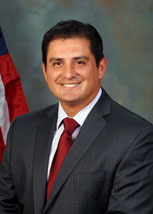
Photo of Ben Hueso
D California Senate · District 40

Sen. Ben Hueso

Compare
Total votes
23,049
all sessions
Attendance
95%
896 missed
Higher than 87% of chamber peers
With party
99%
of cast votes
Near the chamber average
Bipartisan score
0%
crosses aisle rarely
Near the chamber average
Sponsored
741
bills & resolutions
Near the chamber average
Committees
0
assignments
741 bills and resolutions

Sponsored bills

Total
741
Primary
265
Co-sponsor
476
This page
741
matching current filters
Primary SJR 22
Signed into law · California Senate · Lead sponsor
Relative to Calexico West Land Port of Entry project.

This measure would respectfully urge Congress to appropriate $248 million in funding to complete Phase 2 of the Calexico West Land Port of Entry reconfiguration and expansion project in order to realize the benefits the improvements of this project will have on the nation's economy.

Signed into law Aug 17, 2016 0 co-sponsors
Co-sponsor AB 2781
Passed · California Assembly · Co-sponsor
Supplemental environmental projects.

Existing law requires each board, department, and office within the California Environmental Protection Agency that has enforcement authority to establish a policy on supplemental environmental projects that benefits disadvantaged communities, as defined. Existing law requires that policy to include among other things, allowing the amount of a supplemental environmental project to be up to 50% of the enforcement action. This bill would require an assurance that no less than 10% of the enforcement action monetary penalties received by each board, department, and office within the agency is allocated to supplemental environmental projects in disadvantaged communities. The bill would require each board, department, and office within the agency to compile and submit specified information to the agency and would require the agency to consolidate that information and post it on the agency's Internet Web site.

Passed Aug 11, 2016 1 co-sponsor
Primary SB 726
Passed · California Senate · Lead sponsor
Corporate securities: unlawful conduct: regulations.

The Corporate Securities Law of 1968 generally regulates the offer and sale of corporate securities within the state, and specifically makes specified conduct with regard to the offer and sale of corporate securities unlawful. That law requires the Commissioner of Business Oversight to perform specific oversight duties regarding the offer and sale of securities and provides that any willful violation of that law is a crime. Existing law prohibits any person from selling a security in this state by means of a communication that includes an untrue statement of material fact or that omits a material fact necessary in order to make the statements made, in light of the circumstances under which the statements are made, not misleading. This bill would require the commissioner to adopt regulations to prohibit fraudulent and manipulative practices by persons undertaking short sales in the securities market. By expanding the scope of a crime, this bill would impose a state-mandated local program. (2) The California Constitution requires the state to reimburse local agencies and school districts for certain costs mandated by the state. Statutory provisions establish procedures for making that reimbursement. This bill would provide that no reimbursement is required by this act for a specified reason.

Passed Aug 11, 2016 0 co-sponsors
Primary SB 1041
Passed · California Senate · Lead sponsor
Energy: electric rates: public elementary and secondary schools.

Under existing law, the Public Utilities Commission has regulatory authority over public utilities, including electrical corporations. Existing law authorizes the commission to fix the rates and charges for electrical corporations and requires that those rates and charges be just and reasonable. Existing law requires public utilities to develop programs in cooperation with local school districts in reducing their electricity and gas bills through conservation and improvements in efficiency. Existing law authorizes public utilities to offer school districts on a priority basis, and authorizes school districts to utilize, any programs or incentives for commercial customers developed by the utility and approved by the commission, including rebates, loan programs, and incentives for the installation of efficient lighting, heating, or cooling systems. This bill would require the commission to consider the effects of establishing a rate for electric service specific to public elementary and secondary schools, including consideration of the extent to which the average electrical bills paid by public elementary and secondary schools will increase or decrease and the consistency between establishing the rate and other statutory obligations and state policies. The bill would require the commission to report its findings and conclusions to the relevant policy committees of the Legislature by January 1, 2018.

Passed Aug 11, 2016 0 co-sponsors
Co-sponsor AB 1972
Passed · California Assembly · Co-sponsor
Veterans: state park passes.

Existing law requires the Department of Parks and Recreation to issue a park pass for free use of all park facilities in the state park system to any veteran of war, as defined, in which the United States has been, or may be, engaged, and who meets specified criteria, such as being a resident of this state, presenting to the department proof of a service-connected disability, being held captive as a prisoner of war, or receiving a Congressional Medal of Honor, and having been honorably discharged from service. This bill would instead require the Department of Parks and Recreation to issue a park pass for free use of all park facilities in the state park system to any veteran who meets the criteria set forth above. The bill would make related conforming changes. The bill would require the department to report in its proposed budget, on or before January 1, 2019, on revenue losses with regard to the issuance of free veterans passes under these provisions.

Passed Aug 11, 2016 1 co-sponsor
Primary SB 899
Passed · California Senate · Lead sponsor
Gender discrimination: pricing.

Existing law, the Gender Tax Repeal Act of 1995, prohibits a business establishment from discriminating against a person because of the person's gender with respect to the price charged for services of similar or like kind and specifies that this prohibition does not apply to price differences based specifically upon the amount of time, difficulty, or cost of providing the services. This bill would also prohibit a business establishment from discriminating against a person because of a person's gender with respect to the price charged for goods of a substantially similar or like kind, except for food, as defined, or goods sold by a new motor vehicle dealer, as defined. The bill would specify that these exceptions shall not bar or otherwise impact a claim brought under the Unruh Civil Rights Act. The bill would specify that a price difference based specifically on labor, materials, tariffs, or other gender-neutral reasons for having an increased cost of providing the goods is not included within this prohibition. The bill would also specify that a retail establishment is not prohibited from passing through a price to the consumer that is set by a manufacturer, distributor, or other entity that the retailer cannot control.

Passed Jul 12, 2016 0 co-sponsors
Co-sponsor SCA 8
Failed · California Senate · Co-sponsor
A resolution to propose to the people of the State of California an amendment to the Constitution of the State, by amending Sections 1 and 4 of, and adding Section 4.5 to, Article XI thereof, relating to counties.

The California Constitution requires that a county charter provide for a governing body of 5 or more members, elected (1) by district or, (2) at large, or (3) at large with a requirement that they reside in a district, and to provide for the compensation, terms, and removal of members of the governing body. The California Constitution also provides that charter counties are subject to statutes that relate to apportioning population of governing body districts. Existing law requires, following each decennial federal census and using that census as a basis, the board of supervisors of a county to adjust the boundaries of any or all of the supervisorial districts of the county so that the districts are as nearly equal in population as may be and comply with applicable provisions of federal law. Existing law also requires a general law county to have a board of supervisors consisting of 5 members, and requires, except as provided, each member of the board of supervisors to be elected by the district which the member represents. This measure would, in a charter county that is found at a decennial United States census, beginning with the 2020 United States census, to have a population of more than 3,000,000, require, and deem the county charter to provide for, a governing body consisting of 7 or more members, not to be thereafter reduced to fewer than 7 members even if, in a future decennial United States census, the county is not a county with a population of more than 3,000,000. The measure would similarly provide that, in such a county, the expenditures for the governing body and its staff may not exceed, for any subsequent fiscal year after the release of the census finding that the county has a population of more than 3,000,000 the amount that was allocated for the expenses of the governing body and its staff in the county's adopted budget for the fiscal year in which that same census was conducted, as adjusted each fiscal year thereafter for changes in the California Consumer Price Index. This measure would also extend these same requirements to the governing body of a general law county that is found at a decennial United States census, beginning with the 2020 United States census, to have a population of more than 3,000,000. This measure would require, on and after January 1, 2021, a county charter to provide for members to be elected by district with a requirement that the member reside in a district, and would impose that requirement on all general law counties. As described above, the California Constitution requires that a county charter provide for the compensation of members of the governing body. The California Constitution also requires that, if a county charter provides for the Legislature to prescribe the salary of the governing body, the salary be prescribed by the governing body by ordinance. This bill would repeal that latter provision on January 1, 2021. This measure would also make other technical, nonsubstantive changes.


Failed Jun 2, 2016 1 co-sponsor
Co-sponsor AB 2768
In committee · California Assembly · Co-sponsor
Income and corporation taxes: credit: donation of food.

The Personal Income Tax Law and the Bank and Corporation Tax Law allow various credits against the taxes imposed by those laws, including a credit for a farmer to donate fresh foods and vegetables to a food bank. This bill would allow a credit against those taxes for each taxable year, beginning on and after January 1, 2017, and before January 1, 2023, to a taxpayer that donates qualified food, as defined, of its trade or business to an organization located in California and exempt from federal income taxation, as specified. This bill would take effect immediately as a tax levy.

In committee May 27, 2016 1 co-sponsor
Primary SB 1145
In committee · California Senate · Lead sponsor
Language arts: reading: diagnostic tools and plans.

The Comprehensive Reading Leadership Program Act of 1996 authorizes county offices of education to apply to the State Board of Education to design a reading leadership program and develop materials that focus on reading skills, including phonics. This bill would require the state board, on or before December 31, 2017, to identify formative reading diagnostic tools that can be used by the public schools to assess pupils' developmental levels of reading proficiency in grades 1 to 3, inclusive, in their ability to read proficiently by the end of grade 3 and to post a list of those diagnostic tools on the department's Internet Web site. The bill would require, on or before the beginning of the 2018–19 school year, public schools that enroll pupils in grades 1 to 4, inclusive, and at which less than 50% of 4th grade pupils demonstrate proficiency on English language arts standards on the statewide assessment administered the previous school year, to ensure that each pupil's reading proficiency is measured using at least one of the formative reading diagnostic tools identified above. The bill would require any pupil who does not have an appropriate developmental reading level, as provided, to have a reading plan to be created in collaboration with the pupil's parent and teacher. The bill would require the reading plan to have certain elements to be reviewed at least annually by the school and updated or revised as appropriate. By expanding the duties of a public school, the bill would create a state-mandated local program. The California Constitution requires the state to reimburse local agencies and school districts for certain costs mandated by the state. Statutory provisions establish procedures for making that reimbursement. This bill would provide that, if the Commission on State Mandates determines that the bill contains costs mandated by the state, reimbursement for those costs shall be made pursuant to these statutory provisions.

In committee May 27, 2016 0 co-sponsors
Co-sponsor ACR 146
Signed into law · California Assembly · Co-sponsor
Relative to commemorating the 85th anniversary of Roberto Alvarez v. Board of Trustees of the Lemon Grove School District.

This measure would commemorate March 30, 2016, as the 85th anniversary of the historic ruling in the case of Roberto Alvarez v. Board of Trustees of the Lemon Grove School District, which invalidated that district's attempt to restrict its pupils of Mexican heritage to an inferior, segregated educational experience.

Signed into law May 5, 2016 1 co-sponsor
Showing 351 to 360 of 741 bills
Previous 1 … 35 36 37 … 75 Next