This measure would declare the month of September 2023 as Childhood Cancer Awareness Month.
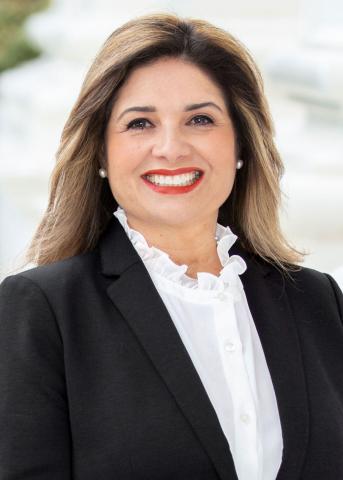
Sen. Marie Alvarado-Gil
Sponsored bills
This measure would proclaim the month of October 2023 as Domestic Violence Awareness Month.
This measure would declare the month of September 2023 as California Emergency Preparedness Month.
This measure would recognize the month of January 2024 as National Human Trafficking Awareness Month.
This measure would designate, in perpetuity, the 4th week of January as Data Privacy Week and the last Sunday of January as Data Privacy Day.
Existing law vests the Public Utilities Commission with regulatory authority over public utilities, including electrical corporations, while local publicly owned electric utilities are under the direction of their governing boards. Existing law requires electrical corporations, by December 1, 2023, to collectively procure, through financial commitments of 5 to 15 years, inclusive, their proportionate share of 125 megawatts of cumulative rated generating capacity from existing bioenergy projects that commenced operations before June 1, 2013, and requires a local publicly owned electric utility serving more than 100,000 customers to procure its proportionate share of 125 megawatts of cumulative rated generating capacity from bioenergy projects subject to terms of at least 5 years, but exempts from these requirements a local publicly owned electric utility that previously entered into 5-year financial commitments for its proportionate share under certain conditions. This bill would authorize the cumulative rated generating capacity to be procured from bioenergy projects regardless of when the projects commence operations. The bill also would authorize a community choice aggregator to procure, subject to terms of at least 5 years, any portion of a local publicly owned electric utility's required proportionate share of 125 megawatts of cumulative rated generating capacity from bioenergy projects that was not procured because of the exemption described above. The bill would require the commission to ensure that the costs of any contract procured by a community choice aggregator are recoverable, as specified.
Existing law, with certain exceptions, entitles an employee to paid sick days for certain purposes if the employee works in California for the same employer for 30 or more days within a year from the commencement of employment. Existing law requires the leave to be accrued at a rate of no less than one hour for every 30 hours worked, and to be available for use beginning on the 90th day of employment. Existing law authorizes an employer to use a different accrual method as long as an employee has no less than 24 hours of accrued sick leave or paid time off by the 120th calendar day of employment or each calendar year, or in each 12-month period. Existing law also provides that an employer may satisfy the accrual requirements by providing not less than 24 hours or 3 days of paid sick leave that is available to the employee to use by the completion of the employee's 120th calendar day of employment. Under existing law, an employer has no obligation under these provisions to allow an employee's total accrual of paid sick leave to exceed 48 hours or 6 days, provided that an employee's rights to accrue and use paid sick leave are not otherwise limited, as specified. Under existing law, sick leave carries over to the following year of employment, but an employer is permitted to limit the use of the carryover amount, in each year of employment, calendar year, or 12-month period, to 24 hours or 3 days. This bill would modify the employer's alternate sick leave accrual method to require that an employee have no less than 40 hours of accrued sick leave or paid time off by the 200th calendar day of employment or each calendar year, or in each 12-month period. The bill would modify that satisfaction provision to authorize an employer to satisfy accrual requirements by providing not less than 40 hours or 5 days of paid sick leave that is available to the employee to use by the completion of the employee's 200th calendar day of employment. The bill would also provide that an employer is under no obligation to allow an employee's total accrual of paid sick leave to exceed 80 hours or 10 days, as specified. The bill would raise the employer's authorized limitation on the employee's use of carryover sick leave to 40 hours or 5 days. Under existing law, an employer is not required to provide additional paid sick leave days if the employer has a paid leave policy or paid time off policy that provided paid sick leave or paid time off to a class of employees before January 1, 2015, and the employee was eligible to earn at least 3 days or 24 hours of sick leave or paid time off within 9 months of employment. This bill would instead provide that an employer is not required to provide additional paid sick leave days in the above circumstances if the employer provided paid sick leave or paid time off to a class of employees before January 1, 2024, and the employee was eligible to earn at least 5 days or 40 hours of sick leave or paid time off within 9 months of employment, subject to certain conditions. Existing law requires paid sick leave for nonexempt employees to be calculated in the same manner as the regular rate of pay for the workweek in which the employee uses paid sick time, as specified. This bill would instead require paid sick leave for nonexempt employees to be paid at the employee's base rate of pay. The bill would also authorize an employer to request an employee, if an employee uses paid sick leave, to provide a written statement indicating that the employee was absent from work for a specified reason, and in certain cases, to provide written documentation regarding the leave. The bill would provide that an employer is not in violation of these provisions if the employer denies leave based on a determination that the verification or documentation is false. Existing law establishes that providers of in-home supportive services accrue sick leave in accordance with a schedule that is based on the timeline for state minimum wage increases, up to a maximum of 24 hours or 3 days when the minimum wage reaches $15 per hour. This bill would amend the schedule for in-home supportive services providers to increase the sick leave accrual maximum to 40 hours or 5 days in each year of employment, beginning January 1, 2026. The bill would also provide that, on or after January 1, 2024, a county, city, or municipality shall not adopt an ordinance, resolution, law, rule, or regulation, or amend an ordinance, resolution, law, rule, or regulation regarding paid sick leave, other than related to COVID-19-specific paid leave. The bill would provide that these sick leave provisions would preempt any existing local ordinance, resolution, law, rule, or regulation regarding earned sick leave, excluding local ordinances regarding COVID-19-specific sick leave and local ordinances enacted before January 1, 2023, as specified. Existing law authorizes the Labor Commissioner to enforce the above provisions governing paid sick leave, including by investigating an alleged violation, and ordering appropriate temporary relief to mitigate the violation, issuing a citation, and filing a civil action. The Labor Code Private Attorneys General Act of 2004 authorizes an aggrieved employee who complies with specified notice and filing requirements to bring a civil action to recover specified civil penalties that would otherwise be assessed and collected by the Labor and Workforce Development Agency. This bill would provide that the paid sick leave provisions are not enforceable by an action under the Labor Code Private Attorneys General Act of 2004. The bill would include findings that changes proposed by this bill address a matter of statewide concern rather than a municipal affair and, therefore, apply to all cities and counties, including charter cities and counties.

Existing law vests the Public Utilities Commission with regulatory authority over public utilities, including telephone corporations. Existing law authorizes the commission to fix just and reasonable rates and charges for public utilities. Existing law requires the commission to maintain the California High-Cost Fund-A Administrative Committee Fund (CHCF-A) program until January 1, 2028, to provide universal service rate support to small independent telephone corporations, as defined, in certain amounts in furtherance of the state's universal service commitment to the continued affordability and widespread availability of safe, reliable, high-quality communications services in rural areas of the state. This bill would, among other things, modify the definition of "rate design" for purposes of the CHCF-A program to specify that it does not include certain revenues, including internet access services, and would require the commission to ensure that each small independent telephone corporation's rate design equals its revenue requirement. The bill would also require the commission, on or before February 1, 2024, to adjust each small independent telephone corporation's rate design to remove any broadband or internet access revenues and implement corresponding increases to the distribution of CHCF-A program funds to each small independent telephone corporation to ensure that its rate design equals its revenue requirement. Under existing law, a violation of the Public Utilities Act or an order, decision, rule, direction, demand, or requirement of the commission is a crime. Because the CHCF-A program is within the act and a violation of a commission action implementing this bill's requirements would be a crime, the bill would impose a state-mandated local program. The California Constitution requires the state to reimburse local agencies and school districts for certain costs mandated by the state. Statutory provisions establish procedures for making that reimbursement. This bill would provide that no reimbursement is required by this act for a specified reason.
Existing law, the Public Employees' Retirement Law (PERL) , establishes the Public Employees' Retirement System (PERS) , which provides a defined benefit to members of the system, based on final compensation, credited service, and age at retirement, subject to certain variations. Existing law prescribes various definitions of final compensation based on employment classification, bargaining unit, date of hire, and date of retirement, among other things. PERL authorizes public agencies to join PERS and prescribes the rights and duties of agencies participating in PERS. Existing law authorizes PERS to enter into agreements with specified public retirement systems to establish reciprocity between PERS and those public retirement systems. Existing law provides that an agency that has entered into an agreement establishing reciprocity with PERS is deemed to have obtained the same rights and limitations that apply to all other public agencies that have entered into similar reciprocal agreements with PERS. This bill would establish the California Public Retirement System Agency Cost and Liability Panel, located in the Controller's office, with members as defined. The bill would assign responsibilities to the panel related to retirement benefit costs, including determining how costs and unfunded liability are apportioned to a public agency when a member changes employers within the same public retirement system or when a member concurrently retires with 2 or more retirement systems that have entered into reciprocity agreements. The bill would require the panel to meet no later than March 31, 2024, and quarterly beginning on April 1, 2024, and to submit a report to the Legislature, no later than December 31, 2024, providing information regarding the financial impact a public agency assumes when an employee transfers to another public agency within the same retirement system or when an employee transfers to a public agency in a reciprocal retirement system and concurrently retires under 2 or more systems.