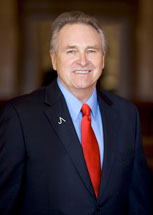
Photo of Jim Nielsen
R California Senate · District 4 · Former member

Sen. Jim Nielsen

Compare
Total votes
34,147
all sessions
Attendance
94%
1,435 missed
Near the chamber average
With party
97%
of cast votes
Lower than 90% of chamber peers
Bipartisan score
2%
crosses aisle rarely
Higher than 92% of chamber peers
Sponsored
1,204
bills & resolutions
Near the chamber average
Committees
0
assignments
1,204 bills and resolutions

Sponsored bills

Total
1,204
Primary
201
Co-sponsor
1,003
This page
1,204
matching current filters
Co-sponsor SCR 39
Signed into law · California Senate · Co-sponsor
California Peace Officers' Memorial Day.

This measure would designate Monday, May 6, 2013, as California Peace Officers' Memorial Day, urge all Californians to use that day to honor California peace officers, and recognize specified California peace officers who were killed in defense of their communities.

Signed into law Aug 29, 2013 1 co-sponsor
Primary SCR 13
Signed into law · California Senate · Lead sponsor
Relative to the Redding Police Officer Owen "Ted" Lyon Memorial Bridge.

This measure would designate the Sacramento River Bridge (#6-14) located on State Highway Route 273 as it crosses the Sacramento River into downtown in the City of Redding as the Redding Police Officer Owen "Ted" Lyon Memorial Bridge. The measure would request the Department of Transportation to determine the cost for appropriate signs showing this special designation and, upon receiving donations from nonstate sources covering that cost, to erect those signs.

Signed into law Aug 29, 2013 0 co-sponsors
Co-sponsor AB 133
Signed into law · California Assembly · Co-sponsor
Instructional materials: digital format.

Existing law requires the State Board of Education and the governing board of each school district maintaining one or more high schools to adopt instructional materials for use in kindergarten and grades 1 to 8, inclusive, and high schools, respectively. Existing law authorizes a local educational agency to use instructional materials that are aligned with the adopted academic content standards, as specified, including basic instructional materials that have not been adopted by the state board. Existing law places specified requirements on a publisher or manufacturer of instructional materials offered for adoption. Existing law, until July 1, 2015, exempts school districts from requirements to provide pupils with instructional materials by a specified time period following adoption of those materials by the state board. This bill would require a publisher or manufacturer that submits a printed instructional material for adoption by the state board, or for adoption or use by the governing board of a school district, on or after January 1, 2014, to ensure that the printed instructional material is also available in an equivalent digital format during the entire term of the adoption. The bill would require the equivalent digital format of a printed instructional material to conform to certain standards and guidelines, as specified.

Signed into law Aug 27, 2013 1 co-sponsor
Co-sponsor SB 531
died · California Senate · Co-sponsor
School employees: discipline: suspension and dismissal.

(1) Existing law prohibits a permanent school employee from being dismissed except for one or more specified causes. This bill would prohibit a collective bargaining agreement entered into or renewed on or after January 1, 2014, from requiring the removal, after a specified time period, from an employee's record of records pertaining to discipline, complaints, reprimands, or investigations relating to the employee's commission, or potential commission, of one of those specified causes for dismissal. (2) Existing law authorizes a governing board of a school district to give notice to a permanent employee of its intention to dismiss or suspend him or her for specified causes at the expiration of 30 days from the date of service of the notice, unless the employee demands a hearing. Existing law prohibits that notice from being given between May 15th and September 15th in any year. This bill would remove that prohibition. (3) Existing law prohibits the governing board of a school district from acting upon any charges of unprofessional conduct, or unsatisfactory performance, unless at least 45, or 90, calendar days, respectively, prior to the date of the filing of the charges the governing board, or its authorized representative, has given the employee written notice, as specified. This bill would remove those 45-day and 90-day requirements of written notice to the charged employee. (4) Existing law establishes a Commission on Professional Competence for each dismissal or suspension hearing requested by an employee, consisting of specified members, and requires the proceeding to be conducted in accordance with the Administrative Procedure Act. Existing law deems the decision of the Commission on Professional Competence to be the final decision of the governing board of the school district. This bill would delete the provisions providing for the establishment of a Commission on Professional Competence, and would instead require the proceedings to be conducted pursuant to the Administrative Procedure Act by an administrative law judge. The bill would require that the administrative law judge or, for a dismissal proceeding where the charges against the employee do not involve sex, drugs, or violence against children, a panel composed of the judge and 2 certificated employees, acting by a majority vote, propose a decision. The bill would provide that the decision of the administrative law judge or panel would be advisory, and the final decision regarding the discipline of the employee would be determined by action of the governing board of the school district. The bill would provide that an employee requesting a hearing may be placed on administrative leave without pay, and that an employee who is placed on administrative leave would be required to be paid his or her regular salary if he or she furnishes to the school district acceptable security, as specified. By increasing the duties of a governing board in this regard, this bill would impose a state-mandated local program. (5) Existing law prohibits testimony from being given or evidence being introduced at the hearing relating to matters that occurred more than 4 years prior to the date of the filing of the notice of dismissal or suspension. This bill would remove that 4-year limitation. (6) This bill would make additional changes that are nonsubstantive and conforming. (7) The California Constitution requires the state to reimburse local agencies and school districts for certain costs mandated by the state. Statutory provisions establish procedures for making that reimbursement. This bill would provide that, if the Commission on State Mandates determines that the bill contains costs mandated by the state, reimbursement for those costs shall be made pursuant to these statutory provisions.

died May 29, 2013 1 co-sponsor
Co-sponsor ACR 20
Signed into law · California Assembly · Co-sponsor
Postsecondary education: instruction in world religions: Sikhism.

This measure would recognize the need for the inclusion of Sikhism in world religions, Eastern religions, Asian, and South Asian courses at all postsecondary educational institutions and advise the concerned academic governing bodies, deans, and department chairs to include Sikhism in their institution's world religions, Eastern religions, Asian, and South Asian courses.

Signed into law May 1, 2013 1 co-sponsor
Co-sponsor SCR 16
Signed into law · California Senate · Co-sponsor
California Aerospace Month.

This measure would recognize the contributions of the aerospace industry to the history, economy, security, and educational system of California, its communities, and its citizens by proclaiming the month of March 2013 as California Aerospace Month.

Signed into law Apr 8, 2013 1 co-sponsor
Co-sponsor ACR 6
Signed into law · California Assembly · Co-sponsor
Relative to human trafficking.

This resolution would recognize the month of January 2013, and each following January, as National Slavery and Human Trafficking Prevention Month, and it would recognize February 1, 2013, and each following February 1, as California's Free From Slavery Day.

Signed into law Feb 21, 2013 1 co-sponsor
Co-sponsor AB 1588
Signed into law · California Assembly · Co-sponsor
Professions and vocations: reservist licensees: fees and continuing education.

Existing law provides for the regulation of various professions and vocations by boards within the Department of Consumer Affairs and for the licensure or registration of individuals in that regard. Existing law authorizes any licensee whose license expired while he or she was on active duty as a member of the California National Guard or the United States Armed Forces to reinstate his or her license without examination or penalty if certain requirements are met. This bill would require the boards described above, with certain exceptions, to waive the renewal fees, continuing education requirements, and other renewal requirements as determined by the board, if any are applicable, of any licensee or registrant who is called to active duty as a member of the United States Armed Forces or the California National Guard if certain requirements are met. The bill would, except as specified, prohibit a licensee or registrant from engaging in any activities requiring a license while a waiver is in effect. The bill would require a licensee or registrant to meet certain renewal requirements within a specified time period after being discharged from active duty service prior to engaging in any activity requiring a license. The bill would require a licensee or registrant to notify the board of his or her discharge from active duty within a specified time period.

Signed into law Sep 29, 2012 1 co-sponsor
Co-sponsor AB 2358
Signed into law · California Assembly · Co-sponsor
State Capitol: Ronald Reagan statue.

Existing law prescribes various duties for the Department of General Services in connection with development and maintenance of the park around the State Capitol Building. This bill would authorize the Ronald Reagan Centennial Capitol Foundation, in consultation with the Department of General Services, to plan a statue of Ronald Reagan in the State Capitol Building Annex. The bill would require the Department of General Services and the Ronald Reagan Centennial Capitol Foundation to approve the design and any other aspect of the statue. The bill would require that the planning, construction, and maintenance of the statue be funded with private donations through the Ronald Reagan Centennial Capitol Foundation. The bill would prohibit construction of the statue until the Joint Committee on Rules has approved and adopted the plan for the statue, and the Joint Committee on Rules and the Department of Finance have determined that sufficient private funding is available to construct and maintain the statue.

Signed into law Sep 28, 2012 1 co-sponsor
Co-sponsor SB 379
Signed into law · California Senate · Co-sponsor
Telecommunications: universal service: regulation.

Existing law, the federal Telecommunications Act of 1996, establishes a program of cooperative federalism for the regulation of telecommunications to attain the goal of local competition, while implementing specific, predictable, and sufficient federal and state mechanisms to preserve and advance universal service, consistent with certain universal service principles. The universal service principles include the principle that consumers in all regions of the nation, including low-income consumers and those in rural, insular, and high-cost areas, should have access to telecommunications and information services, including interexchange services and advanced telecommunications and information services, that are reasonably comparable to those services provided in urban areas and that are available at rates that are reasonably comparable to rates charged for similar services in urban areas. Existing law authorizes the Public Utilities Commission to supervise and regulate every public utility in the state, including telephone corporations, and to fix just and reasonable rates and charges for the public utility. Existing law establishes the state's universal service funds, including the California High-Cost Fund-A Administrative Committee Fund (CHCF-A) and the California High-Cost Fund-B Administrative Committee Fund (CHCF-B) , in the State Treasury, and provides that moneys in each of the state's universal service funds are the proceeds of rates and are held in trust for the benefit of ratepayers and to compensate telephone corporations for their costs of providing universal service. Moneys in the funds may only be expended to accomplish specified telecommunications universal service programs, upon appropriation in the annual Budget Act or upon supplemental appropriation. Existing law, until January 1, 2015, requires the commission to develop, implement, and maintain a suitable program to establish a fair and equitable local rate structure aided by universal service rate support to small independent telephone corporations that serve rural areas and are subject to rate-of-return regulation by the commission (the CHCF-A program) . This bill would revise the CHCF-A program to instead require the commission, until January 1, 2015, to exercise its regulatory authority to maintain the CHCF-A program to provide universal rate support to small independent telephone corporations in amounts sufficient to meet the revenue requirements established by the commission through rate-of-return regulation in furtherance of the state's universal service commitment to the continued affordability and widespread availability of safe, reliable, high-quality communications services in rural areas of the state. The bill would specify eligibility requirements for small independent telephone corporations to participate in the CHCF-A program and requirements for the commission in maintaining the program. This bill would require a small independent telephone corporation that receives support from the CHCF-A program to provide information regarding revenues derived from the provision of unregulated internet access service upon request from the commission and would require the commission to treat this information as confidential. Under existing law, a violation of the Public Utilities Act or any order, decision, rule, direction, demand, or requirement of the commission is a crime. Because the provisions of this bill would be a part of the act and because a failure by a small independent telephone corporation that receives support from the CHCF-A program to provide information regarding revenues derived from unregulated internet access service when requested by the commission would be a crime, the bill would impose a state-mandated local program by creating a new crime. The California Constitution requires the state to reimburse local agencies and school districts for certain costs mandated by the state. Statutory provisions establish procedures for making that reimbursement. This bill would provide that no reimbursement is required by this act for a specified reason.


Signed into law Sep 28, 2012 1 co-sponsor
Showing 681 to 690 of 1,204 bills
Previous 1 … 68 69 70 … 121 Next