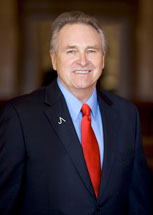
Photo of Jim Nielsen
R California Senate · District 4 · Former member

Sen. Jim Nielsen

Compare
Total votes
34,147
all sessions
Attendance
94%
1,435 missed
Near the chamber average
With party
97%
of cast votes
Lower than 90% of chamber peers
Bipartisan score
2%
crosses aisle rarely
Higher than 92% of chamber peers
Sponsored
1,204
bills & resolutions
Near the chamber average
Committees
0
assignments
1,204 bills and resolutions

Sponsored bills

Total
1,204
Primary
201
Co-sponsor
1,003
This page
1,204
matching current filters
Primary SB 796
In committee · California Senate · Lead sponsor
Medicine: physicians and surgeons.

Existing law states that California is currently experiencing a geographical and specialty maldistribution of physicians and surgeons. Existing law states that it is the intent of the Legislature to address these problems by assisting licensed physicians and surgeons in establishing medical practices in areas deficient in physician services and primary care specialties. This bill would express the intent of the Legislature to enact legislation that would ensure that physicians and surgeons are encouraged to retain practices and serve communities in rural and underserved areas of California.

In committee Feb 3, 2014 0 co-sponsors
Primary SB 474
In committee · California Senate · Lead sponsor
Appropriation of water: Sewerage Commission Oroville.

Under existing law, the State Water Resources Control Board (board) administers a water rights program pursuant to which the board grants permits and licenses to appropriate water. Existing law requires the owner of a wastewater treatment plant to obtain the approval of the board prior to making any changes in the point of discharge, place of use, or purpose of use of treated wastewater, and requires the board to review the proposed changes in accordance with prescribed procedures. Existing law authorizes any municipality, governmental agency, or political subdivision operating a waste disposal plant that discharges water meeting the requirements of the appropriate regional board into the San Joaquin River to file an application for a permit to appropriate an equal amount of water, as adjusted for seepage and other factors, downstream from the disposal plant and out of the San Joaquin River or the Sacramento-San Joaquin Delta, which water may be sold or utilized for any beneficial purpose. Existing law authorizes the board to grant the permit to appropriate on such terms and conditions as in the board's judgment are necessary for the protection of the rights of others. This bill would authorize the Sewerage Commission Oroville to file an application for a permit, on or after July 1, 2014, to appropriate a specified amount of water that is based on the volume of treated wastewater that it discharges into the Feather River, as specified. The bill would authorize the board to grant a permit to appropriate that treated wastewater upon terms and conditions determined by the board. The bill would require the board, prior to granting a permit pursuant to these provisions, to comply with permit, approval, and review requirements and other laws applicable to the appropriation of water. The bill would require the board to prepare a report assessing the potential cumulative effects of granting the above-described permit, as prescribed. The bill would require the board to post the report on its Internet Web site and transmit an electronic copy of the final report to certain committees of the Legislature by July 1, 2014, as specified. This bill would require the Sewerage Commission Oroville to be responsible for the reasonable costs incurred by the board in complying with this reporting requirement. This bill would make legislative findings and declarations as to the necessity of a special statute for the Sewerage Commission Oroville.

In committee Feb 3, 2014 0 co-sponsors
Primary SB 709
In committee · California Senate · Lead sponsor
Inmates: mental evaluations.

Existing law requires that as a condition of parole, a prisoner who has a severe mental disorder, as defined, shall be required to be treated by the State Department of State Hospitals, and the State Department of State Hospitals shall provide the necessary treatment. Existing law requires that, prior to release on parole, the person in charge of treating the prisoner and a practicing psychiatrist or psychologist from the State Department of State Hospitals have evaluated the prisoner at a facility of the Department of Corrections and Rehabilitation. This bill would require the evaluation to be a face-to-face evaluation. Existing law requires that whenever the Secretary of the Department of Corrections and Rehabilitation determines that an individual who is in custody under the jurisdiction of the department, and who is either serving a determinate prison sentence or whose parole has been revoked, may be a sexually violent predator, the secretary shall, at least 6 months prior to that individual's scheduled date for release from prison, refer the person for evaluation to the State Department of State Hospitals. Existing law requires the State Department of State Hospitals to evaluate the person in accordance with a standardized assessment protocol, developed and updated by that department, to determine whether the person is a sexually violent predator. This bill would require the evaluation to be a face-to-face evaluation. The bill would make additional technical changes.

In committee Feb 3, 2014 0 co-sponsors
Primary SB 645
In committee · California Senate · Lead sponsor
Diagnosis-related group methodology.

Existing law provides for the Medi-Cal program, which is administered by the State Department of Health Care Services, under which qualified low-income individuals receive health care services. The Medi-Cal program is, in part, governed and funded by federal Medicaid Program provisions. Existing law requires the department, subject to federal approval, to develop and implement a payment methodology based on diagnosis-related groups that reflects that costs and staffing levels associated with quality of care for patients in all general acute care hospitals, as specified. Existing law requires that the methodology developed pursuant to these provisions be implemented on July 1, 2012, or on the date upon which the director executes a declaration certifying that all necessary federal approvals have been obtained and the methodology is sufficient for formal implementation, whichever is later. This bill would require the department, before the diagnosis-related group methodology can be implemented, to develop a methodology, in consultation with the hospital community, for hospitals to review base payment rates proposed by the department. The bill would require the department, commencing July 1, 2013, to begin collecting diagnosis codes and procedure codes to establish a database from which to develop base payment rates and would require the department to develop an education and training program for hospital Medi-Cal billing staff, in consultation with the hospital community, to be conducted between April 1, 2014, and May 13, 2014. This bill would declare that it is to take effect immediately as an urgency statute.

In committee Feb 3, 2014 0 co-sponsors
Co-sponsor AB 486
Failed · California Assembly · Co-sponsor
Sales and use taxes: exemption: manufacturing research and development.

Existing sales and use tax laws impose taxes on retailers measured by the gross receipts from the sale of tangible personal property sold at retail in this state, or on the storage, use, or other consumption in this state of tangible personal property purchased from a retailer for storage, use, or other consumption in this state. That law provides various exemptions from those taxes. The bill would exempt from those taxes, on and after January 1, 2014, the gross receipts from the sale of, and the storage, use, or other consumption of, qualified tangible personal property purchased by a qualified person for use primarily in manufacturing, processing, refining, fabricating, or recycling of property, as specified, qualified tangible personal property purchased for use by a contractor for specified purposes, as provided, and tangible personal property purchased for use by a qualified person to be used primarily in research and development, as provided. The Bradley-Burns Uniform Local Sales and Use Tax Law authorizes counties and cities to impose local sales and use taxes in conformity with the Sales and Use Tax Law, and existing law authorizes districts, as specified, to impose transactions and use taxes in conformity with the Transactions and Use Tax Law, which conforms to the Sales and Use Tax Law. Exemptions from state sales and use taxes are incorporated into these laws. This bill would specify that this exemption does not apply to local sales and use taxes, transactions and use taxes, and specified state taxes from which revenues are deposited into the Local Public Safety Fund, the Education Protection Account, and the Local Revenue Fund. This bill would take effect immediately as a tax levy.

Failed Feb 3, 2014 1 co-sponsor
Primary SB 710
died · California Senate · Lead sponsor
Parole.

(1) Existing law requires that all persons released from prison on and after October 1, 2011, after serving a prison term for a felony, be subject to postrelease community supervision provided by a county agency for a period of 3 years immediately following release, except for persons released after serving a term for a serious felony, a violent felony, an offense for which the person was sentenced pursuant to the three strikes law, a crime where the person is classified as a high risk sex offender, or a crime where the person is required to undergo treatment by the State Department of State Hospitals because the person has a severe mental disorder. Existing law requires these persons to be subject to parole supervision by the Department of Corrections and Rehabilitation following release from state prison. This bill would require all offenders released from prison on and after January 1, 2014, to be subject to parole supervision by the Department of Corrections and Rehabilitation and the Board of Parole Hearings for a minimum period of 3 years. The bill would require the board to have exclusive jurisdiction over the supervision and revocation of parole of all inmates upon their release from prison. For crimes committed on or after January 1, 2014, the bill would set the period of parole not to exceed 5 years and not less than 3 years in the case of an inmate imprisoned for any offense other than first or 2nd degree murder for which the inmate has received a life sentence, and would set a parole period not to exceed 4 years and not less than 3 years in the case of any other inmate. The bill would prohibit a person from being discharged from parole without first completing 12 consecutive months of supervision without a parole violation or arrest on new criminal charges, and would provide that no person may be discharged from parole while incarcerated or if his or her whereabouts are unknown. The bill would make the provisions on postrelease supervision applicable only to persons released from prison prior to January 1, 2014. The bill would make conforming changes. The bill would require the Department of Corrections and Rehabilitation to develop a minimum of 3 parole violator adjustment and rehabilitation facilities. The bill would require that parolees who violate the conditions of parole shall be sentenced to up to one year in a facility. For violations that are drug related, but do not involve an offense that could be charged as a violent or serious crime or that would require registration as a sex offender, the bill would require the violation to be served in a facility for at least 6 months. All other parole violations would result in the parolee serving the rest of his or her term in the facility on revoked status. The bill would require a treatment and programming plan to be developed for each parole violator. (2) Existing law, the Victims' Bill of Rights Act of 2008: Marsy's Law, as added by Proposition 9 at the November 4, 2008, statewide general election, provides that the Board of Parole Hearings or its successor in interest shall be the state's parole authority and shall be responsible for protecting victims' rights in the parole process. Existing law requires the board to enjoy sufficient autonomy to conduct unbiased hearings and maintain an independent legal and administrative staff. Proposition 9 provides that the Legislature may amend its provisions by a majority vote to expand the scope of their application, to recognize additional rights of victims of crime, or to further the rights of victims of crime. This bill would also require the board to enjoy sufficient autonomy to protect the rights of crime victims.

died Feb 3, 2014 0 co-sponsors
Co-sponsor AB 661
Failed · California Assembly · Co-sponsor
State government: FISMA.

Existing law, the Financial Integrity and State Manager's Accountability Act of 1983 (FISMA) , provides that state agency heads are responsible for the establishment and maintenance of a system or systems of internal accounting and administrative control within their agencies, as specified. Existing law requires that state agency heads covered by FISMA shall, biennially, conduct an internal review and prepare a report on the adequacy of the agency's systems of internal accounting, administrative control, and monitoring practices. Copies of the reports are required to be submitted to the Legislature, the California State Auditor, the Controller, the Treasurer, the Attorney General, the Governor, the director, and to the State Library where the copies are required to be available for public inspection. This bill would also require the report to be posted on the agency's Internet Web site within 5 days of finalization and would require the report to be signed by the head of the agency under penalty of perjury. By requiring the head of an agency to sign the report under penalty of perjury, this bill would expand circumstances under which a person may be convicted of a crime and, thereby, would impose a state-mandated local program. This bill would provide that the head of an agency that fails to submit the report within 30 days of its deadline shall be suspended without pay until the agency comes into compliance with the reporting requirements. This bill would require the framework for conducting an internal review of an agency's systems of internal accounting and administrative control to include Protocols for auditing and monitoring of the agency's assets, liabilities, revenues, and expenditures, as well as reconciliation of accounting and budget documents reported to the Department of Finance and the Office of the Controller. Existing law requires the head of an internal audit staff of a state agency to investigate any allegation that an employee of the agency provided false or misleading information in connection with the review of the agency's systems of internal accounting and administrative control or in connection with the preparation of the biennial report on the systems of internal accounting, administrative control, and monitoring practices. Existing law requires the head of an internal audit staff or designated internal control person to report in writing to the head of the agency or the division if there is reasonable cause to believe that false or misleading information was provided. This bill would require the report to also be submitted to the Department of Finance and the Joint Legislative Audit Committee. The California Constitution requires the state to reimburse local agencies and school districts for certain costs mandated by the state. Statutory provisions establish procedures for making that reimbursement. This bill would provide that no reimbursement is required by this act for a specified reason.

Failed Feb 3, 2014 1 co-sponsor
Co-sponsor AB 350
Failed · California Assembly · Co-sponsor
Timber harvesting plans: exempt activities.

The Z'berg-Nejedly Forest Practice Act of 1973 prohibits a person from conducting timber operations unless a timber harvesting plan prepared by a registered professional forester has been submitted to the Department of Forestry and Fire Protection. The act authorizes the State Board of Forestry and Fire Protection to exempt from those provisions of the act a person engaging in specified forest management activities, including, among other things, the harvesting of only trees less than 18 inches in stump diameter, measured at 8 inches above ground level. However, existing law permits the removal of trees less than 24 inches in stump diameter to achieve the goal of fuel reduction if the removal of any such tree is within 500 feet of a legally permitted structure, or in an area prioritized as a shaded fuel break in a community wildfire protection plan approved by a public fire agency, if the goal of fuel reduction cannot be achieved by removing only trees less than 18 inches in stump diameter. This bill would, instead, exempt the removal of trees less than 28 inches in stump diameter, measured at 8 inches above ground level. However, the bill would permit the removal of trees less than 28 inches in stump diameter to achieve the goal of fuel reduction if the removal of any such tree is within 500 feet of a legally permitted structure, in an area prioritized as a shaded fuel break in a community wildfire protection plan approved by a public fire agency, if the goal of fuel reduction cannot be achieved by removing only trees less than 28 inches in stump diameter.

Failed Feb 3, 2014 1 co-sponsor
Co-sponsor AB 23
Failed · California Assembly · Co-sponsor
State responsibility areas: fire prevention fees.

Existing law requires the State Board of Forestry and Fire Protection, on or before September 1, 2011, to adopt emergency regulations to establish a fire prevention fee in an amount not to exceed $150 to be charged on each structure on a parcel that is within a state responsibility area, as defined, and requires that the fire prevention fee be adjusted annually using prescribed methods. Existing law requires the State Board of Equalization to collect the fire prevention fees, as prescribed, commencing with the 2011–12 fiscal year. Existing law establishes the State Responsibility Area Fire Prevention Fund and prohibits the collection of fire prevention fees if, commencing with the 2012–13 fiscal year, there are sufficient amounts of moneys in the fund to finance specified fire prevention activities for a fiscal year. Existing law requires that the fire prevention fees collected, except as provided, be deposited into the fund and be made available, to the board and the Department of Forestry and Fire Protection for certain specified fire protection activities that benefit the owners of structures in state responsibility areas who are required to pay the fee. Existing law further requires the board, on and after January 1, 2013, to submit an annual written report to the Legislature on specified topics. This bill would repeal the above provisions relating to the fire prevention fees.

Failed Feb 3, 2014 1 co-sponsor
Primary SB 742
died · California Senate · Lead sponsor
Defendants.

Existing law, as amended by Proposition 83 of the November 7, 2006, statewide general election, requires every inmate who has been convicted of an offense that requires him or her to register as a sex offender or any attempt to commit any of those offenses and who is committed to prison and released on parole to be monitored by a global positioning system (GPS) for life. Proposition 83 permits the Legislature to amend its provisions, either by a 23 vote of the membership of each house, or by a majority vote of the membership of each house, if the amendments expand the scope of the application of the provisions of the proposition or increase the punishments or penalties provided in the proposition. Existing law permits, and with respect to certain sex offenders requires, the use of electronic monitoring by the department and by county probation departments to electronically monitor the whereabouts of individuals on parole and probation, respectively. This bill would provide that any person who willfully removes or disables an electronic monitoring or supervising device, including a GPS or other monitoring device, affixed to his or her person or the person of another, knowing that the device was affixed as part of a criminal sentence or juvenile court disposition, as a condition of parole or probation, or otherwise pursuant to law, is guilty of a public offense, punishable as specified. The bill would also provide for revocation of probation, parole, or postrelease community supervision, and would subject persons with a specified sex offense conviction who violate the section to be subject to lifetime GPS monitoring. By creating a new crime, this bill would impose a state-mandated local program. Existing law requires that whenever the Secretary of the Department of Corrections and Rehabilitation determines that an individual who is in custody under the jurisdiction of the department, and who is either serving a determinate prison sentence or whose parole has been revoked, may be a sexually violent predator, the secretary shall, at least 6 months prior to that individual's scheduled date for release from prison, refer the person for evaluation to the State Department of State Hospitals. Existing law requires the State Department of State Hospitals to evaluate the person in accordance with a standardized assessment protocol, developed and updated by that department, to determine whether the person is a sexually violent predator. This bill would require the evaluation to be a face-to-face evaluation. The bill would require an agency having supervisory authority over an individual who has been convicted of a sexually violent offense to refer the individual to the State Department of State Hospitals for an evaluation pursuant to the law governing the civil commitment of sexually violent predators when the individual has been found, in an adjudicatory proceeding, to have knowingly removed or disabled, or to have knowingly permitted another to remove or disable, an electronic monitoring device affixed to his or her person pursuant to existing law. The bill would make additional technical changes. By imposing additional duties on county agencies, this bill would impose a state-mandated local program. The California Constitution requires the state to reimburse local agencies and school districts for certain costs mandated by the state. Statutory provisions establish procedures for making that reimbursement. This bill would provide that with regard to certain mandates no reimbursement is required by this act for a specified reason. With regard to any other mandates, this bill would provide that, if the Commission on State Mandates determines that the bill contains costs so mandated by the state, reimbursement for those costs shall be made pursuant to the statutory provisions noted above. This bill would declare that it is to take effect immediately as an urgency statute.


died Feb 3, 2014 0 co-sponsors
Showing 651 to 660 of 1,204 bills
Previous 1 … 65 66 67 … 121 Next