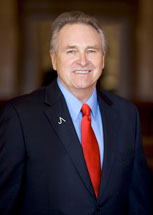
Photo of Jim Nielsen
R California Senate · District 4

Sen. Jim Nielsen

Compare
Total votes
34,147
all sessions
Attendance
94%
1,478 missed
Near the chamber average
With party
97%
of cast votes
Lower than 90% of chamber peers
Bipartisan score
2%
crosses aisle rarely
Higher than 91% of chamber peers
Sponsored
1,204
bills & resolutions
Near the chamber average
Committees
0
assignments
1,204 bills and resolutions

Sponsored bills

Total
1,204
Primary
201
Co-sponsor
1,003
This page
1,204
matching current filters
Co-sponsor SCR 99
Signed into law · California Senate · Co-sponsor
Relative to Take Our Daughters And Sons To Work Day.

This measure would declare April 28, 2022, as Take Our Daughters and Sons to Work Day, and would recognize the goals of introducing our daughters and sons to the workplace and commend all participants of Take Our Daughters And Sons To Work Day.

Signed into law May 27, 2022 1 co-sponsor
Co-sponsor AB 2820
Passed · California Assembly · Co-sponsor
The California Online Community College.

Existing law establishes the California Community Colleges, under the administration of the Board of Governors of the California Community Colleges, as one of the segments of public postsecondary education in this state. The board of governors appoints the Chancellor of the California Community Colleges as the chief executive officer of the segment. Existing law establishes the California Online Community College, under the administration of the board of governors, for purposes of creating an organized system of accessible, flexible, and high-quality online content, courses, and programs focused on providing industry-valued credentials compatible with the vocational and educational needs of Californians who are not currently accessing higher education. This bill would make the California Online Community College Act inoperative on January 1, 2024. On or before January 1, 2024, the bill would appropriate the California Online Community College's funding for specified purposes at the California Community Colleges, as provided.

Passed May 25, 2022 1 co-sponsor
Co-sponsor SB 1353
In committee · California Senate · Co-sponsor
Homeless population census information: collection and reporting.

(1) Existing law creates the California Interagency Council on Homelessness (council) and requires departments administering state programs created on or after July 1, 2017, to collaborate with the council for the purpose of adopting guidelines and regulations to incorporate core components of Housing First. Existing law defines "Housing First" as an evidence-based model that uses housing as a tool, rather than a reward, for recovery and that centers on providing or connecting homeless people to permanent housing as quickly as possible. Under existing law, Housing First providers offer services as needed and requested on a voluntary basis and do not make housing contingent on participation in services. This bill would require a local government entity to provide specified homelessness information for its jurisdiction to the council by January 1, 2025, including expenditures on homelessness programs and efforts provided to homeless persons within its jurisdiction, as well as related information regarding the funding of these services. The bill would specify how a local government would meet this requirement. This bill would require the council to develop and maintain a publicly available internet website homelessness dashboard for prescribed purposes. The bill would require the council to report to the Legislature, and post to its homelessness dashboard, information related to programs that the state has undertaken to reduce homelessness in California, including federal funding for state and local programs by January 1, 2026. The bill would require a state agency or office responsible for these programs to report data related to the programs, in a form prescribed by the council, to the council no later than January 1, 2025. The bill would require the council to perform a specified assessment of the success or failure of funded and implemented programs addressing homelessness. This bill would express that it is the intent of the Legislature that continuums of care collaborate with local government entities, state agencies, and the council to help collect the required information. The bill would repeal these provisions as of January 1, 2027. By increasing the duties of local government entities, this bill would impose a state-mandated local program. (2) The California Constitution requires the state to reimburse local agencies and school districts for certain costs mandated by the state. Statutory provisions establish procedures for making that reimbursement. This bill would provide that, if the Commission on State Mandates determines that the bill contains costs mandated by the state, reimbursement for those costs shall be made pursuant to the statutory provisions noted above.


In committee May 19, 2022 1 co-sponsor
Co-sponsor AB 1956
In committee · California Assembly · Co-sponsor
Solid waste: woody biomass: collection and conversion.

Existing law establishes the CalRecycle Greenhouse Gas Reduction Revolving Loan Program, administered by the Department of Resources Recycling and Recovery, to provide loans to reduce the emissions of greenhouse gases by promoting in-state development of infrastructure or other projects to reduce organic waste or process organic and other recyclable materials into new value-added products. This bill would create a 5-year woody biomass rural county collection and disposal pilot program, to be administered by the department. The bill would require the department, pursuant to the program, to award funding to participating counties with a total population of less than 250,000 for the purpose of conducting community collection days on which individuals could dispose of woody biomass and other source-separated biomass free of charge. The bill would require a county awarded funding under the program to contract with a local compost facility, mulch production facility, or biomass conversion facility to collect and to process or convert the biomass in a way that results in less greenhouse gas emitted than if the biomass had been disposed of. The bill would require the department to report specified program information to the Legislature after the conclusion of the program.

In committee May 19, 2022 1 co-sponsor
Co-sponsor AB 2569
In committee · California Assembly · Co-sponsor
Department of Homelessness Prevention, Outreach, and Support.

Existing law establishes various programs to provide assistance to homeless persons, including, among others, the Emergency Housing and Assistance Program and homeless youth emergency service pilot projects. Existing law also establishes the California Interagency Council on Homelessness to oversee the implementation of Housing First guidelines and regulations, and, among other things, identify resources, benefits, and services that can be accessed to prevent and end homelessness in California. This bill would require the California Health and Human Services Agency to convene a working group that includes representatives from all departments and agencies that currently receive funding relating to services for homeless individuals. The bill would require the working group to determine the best approach to creating a Department of Homelessness Prevention, Outreach, and Support and to submit its findings and recommendations to the Legislature no later than January 1, 2024. The bill would repeal these provisions on January 1, 2024.

In committee May 19, 2022 1 co-sponsor
Co-sponsor AB 2819
In committee · California Assembly · Co-sponsor
The Rural California Infrastructure Act.

Existing law, the Bergeson-Peace Infrastructure and Economic Development Bank Act, establishes the Infrastructure and Economic Development Bank (I-Bank) and authorizes it to, among other things, issue bonds, make loans, and provide other financial assistance to various types of projects that constitute economic development facilities or public development facilities. The act establishes in the State Treasury the California Infrastructure and Economic Development Bank Fund (I-Bank Fund) for the purpose of implementing the objectives and provisions of the act and continuously appropriates moneys in the fund, except as prescribed. This bill, the Rural California Infrastructure Act, would authorize the I-Bank to establish the Rural California Infrastructure Program for the purpose of making competitive grant awards to eligible local agencies for rural infrastructure projects, as prescribed. The act would require the Controller to transfer a sum of $1,000,000,000 to the Rural California Infrastructure Account in the I-Bank Fund, which the bill would create and continuously appropriate for purposes of the act. By requiring the Controller to transfer moneys from the General Fund to the Rural California Infrastructure Account for purposes of the program, the bill would make an appropriation. The act would require the I-Bank to submit a specified report to the Governor and the Legislature regarding program activity in any fiscal year that the account receives funding or in which the I-Bank administers the program.

In committee May 19, 2022 1 co-sponsor
Co-sponsor AB 2541
In committee · California Assembly · Co-sponsor
Special education: funding: deaf and hard of hearing children.

Existing law establishes the special education early intervention preschool grant, which requires the Superintendent of Public Instruction, in any year moneys are appropriated for this purpose, to allocate grant funding to school districts for preschool children with exceptional needs, as provided. Existing law requires the Superintendent to make specified computations to determine the amount of grant funding for each school district. This bill would require the Superintendent to add to that calculation an unspecified dollar amount, based on the total number of children from birth to 5 years of age, inclusive, who are deaf and hard of hearing to the amount to be apportioned to each school district in order to contract with the California Schools for the Deaf or nonprofit organizations for purposes of providing specified services to children from birth to 5 years of age, inclusive, who are deaf and hard of hearing, as provided. The bill would require this funding to be allocated to settings that offer both or one of the languages of American Sign Language and English, as defined. The bill would require the funding allocated to school districts pursuant to these provisions to be used to provide specified services to children from birth to 5 years of age, inclusive, who are deaf and hard of hearing, including for strategies to improve outcomes for deaf and hard of hearing children that involve early intensive language services and related specialized services, as provided. The bill would also make related findings and declarations regarding the need for early intervention services for deaf and hard of hearing pupils.

In committee May 19, 2022 1 co-sponsor
Co-sponsor SB 1031
In committee · California Senate · Co-sponsor
Healing arts boards: inactive license fees.

Existing law establishes healing arts boards in the Department of Consumer Affairs to ensure private businesses and professions deemed to engage in activities which have potential impact upon the public health, safety, and welfare are adequately regulated in order to protect the people of California. Existing law requires each healing arts board to issue inactive licenses to holders of active licenses whose license is not punitively restricted by that board. Existing law prohibits the holder of an inactive license from engaging in any activity for which an active license is required. Existing law requires the renewal fee for an active license to apply to an inactive license, unless the board establishes a lower fee. This bill would instead require the renewal fee for an inactive license to be 12 of the amount of the fee for a renewal of an active license, unless the board establishes a lower fee. The bill would make conforming and other nonsubstantive changes.

In committee May 19, 2022 1 co-sponsor
Co-sponsor AB 1665
Failed · California Assembly · Co-sponsor
Trafficking a minor: plea bargains.

Existing law defines the crime of human trafficking and imposes a penalty of at least 5, 8, or 12 years in state prison and a fine of not more than $500,000. This bill would prohibit plea bargaining in a case in which the indictment or information charges the crime of human trafficking and it is alleged that the victim is a minor, unless there is insufficient evidence to prove the people's case, or testimony of a material witness cannot be obtained, or a reduction or dismissal would not result in a substantial change in sentence. By increasing the penalty for a crime, this bill would impose a state-mandated local program. The California Constitution requires the state to reimburse local agencies and school districts for certain costs mandated by the state. Statutory provisions establish procedures for making that reimbursement. This bill would provide that no reimbursement is required by this act for a specified reason.

Failed May 19, 2022 1 co-sponsor
Showing 41 to 50 of 1,204 bills
Previous 1 … 4 5 6 … 121 Next