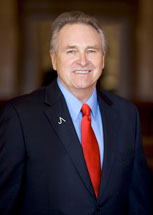
Photo of Jim Nielsen
R California Senate · District 4

Sen. Jim Nielsen

Compare
Total votes
34,147
all sessions
Attendance
94%
1,478 missed
Near the chamber average
With party
97%
of cast votes
Lower than 90% of chamber peers
Bipartisan score
2%
crosses aisle rarely
Higher than 91% of chamber peers
Sponsored
1,204
bills & resolutions
Near the chamber average
Committees
0
assignments
1,204 bills and resolutions

Sponsored bills

Total
1,204
Primary
201
Co-sponsor
1,003
This page
1,204
matching current filters
Co-sponsor SB 316
Passed · California Senate · Co-sponsor
Medi-Cal: federally qualified health centers and rural health clinics.

Existing law provides for the Medi-Cal program, which is administered by the State Department of Health Care Services, under which qualified low-income individuals receive health care services, including federally qualified health center (FQHC) services and rural health clinic (RHC) services. The Medi-Cal program is, in part, governed and funded by federal Medicaid program provisions. Existing law provides that FQHC and RHC services are to be reimbursed, to the extent that federal financial participation is obtained, to providers on a per-visit basis. "Visit" is defined as a face-to-face encounter between a patient of an FQHC or RHC and specified health care professionals, including a physician and marriage and family therapist. Under existing law, "physician," for these purposes, includes, but is not limited to, a physician and surgeon, an osteopath, and a podiatrist. This bill would authorize reimbursement for a maximum of 2 visits taking place on the same day at a single location if after the first visit the patient suffers illness or injury requiring additional diagnosis or treatment, or if the patient has a medical visit and a mental health visit or a dental visit, as defined. The bill would authorize an FQHC or RHC that currently includes the cost of a medical visit and a mental health visit that take place on the same day at a single location as a single visit for purposes of establishing the FQHC's or RHC's rate to apply for an adjustment to its per-visit rate, and after the department has approved that rate adjustment, to bill a medical visit and a mental health visit that take place on the same day at a single location as separate visits, in accordance with the bill. This bill would also include a licensed acupuncturist within those health professionals covered under the definition of a "visit." The bill would require the department, by July 1, 2022, to submit a state plan amendment to the federal Centers for Medicare and Medicaid Services to reflect certain changes described in the bill, and to seek necessary federal approvals. The bill would also make conforming and technical changes.

Passed Sep 9, 2021 1 co-sponsor
Co-sponsor SB 39
Passed · California Senate · Co-sponsor
Fraudulent claims: inmates.

Existing law provides for the payment of unemployment compensation benefits to eligible persons who are unemployed through no fault of their own through a federal-state unemployment insurance program administered by the Employment Development Department, subject to oversight by the Director of Employment Development. Under existing law, the expenses of administering the unemployment insurance program are paid from the Unemployment Administration Fund, a continuously appropriated fund. Existing law requires the Department of Justice to maintain state summary criminal history information, including the identification and criminal history of a person, including name, date of birth, social security number, physical description, fingerprints, photographs, dates of arrests, arresting agencies and booking numbers, charges, dispositions, sentencing information, and similar data about the person. Existing law requires the Attorney General to furnish this information to specified persons, agencies, or organizations, including the Department of Corrections and Rehabilitation, if needed in the course of their duties. Existing law makes it a crime for any person authorized by law to receive state summary criminal history information to knowingly furnish the information to a person who is not authorized by law to receive it. This bill would require the Department of Corrections and Rehabilitation to provide the names and social security numbers of current inmates to the Employment Development Department for the purposes of preventing payments on fraudulent claims for unemployment compensation benefits. The bill would require the Department of Corrections and Rehabilitation to provide the information to the Employment Development Department at least every 90 calendar days and upon that department's request. Because this bill would expand the group of persons who can be convicted for knowingly furnishing state summary criminal history information to unauthorized persons, it would impose a state-mandated local program. This bill would require, for the purpose of preventing payments on fraudulent claims for unemployment compensation benefits, for any unemployment compensation benefits paid on and after July 1, 2021, the Director of Employment Development to verify with the information provided by the Department of Corrections and Rehabilitation before making any payment of unemployment compensation benefits that the claimant is not an inmate currently incarcerated in the state prisons. The bill would also prohibit the department from using the information provided by the Department of Corrections and Rehabilitation unless the information of current inmates is equal to or less than 90 calendar days old. This bill would require, if the department determines a claimant is an inmate currently incarcerated in the state prisons, the department to notify the Department of Corrections and Rehabilitation and the Department of Justice of the attempt to make a fraudulent claim for unemployment compensation benefits. The bill would authorize the Employment Development Department to disseminate social security numbers to the Department of Corrections and Rehabilitation for this purpose. By expanding the purposes of a continuously appropriated fund, the bill would make an appropriation. The California Constitution requires the state to reimburse local agencies and school districts for certain costs mandated by the state. Statutory provisions establish procedures for making that reimbursement. This bill would provide that no reimbursement is required by this act for a specified reason. This bill would declare that it is to take effect immediately as an urgency statute.

Passed Aug 26, 2021 1 co-sponsor
Primary SB 491
Passed · California Senate · Lead sponsor
Cigarette and Tobacco Products Licensing Act of 2003.

Existing law makes it a misdemeanor for a person to dispense or distribute nitrous oxide to a person if the distributor knows or should know that the person is going to use the nitrous oxide for certain unlawful purposes and that person proximately causes great bodily injury or death to that person or another person. Existing law also requires a person who dispenses or distributes nitrous oxide to record each transaction involving the dispensing or distribution of nitrous oxide in a written or electronic document, as specified. This bill would require a court to order the suspension, for up to one year, of the business license of a person who knowingly violates either of those provisions after having been previously convicted of a violation of the same provision, except as specified, and would authorize the prosecuting entity to notify the California Department of Tax and Fee Administration of convictions for violations of those provisions. Existing law, the Cigarette and Tobacco Products Licensing Act of 2003, requires the California Department of Tax and Fee Administration to issue a license to a retailer to engage in the sale of cigarettes or tobacco products upon receipt of a completed application and payment of certain fees unless any of certain exceptions apply, including that the retailer, or if the retailer is not an individual, any person controlling the retailer, has been convicted of certain felonies related to evading taxes on cigarette and tobacco products. The act also subjects a license issued under the act to revocation or suspension for violations of the act and the Revenue and Taxation Code, as specified. This bill would additionally except from the requirement that the board issue a license a retailer that has been convicted of certain crimes relating to the distribution of nitrous oxide, including those described above. The bill would require the department to provide a licensee with at least 10 days' written notice of a pending suspension or revocation and an opportunity to appeal the suspension or revocation only to correct a mistake or clerical error, as specified. The bill would also additionally subject a license issued under the act to revocation or suspension for commission of those crimes.

Passed Aug 26, 2021 0 co-sponsors
Primary SB 232
Passed · California Senate · Lead sponsor
Employment Development Department: policies and practices.

Existing law requires the Employment Development Department to administer a program for the payment of unemployment compensation to the eligible unemployed. Existing law requires the department to periodically review policies and practices used to determine eligibility and benefits that result in delayed eligibility unemployment determinations or benefit payments and that fail to identify or prevent fraud. Existing law requires the director of the department to report the results of the first review to the Legislature on or before July 1, 2015, and authorizes the submission of subsequent reports. This bill would require the Employment Development Department to take various actions in response to recommendations by the California State Auditor regarding the timely issuance of unemployment insurance benefits and the reduction of fraud associated with the payment of those benefits. Among other things, the bill would require the department, on or before May 31, 2022, to identify elements of the Benefit Modernization System IT project and to prioritize implementing these elements. The bill would also require the department, on or before May 31, 2022, to implement a policy establishing a process for tracking and analyzing the reasons why unemployment insurance claimants call for assistance. On or before October 31, 2022, and every 6 months thereafter, the bill would require the department to analyze the data to improve call center performance, as specified. The bill would require the department to provide the Legislature with a plan for assessing the effectiveness of its fraud prevention and detection tools by May 1, 2022, and to provide a report to the Legislature with an update on its progress on performing this analysis by July 1, 2022. The bill would require the department to designate a unit that is responsible for coordinating all unemployment insurance fraud prevention and detection efforts, as specified.

Passed Aug 26, 2021 0 co-sponsors
Co-sponsor SB 58
Passed · California Senate · Co-sponsor
Personal information: social security numbers: state agencies: Employment Development Department: fraud prevention.

Existing law prohibits a state agency from sending any outgoing United States mail to an individual that contains personal information about that individual, including, but not limited to, the individual's social security number, telephone number, driver's license number, or credit card account number, unless that personal information is contained within sealed correspondence and cannot be viewed from the outside of that sealed correspondence. Existing law, commencing on or before January 1, 2023, prohibits a state agency from sending any outgoing United States mail that contains an individual's social security number unless the number is truncated to its last 4 digits or in specified circumstances. This bill would instead require, as soon as feasible, but not later than January 1, 2023, a state agency to stop sending any outgoing United States mail that contains an individual's social security number unless the number is truncated to its last 4 digits or in specified circumstances. The bill, commencing on or before October 1, 2021, would prohibit, with exceptions, the Employment Development Department from sending any outgoing United States mail to an individual containing the individual's social security number, unless that social security number is replaced with a modified unique identifier or the number is truncated to its last 4 digits. Existing law creates, in the Labor and Workforce Development Agency, the Employment Development Department, which is vested with the duties, purposes, responsibilities, and jurisdiction with respect to job creation activities. Existing law requires the Director of Employment Development to periodically review policies and practices used to determine eligibility for and the amount of benefits in the unemployment insurance program to identify those policies and practices doing certain things, including, but not limited to, providing little or no value in identifying or preventing fraud or abuse in the unemployment insurance program. This bill would require the department, on or before January 1, 2022, to identify the fraud prevention efforts it can adjust to improve effectiveness during periods of high demand for benefits. The bill would also require the department, on or before January 1, 2022, using existing resources, to designate a single unit responsible for coordinating fraud prevention and align the unit's duties with best practices for detecting and preventing fraud. This bill would declare that it is to take effect immediately as an urgency statute.


Passed Aug 26, 2021 1 co-sponsor
Co-sponsor AB 1039
Passed · California Assembly · Co-sponsor
Model curricula: Vietnamese American refugee experience, the Cambodian genocide, and Hmong history and cultural studies.

Existing law requires the Instructional Quality Commission to develop and submit to the State Board of Education, on or before December 31, 2022, and the state board to adopt, modify, or revise or reject, as prescribed, on or before March 31, 2023, a model curriculum relative to (1) the Vietnamese American refugee experience, (2) the Cambodian genocide, and (3) Hmong history and cultural studies, as specified, for use in elementary schools, middle schools, and high schools. Existing law requires implementation of these provisions to be subject to the receipt of grants, donations, or other financial support from private or public sources for its purposes, including, but not limited to, an appropriation in the annual Budget Act or another statute. This bill instead would extend the timelines for the development and submission by the commission of, and the adoption, modification, or revision by the state board of, the above-described model curricula by 4 years.

Passed Aug 26, 2021 1 co-sponsor
Co-sponsor SCR 28
Signed into law · California Senate · Co-sponsor
Relative to the Korean War Veterans Memorial Highway.

This measure would designate a specified portion of State Highway Route 37 as the Korean War Veterans Memorial Highway. The measure would request that the Department of Transportation determine the cost of appropriate signs showing this special designation and, upon receiving donations from nonstate sources covering that cost, erect those signs.

Signed into law Jul 9, 2021 1 co-sponsor
Showing 111 to 120 of 1,204 bills
Previous 1 … 11 12 13 … 121 Next