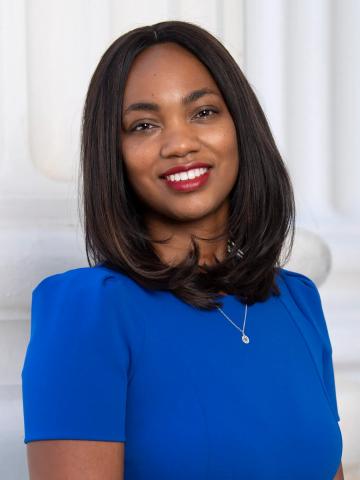
Photo of Akilah Weber Pierson
D California Senate · District 39

Sen. Akilah Weber Pierson

Compare
Total votes
16,856
all sessions
Attendance
95%
601 missed
Near the chamber average
With party
99%
of cast votes
Near the chamber average
Bipartisan score
0%
crosses aisle rarely
Near the chamber average
Sponsored
1,097
bills & resolutions
Near the chamber average
Committees
11
assignments
1,097 bills and resolutions

Sponsored bills

Total
1,097
Primary
135
Co-sponsor
962
This page
1,097
matching current filters
Co-sponsor SCR 88
Signed into law · California Senate · Co-sponsor
Relative to California Wines: Down to Earth Month.

This measure would proclaim, in perpetuity, the month of April as California Wines: Down to Earth Month, to celebrate the sustainable leadership of California wineries and winegrape growers throughout the month of April.

Signed into law May 24, 2022 1 co-sponsor
Co-sponsor AB 35
Signed into law · California Assembly · Co-sponsor
Civil damages: medical malpractice.

Existing law, referred to as the Medical Injury Compensation Reform Act of 1975 (MICRA) , prohibits an attorney from contracting for or collecting a contingency fee for representing any person seeking damages in connection with an action for injury or damage against a health care provider based upon alleged professional negligence in excess of specified limits. This bill would recast those provisions and base the amount of contingency fee that may be contracted for upon whether recovery is pursuant to settlement agreement and release of all claims executed before a civil complaint or demand for arbitration is filed, or pursuant to settlement, arbitration, or judgment after a civil complaint or demand for arbitration is filed, as specified. The bill would add and revise definitions for these purposes. Existing law provides that in any action against a health care provider based upon professional negligence, the injured plaintiff is entitled to recover noneconomic losses to compensate for pain, suffering, inconvenience, physical impairment, disfigurement, and other nonpecuniary damage. Existing law limits the amount of damages for noneconomic losses in an action for injury against a health care provider based on professional negligence to $250,000. This bill would remove the $250,000 limit on noneconomic damages and expand the recast provisions to include an action for injury against a health care institution, as defined. The bill would increase the applicable limitation based upon whether the action for injury involved wrongful death. The bill would specify that these limitations would increase by $40,000 each January 1st for 10 years and beginning on January 1, 2034, the applicable limitations on noneconomic damages for personal injury and for wrongful death would be adjusted for inflation on January 1st of each year by 2%. Existing law specifies that in any action for injury or damages against a provider of health care services, a superior court shall, at the request of either party, enter a judgment ordering that money damages or its equivalent for future damages of the judgment creditor be paid in whole or in part by periodic payments rather than by a lump-sum payment if the award equals or exceeds $50,000. This bill would increase the minimum amount of the judgment required to request periodic payments to $250,000. Existing law makes statements, writings, or benevolent gestures expressing sympathy or a general sense of benevolence relating to the pain, suffering, or death of a person involved in an accident and made to that person, or to the family of that person, inadmissible as evidence of an admission of liability in a civil action. This bill would specify that statements, writings, or benevolent gestures expressing sympathy, regret, a general sense of benevolence, or suggesting, reflecting, or accepting fault relating to the pain, suffering, or death of a person, or to an adverse patient safety event or unexpected health care outcome, as specified, shall be confidential, privileged, protected, not subject to subpoena, discovery, or disclosure, and shall not be used or admitted into evidence in any civil, administrative, regulatory, licensing, or disciplinary board, agency, or body action or proceeding, and shall not be used or admitted in relation to any sanction, penalty, or other liability, as evidence of an admission of liability or for any other purpose.

Signed into law May 23, 2022 1 co-sponsor
Co-sponsor AB 2549
In committee · California Assembly · Co-sponsor
Street harassment prevention.

Existing law requires the State Department of Public Health, through its Office of Health Equity, to perform strategic planning relating to gaps in health status and access to care among the state's diverse racial and ethnic communities, women, persons with disabilities, and the lesbian, gay, bisexual, transgender, queer, and questioning communities. Existing law requires the office to report to the Legislature on its activities on multicultural health. Existing law makes it unlawful to, by force or threat of force, willfully injure, intimidate, interfere with, oppress, or threaten any other person in whole or in part because of one or more of certain actual or perceived characteristics of the victim, as specified. Existing law also sets forth various criminal or civil penalties for different offenses involving certain forms of harassment. This bill would require the department to conduct research and a 5-year, statewide, public campaign to raise awareness and understanding of street harassment as a public health problem in the state with the purpose of preventing its occurrence. The bill would define "street harassment" as words, gestures, or actions directed at a specific person in a public place, as defined, without the consent of that person, based on the person's actual or perceived race, color, ethnic group identification, ancestry, national origin, religion, mental disability, physical disability, medical condition, genetic information, age, marital status, sex, gender, gender identity, gender expression, or sexual orientation, that the person experiences as intimidating, alarming, terrorizing, or threatening to their safety. The bill would make related legislative findings. The bill would require the department to conduct the research through surveys and focus groups, identifying subpopulations at disproportionate risk of experiencing street harassment. The bill would require the department to prepare 2 reports, proposing strategies and policies to prevent and respond to street harassment, as specified. The bill would require the department to submit the reports to the Legislature and the Governor, and to publish them on the department's internet website, no later than January 1, 2024, for the first report, and no later than June 30, 2027, for the 2nd report. The bill would require the department to commence the public campaign on January 1, 2023, conducting it online and in physical locations. The bill would require the department to, among other things, develop culturally relevant content, annually evaluate the effectiveness of the campaign, and prepare and publish on its internet website an annual report describing the campaign's activities, effectiveness, and gaps, as specified.


In committee May 19, 2022 1 co-sponsor
Primary AB 2458
In committee · California Assembly · Lead sponsor
California Children's Services: reimbursement rates.

Existing law establishes the California Children's Services (CCS) Program, administered by the State Department of Health Care Services and a designated agency of each county, to provide medically necessary services for persons under 21 years of age who have any of specified medical conditions and who meet certain financial eligibility requirements. Existing law establishes the Medi-Cal program, which is administered by the department and under which qualified low-income individuals receive health care services. Existing law requires that provider rates of payment for services rendered in the CCS Program be identical to the rates of payment for the same service performed by the same provider type pursuant to the Medi-Cal program. Notwithstanding that requirement, existing law authorizes the reimbursement of services provided under the CCS Program at rates greater than the Medi-Cal rate that would otherwise be applicable if those rates are adopted by the Director of Health Care Services in regulations. Existing law establishes a Whole Child Model program for Medi-Cal eligible CCS children and youth enrolled in a Medi-Cal managed care plan served by a county organized health system or Regional Health Authority in specified counties. Existing law requires the department to pay a participating managed care plan a certain rate, and requires the plan to pay physician and surgeon provider services at rates that are equal to or exceed the applicable CCS fee-for-service rates, except as specified. Physician services provided under the CCS Program are currently reimbursed at rates that are 39.7% greater than the applicable Medi-Cal rates. This bill would make legislative findings relating to the need for an increase in the reimbursement rates for physician services provided under the CCS Program. Under the bill, subject to an appropriation, and commencing January 1, 2023, those reimbursement rates would be increased by adding at least 25% to the above-described augmentation percentage relative to the applicable Medi-Cal rates. The bill would make the rate increase applicable only if the services are provided by a physician in a practice in which at least 30% of the practice's pediatric patients are Medi-Cal beneficiaries. The bill would, no later than January 1, 2026, and every 3 years thereafter, require the department to complete a review of those reimbursement rates, including whether the department recommends an increase in the rates, as specified. The bill would require that the reviews contain data disaggregated by rural or urban area, ZIP Code, and satellite clinic providing CCS services. The bill would require the department to submit reports of the reviews and any recommendations to the legislative health committees.

In committee May 19, 2022 0 co-sponsors
Co-sponsor AB 1690
In committee · California Assembly · Co-sponsor
Tobacco products: single-use electronic cigarettes.

Under existing law, the Stop Tobacco Access to Kids Enforcement Act, an enforcing agency, as defined, may assess civil penalties against any person, firm, or corporation that sells, gives, or furnishes specified tobacco and cigarette related items, including cigarette papers, to a person who is under 21 years of age, except as specified. The existing civil penalties range from $400 to $600 for a first violation, up to $5,000 to $6,000 for a 5th violation within a 5-year period. Existing law prohibits the sale, distribution, or nonsale distribution of tobacco products directly or indirectly to any person under 21 years of age through the United States Postal Service or other public or private postal or package delivery service. Under existing law, a district attorney, city attorney, or the Attorney General may assess civil penalties against a violator of not less than $1,000 or more than $2,000 for the first violation and up to $10,000 for a 5th or subsequent violation within a 5-year period. Under existing law, every person, firm, or corporation that knowingly or under circumstances in which it has knowledge, or should otherwise have grounds for knowledge, sells, gives, or furnishes a cigarette, among other specified items, to another person who is under 21 years of age is, except as specified, subject to either a criminal action for a misdemeanor or to a civil action brought by a city attorney, a county counsel, or a district attorney, punishable by a fine of $200 for the first offense, $500 for the 2nd offense, and $1,000 for the 3rd offense. This bill would prohibit a person or entity from selling, giving, or furnishing to another person of any age in this state a single-use electronic cigarette, as defined, except as specified. The bill would prohibit that selling, giving, or furnishing, whether conducted directly or indirectly through an in-person transaction, or by means of any public or private method of shipment or delivery to an address in this state. This bill would authorize a city attorney, county counsel, or district attorney to assess a $500 civil fine against each person determined to have violated those prohibitions in a proceeding conducted pursuant to the procedures of the enforcing agency, as specified. This bill would make its provisions operative on January 1, 2024.

In committee May 16, 2022 1 co-sponsor
Co-sponsor AJR 28
Signed into law · California Assembly · Co-sponsor
Relative to Bernard B. James.

This measure would respectfully memorialize the President of the United States and the Congress of the United States to take action to restore honor to Bernard B. James, and to take the necessary actions to ensure the treatment of Bernard B. James is rectified by a full exoneration, including having the military record of Bernard B. James cleared of any court judgment and less-than-honorable discharge.

Signed into law May 13, 2022 1 co-sponsor
Co-sponsor SCR 39
Signed into law · California Senate · Co-sponsor
Relative to the Officer Tommy Scott Memorial Highway.

This measure would designate a specified portion of Interstate Highway Route 405 in the County of Los Angeles as the Officer Tommy Scott Memorial Highway. The measure would request that the Department of Transportation determine the cost of appropriate signs showing this special designation and, upon receiving donations from nonstate sources covering that cost, erect those signs.

Signed into law May 13, 2022 1 co-sponsor
Showing 871 to 880 of 1,097 bills
Previous 1 … 87 88 89 … 110 Next