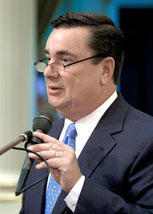
This measure would proclaim July 27, 2013, as Korean War Armistice Day. It would urge Californians to observe the anniversary and call upon them to honor and give thanks to Korean War veterans. It would also urge Governor Jerry Brown to proclaim July 27, 2013, as Korean War Armistice Day and instruct all state departments, agencies, interest groups, organizations, and individuals to fly the United States flag at half-mast on July 27, 2013, in memory of veterans from this state who died as a result of their service in Korea.
Sponsored bills
Existing law provides that a prosecuting witness in the prosecution of a case involving murder, kidnapping, and certain sex offenses, among other specified offenses, is entitled, for support, to the attendance of up to 2 persons of his or her own choosing at the preliminary hearing and at the trial or juvenile court proceeding during the testimony of the prosecuting witness, as specified. This bill would extend these provisions to include cases involving attempted violations of the above-described offenses, and would expand the list of offenses that a witness is entitled to support to include kidnapping with the intent to commit robbery or specified sex offenses, certain sex offenses involving a minor under 10 years of age, criminal threats, and stalking. Existing law requires courts to take special precautions to provide for the comfort and protection of a person with a disability or a minor under 11 years of age when that person is testifying in criminal proceedings alleging certain sex offenses committed with or upon that person. The court may, among other things, allow the witness reasonable periods of relief and relocate parties within the courtroom. This bill would extend these provisions to include cases involving attempted violations of the above-described offenses, and would expand the list of offenses that special precautions apply to include kidnapping with the intent to commit robbery or specified sex offenses, assault with intent to commit certain felonies, human trafficking, aggravated sexual assault of a child, certain sex offenses involving a minor under 10 years of age, criminal threats, and stalking.
(1) Existing law prohibits a permanent school employee from being dismissed except for one or more specified causes. This bill would prohibit a collective bargaining agreement entered into or renewed on or after January 1, 2014, from requiring the removal, after a specified time period, from an employee's record of records pertaining to discipline, complaints, reprimands, or investigations relating to the employee's commission, or potential commission, of one of those specified causes for dismissal. (2) Existing law authorizes a governing board of a school district to give notice to a permanent employee of its intention to dismiss or suspend him or her for specified causes at the expiration of 30 days from the date of service of the notice, unless the employee demands a hearing. Existing law prohibits that notice from being given between May 15th and September 15th in any year. This bill would remove that prohibition. (3) Existing law prohibits the governing board of a school district from acting upon any charges of unprofessional conduct, or unsatisfactory performance, unless at least 45, or 90, calendar days, respectively, prior to the date of the filing of the charges the governing board, or its authorized representative, has given the employee written notice, as specified. This bill would remove those 45-day and 90-day requirements of written notice to the charged employee. (4) Existing law establishes a Commission on Professional Competence for each dismissal or suspension hearing requested by an employee, consisting of specified members, and requires the proceeding to be conducted in accordance with the Administrative Procedure Act. Existing law deems the decision of the Commission on Professional Competence to be the final decision of the governing board of the school district. This bill would delete the provisions providing for the establishment of a Commission on Professional Competence, and would instead require the proceedings to be conducted pursuant to the Administrative Procedure Act by an administrative law judge. The bill would require that the administrative law judge or, for a dismissal proceeding where the charges against the employee do not involve sex, drugs, or violence against children, a panel composed of the judge and 2 certificated employees, acting by a majority vote, propose a decision. The bill would provide that the decision of the administrative law judge or panel would be advisory, and the final decision regarding the discipline of the employee would be determined by action of the governing board of the school district. The bill would provide that an employee requesting a hearing may be placed on administrative leave without pay, and that an employee who is placed on administrative leave would be required to be paid his or her regular salary if he or she furnishes to the school district acceptable security, as specified. By increasing the duties of a governing board in this regard, this bill would impose a state-mandated local program. (5) Existing law prohibits testimony from being given or evidence being introduced at the hearing relating to matters that occurred more than 4 years prior to the date of the filing of the notice of dismissal or suspension. This bill would remove that 4-year limitation. (6) This bill would make additional changes that are nonsubstantive and conforming. (7) The California Constitution requires the state to reimburse local agencies and school districts for certain costs mandated by the state. Statutory provisions establish procedures for making that reimbursement. This bill would provide that, if the Commission on State Mandates determines that the bill contains costs mandated by the state, reimbursement for those costs shall be made pursuant to these statutory provisions.
(1) Existing law, the 2011 Realignment Legislation addressing public safety and related statutes, requires that certain specified felonies be punished by a term of imprisonment in a county jail for 16 months, or 2 or 3 years, and provides for postrelease community supervision by county officials for persons convicted of certain specified felonies upon release from prison or county jail. As part of the realignment of public safety services to local agencies, existing law establishes the Local Revenue Fund 2011 into which specified tax revenues are deposited and are continuously appropriated for the provision of public safety services, as defined. This bill, the 2013 Realignment Legislation addressing justice reinvestment, would establish the Realignment Reinvestment Fund in the State Treasury as a continuously appropriated fund. The bill would require the Director of Finance, in consultation with the Legislative Analyst, to annually calculate the net savings to the state for the prior fiscal year and an estimate of the net current fiscal year savings resulting from the 2011 Realignment Legislation addressing public safety, as specified. The bill would require the Controller to transfer $819,857,000 from the General Fund to the Realignment Reinvestment Fund for the 2013–14 fiscal year, thereby making an appropriation. The bill would, beginning in the 2014–15 fiscal year, and each fiscal year thereafter, require the Controller to transfer an amount equal to the estimate of net current fiscal year savings resulting from the 2011 Realignment Legislation addressing public safety, adjusted by the difference between the preceding year's estimate and the calculated prior fiscal year net savings, thereby making an appropriation. The bill would require the Controller to annually allocate moneys in the Realignment Reinvestment Fund, no later than September 1 of each year, to each county for deposit in the county's Realignment Reinvestment Services Account proportionally, based on the average daily population of realigned offenders under each county's supervision for the preceding fiscal year. The bill would require the Controller to consult with the Board of State and Community Corrections to determine the average daily population for each county. The bill would require a Realignment Reinvestment Services Account to be established in each county treasury. The bill would require the moneys to implement a comprehensive, locally run, supplemental community-based corrections plan, as specified. The bill would require the supplemental community-based corrections plan to be developed by each county's local Community Corrections Partnership and to be voted on by an executive committee of each county's Community Corrections Partnership, as specified. The bill would deem the supplemental community-based corrections plan accepted by the county board of supervisors unless the board rejects the plan by a 45 vote. The bill would require each county or city and county to annually report to the county board of supervisors and the Board of State and Community Corrections on the programs funded pursuant to these provisions, as specified. By imposing additional duties on local officials, this bill would impose a state-mandated local program. The bill would require the Director of Finance, in consultation with the Legislative Analyst, to develop a yearly estimate of the cost avoidances expected to be realized by the Department of Corrections and Rehabilitation that are a result of the 2011 Realignment Legislation, and would require the director to report those estimates to the Legislature, as provided. The bill would require that moneys allocated from a Realignment Reinvestment Services Account be expended exclusively for purposes of the bill's provisions. The bill would require that funds received pursuant to its provisions be expended or encumbered no later than June 30 the following year, and would require unspent moneys to be remitted for deposit in the Realignment Reinvestment Fund. (2) The California Constitution requires the state to reimburse local agencies and school districts for certain costs mandated by the state. Statutory provisions establish procedures for making that reimbursement. This bill would provide that, if the Commission on State Mandates determines that the bill contains costs mandated by the state, reimbursement for those costs shall be made pursuant to these statutory provisions.
This measure would designate April 7 to 13, 2013, inclusive, as Cancer Prevention Week, and would encourage individuals to participate in the Cancer Prevention Study - 3.
Existing law establishes the Dealers' Record of Sale Special Account in the General Fund with moneys in the account available upon appropriation by the Legislature. Existing law requires the Attorney General to establish and maintain an online database to be known as the Prohibited Armed Persons File, sometimes referred to as the Armed Prohibited Persons System, to cross-reference persons who have ownership or possession of a firearm with those who are prohibited from owning or possessing a firearm. This bill would appropriate $24,000,000 from the Dealers' Record of Sale Special Account to the Department of Justice to address the backlog in the Armed Prohibited Persons System, thereby making an appropriation. The bill would require the department to report to the Joint Legislative Budget Committee regarding ways the backlog in the Armed Prohibited Persons System has been reduced or eliminated, as specified. The bill would make related findings and declarations. This bill would declare that it is to take effect immediately as an urgency statute.
This measure would recognize the contributions of the aerospace industry to the history, economy, security, and educational system of California, its communities, and its citizens by proclaiming the month of March 2013 as California Aerospace Month.
Existing law imposes on the State Department of Public Health various duties and responsibilities regarding the regulation of clinics and health facilities, including general acute care hospitals, as defined. Existing law requires a general acute care hospital to annually offer onsite influenza vaccinations, if available, to all hospital employees. Existing law requires a general acute care hospital to require its employees to be vaccinated, or if the employee elects not to be vaccinated, to declare in writing that he or she declined the vaccination. A violation of these provisions is punishable as a misdemeanor. This bill would require clinics, as defined, and health facilities to institute measures, including aerosol transmissible diseases training, designed to maximize influenza vaccination rates and to prevent onsite health care workers affiliated with the clinic or health facility and persons with privileges on the medical staff from contracting, and transmitting to patients, the influenza virus. This bill would provide that a clinic includes a licensed clinic, a clinic conducted, operated, or maintained as an outpatient department of a hospital, or an outpatient setting, as defined. This bill would require each clinic and health facility to annually offer onsite influenza vaccinations to its employees and to require its onsite health care workers affiliated with the clinic or health facility, as defined, and persons with privileges on the medical staff, as defined, to be vaccinated. This bill would require each clinic and health facility to annually record its vaccination rate, as defined, for each year and to make those records available online or upon request. This bill would require clinics and health facilities to maintain vaccination records of their employees and permit clinics and health facilities to require documentation of vaccination or vaccination refusal from an onsite health care worker or person with privileges on the medical staff. By increasing the responsibilities of clinics and health facilities, and adding instances where a clinic or health facility could be subject to a misdemeanor, this bill would expand the definition of a crime and would impose a state-mandated local program. This bill would also require each clinic and health facility to develop policies to implement these provisions and to ensure nonmedical staff, as defined, compliance with vaccination requirements. This bill would require the medical staff to develop separate policies to ensure compliance with vaccination requirements imposed by the clinic or health facility. This bill would require, commencing January 1, 2015, each clinic and health facility to have a 90% or higher vaccination rate. The bill would require the department, by July 1, 2015, to develop a model mandatory vaccination policy, as specified, and for each year a clinic or health facility does not achieve the 90% or higher vaccination rate, would require the clinic or health facility to adopt the model mandatory vaccination policy for the following influenza season. Existing law establishes the Medical Board of California which approves accrediting agencies of outpatient settings. Existing law permits outpatient settings to apply to an accreditation agency for a certificate of accreditation. Existing law requires every outpatient setting which is accredited to be inspected by the accreditation agency. This bill would require an accrediting agency to ensure that an outpatient setting to which it has issued a certificate is in compliance with these provisions. The California Constitution requires the state to reimburse local agencies and school districts for certain costs mandated by the state. Statutory provisions establish procedures for making that reimbursement. This bill would provide that no reimbursement is required by this act for a specified reason.

Existing law specifies the procedures for the forfeiture and exoneration of a bail bond, including requiring a court to direct the order of forfeiture to be vacated and the bond exonerated if the defendant appears in court within 180 days of the date of forfeiture or within 180 days of the date of mailing of a specified notice, if required. Existing law requires a court to vacate the forfeiture and exonerate the bond if the defendant is arrested on the underlying case or surrendered by the bail outside the county where the case is located. This bill would authorize a court, in its discretion, to vacate the forfeiture and exonerate the bond if a person appears in court after the 180-day period ends if the person was arrested on the same case within the county where the case is located during the 180-day period and has been in continuous custody from the time of arrest until his or her appearance in court. The bill would authorize, upon showing of good cause and within 20 days from the mailing of notice of entry of judgment, the filing of a motion to vacate the forfeiture and exonerate the bond where the defendant is secured outside the county where the case is filed, as provided above. The bill would require written notice to the prosecuting agency at least 10 court days before a hearing regarding either of these motions.
Existing law provides that, in addition to any other remedy authorized by law, when a spouse is convicted of attempting to murder the other spouse or of soliciting the murder of the other spouse, the injured spouse shall be entitled to 100% of the community property interest in his or her retirement and pension benefits, and a prohibition of specified support or insurance benefits from the injured spouse to the convicted spouse. Existing law defines "injured spouse" for these purposes. Under existing law, a family court is required to consider specified factors in ordering spousal support, including the criminal conviction of an abusive spouse. This bill would expand the above-described provisions to apply when a spouse is convicted of a specified violent sexual felony against the other spouse, and would require the court to consider the convicted spouse's criminal conviction for a violent sexual felony in ordering spousal support, as specified. The bill would also require the court to order the attorney's fees and costs to be paid from the community assets if warranted by economic circumstances. Under the bill, the injured spouse, as defined, would not be required to pay any of the convicted spouse's attorney's fees out of his or her separate property. The bill would further, at the request of the injured spouse, define the date of the parties' legal separation as the date of the incident giving rise to the conviction, or earlier if the court finds that the circumstances justify an earlier date, for community property purposes.