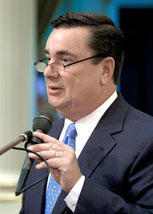
Photo of Joel Anderson
R California Senate · District 38

Sen. Joel Anderson

Compare
Total votes
26,170
all sessions
Attendance
96%
801 missed
Near the chamber average
With party
94%
of cast votes
Lower than 93% of chamber peers
Bipartisan score
4%
crosses aisle rarely
Higher than 92% of chamber peers
Sponsored
925
bills & resolutions
Near the chamber average
Committees
0
assignments
925 bills and resolutions

Sponsored bills

Total
925
Primary
226
Co-sponsor
699
This page
925
matching current filters
Primary SB 849
Failed · California Senate · Lead sponsor
Decedents' estates: electronic mail.

Existing law prescribes a process for the appointment of a personal representative for the purpose of administering the estate of a decedent. Existing law grants to the personal representative certain powers, including the right to possess and control the property of the decedent to be administered in the estate, and limits the liability of a personal representative for actions taken in good faith in connection with real or personal property. This bill would authorize the personal representative to request, and would authorize an electronic communication service or remote computer service to provide, access to the electronic mail account of a decedent or to copies of the content of the account, subject to any applicable service agreement. To exercise this right, the bill would require the personal representative to provide the account's service provider with a certified copy of the court order appointing the personal representative, a copy of the decedent's death certificate, a written request for access or copies, and an order of the probate court designating the executor or administrator as an agent for the subscriber and requiring the estate to indemnify the electronic communication service or remote computing service from all liability in complying with the order.

Failed Nov 30, 2014 0 co-sponsors
Co-sponsor SCR 116
Failed · California Senate · Co-sponsor
California Peace Officers' Memorial Day.

This measure would designate Monday, May 5, 2014, as California Peace Officers' Memorial Day, urge all Californians to use that day to honor California peace officers, and recognize specified California peace officers who were killed in defense of their communities.

Failed Nov 30, 2014 1 co-sponsor
Co-sponsor AB 2180
Failed · California Assembly · Co-sponsor
Business filings: statement of information.

Existing law requires a corporation, a nonprofit public benefit corporation, a nonprofit mutual benefit corporation, a nonprofit religious corporation, a consumer cooperative corporation, other specified corporations, a limited liability company, and a credit union, to file a return with the Franchise Tax Board within a specified period following the close of its taxable year, except as otherwise specifically provided, and to file annually or biennially, as provided, a statement with the Secretary of State containing specified information during the calendar month during which the organization's original articles were filed or during the immediately preceding 5 calendar months. Existing law requires the Secretary of State to provide notice to each organization to comply with this provision approximately 3 months prior to the close of the applicable filing period. This bill would instead require those corporations, limited liability companies, and credit unions to file the statement with the Secretary of State during the calendar month of, or within the 5 months preceding, the organization's due date for filing its return, excluding extensions, with the Franchise Tax Board or if no return is required, by May 15, as provided.

Failed Nov 30, 2014 1 co-sponsor
Primary SCA 13
Failed · California Senate · Lead sponsor
A resolution to propose to the people of the State of California an amendment to the Constitution of the State, by amending Sections 2, 11, and 12 of Article VI thereof, relating to courts.

The California Constitution establishes the jurisdiction of the courts, providing that the Supreme Court has appellate jurisdiction when judgment of death has been pronounced. The California Constitution provides that courts of appeal have appellate jurisdiction when superior courts have original jurisdiction in causes of a type within the appellate jurisdiction of the courts of appeal on June 30, 1995, and in other causes prescribed by statute. This measure would, instead, establish appellate jurisdiction in the courts of appeal in cases when judgment of death has been pronounced. The California Constitution authorizes the Supreme Court to review the decision of a court of appeal in any cause. Concurrence of 4 judges present at the argument is necessary for a judgment. This measure would require the Supreme Court to review the decision of a court of appeal in a capital case on an issue necessary to the judgment on which the court of appeal panel was not unanimous, and would authorize the Supreme Court to review other issues in that case. The measure would authorize the Supreme Court to decide the case upon the concurrence of 4 judges without oral argument if the Supreme Court is required to review the decision of a court of appeal on an issue necessary to the judgment on which the court of appeal panel was not unanimous and does not grant review of any additional issues.

Failed Nov 30, 2014 0 co-sponsors
Co-sponsor AB 1924
Failed · California Assembly · Co-sponsor
Public postsecondary education: Baccalaureate Degree Pilot Program.

(1) Existing law establishes a system of public elementary and secondary schools operated by local educational agencies throughout the state. Existing law also establishes a system of public postsecondary education in this state that includes 3 segments: the California Community Colleges, the California State University, and the University of California. This bill would express the intent of the Legislature to establish a pilot program with the goal of creating a model of articulation and coordination among K–12 schools, community colleges, and campuses of the California State University that will allow students to earn a baccalaureate degree for a total cost as close as possible to $12,000. The bill would establish a Baccalaureate Degree Pilot Program that would include campuses of the California State University, community college districts, and county offices of education in up to 7 areas of the state, but would only include institutions that explicitly request inclusion in the program. The bill would require the public postsecondary educational institutions and local educational agencies participating in the pilot program to coordinate their efforts to expedite the progress of participating students from high school to community college to California State University. Because the bill would impose new duties on community college districts and county offices of education, it would constitute a state-mandated local program. The bill would authorize participating high school students to earn an unlimited number of Advanced Placement course credits, and provide these students with priority enrollment at participating community colleges. The bill would impose grade point average and time requirements on participating students at the community college stage of the pilot program. The bill would require a participating California State University campus to accept a minimum of 60 semester units earned by a participating student at a high school or community college. The bill would require a participating student to receive priority enrollment status at a participating California State University, and would require the participating student to enroll at that California State University either in the summer term or the fall semester immediately succeeding the pupil's completion of the required community college coursework. This bill would limit bachelor's degrees awarded at the participating California State University to a participating student to baccalaureate degrees in one or more of specified fields of study. The bill would prohibit the mandatory systemwide fees and tuition and mandatory campus-based fees charged to a participating student from being increased during the first 2 academic years of his or her attendance at a California State University campus under the pilot program. The bill would authorize the institutions participating in the pilot program, in consultation with the appropriate private entities, to develop summer internships for participating students relating to their fields of study for academic credit. (2) The California Constitution requires the state to reimburse local agencies and school districts for certain costs mandated by the state. Statutory provisions establish procedures for making that reimbursement. This bill would provide that no reimbursement is required by this act for a specified reason.

Failed Nov 30, 2014 1 co-sponsor
Primary SCA 14
Failed · California Senate · Lead sponsor
A resolution to propose to the people of the State of California an amendment to the Constitution of the State, by amending Section 5 of Article II thereof, relating to elections.

Existing provisions of the California Constitution provide for a voter-nominated primary election for each congressional and state elective office in California, in which a voter may vote at the primary election for any candidate for a congressional or state elective office without regard to the political party preference disclosed by the candidate or the voter. Under the California Constitution, the candidates receiving the 2 highest vote totals for each voter-nominated office at a primary election, regardless of party preference, compete for the office at the ensuing general election. This measure would provide that, if a candidate for State Senator or Member of the Assembly receives at least a majority of the votes cast for the office in a voter-nominated primary election, the candidate would be declared elected, and no general election would be held for that office.

Failed Nov 30, 2014 0 co-sponsors
Co-sponsor SJR 31
Failed · California Senate · Co-sponsor
Immigration: unaccompanied minors.

This measure would urge the President and Congress of the United States to take specified action and adopt specified policies designed to protect unaccompanied minors immigrating to the United States.

Failed Nov 30, 2014 1 co-sponsor
Primary SB 974
Failed · California Senate · Lead sponsor
California Health Benefit Exchange.

Existing federal law, the federal Patient Protection and Affordable Care Act (PPACA) , enacts various health care coverage market reforms that take effect January 1, 2014. Among other things, PPACA requires each health insurance issuer that offers health insurance coverage in the individual or group market in a state to accept every employer and individual in the state that applies for that coverage and to renew that coverage at the option of the plan sponsor or the individual. PPACA also requires each state to, by January 1, 2014, establish an American Health Benefit Exchange that facilitates the purchase of qualified health plans by qualified individuals and qualified small employers, as specified. Existing law establishes the California Health Benefit Exchange (Exchange) within state government, specifies the powers and duties of the board governing the Exchange, and requires the board to facilitate the purchase of qualified health plans through the Exchange by qualified individuals and small employers. Existing law requires the board, among other things, to determine the criteria and process for eligibility, enrollment, and disenrollment of enrollees and potential enrollees in the Exchange and coordinate that process with state and local government entities administering other specified health care coverage programs, as specified. This bill would additionally require the board, without unreasonable delay, to allow an applicant to indicate in an application for health care coverage whether or not the applicant would like assistance with completing the application from an Exchange certified insurance agent or certified enrollment counselor. The bill would prohibit the Exchange from disclosing any personal information, as defined, that was obtained from the application for health care coverage to a certified insurance agent or certified enrollment counselor until the Exchange has complied with the provision described above. The bill would also prohibit the Exchange from disclosing personal information that was obtained from the application for health care coverage to a certified insurance agent or certified enrollment counselor if the applicant indicates that the applicant does not want assistance from an Exchange certified insurance agent or certified enrollment counselor. The bill would provide that these provisions do not preclude the Exchange from sharing the information of current enrollees or applicants with the same certified enrollment counselor or certified insurance agent of record that provided the applicant assistance with an existing application, or their successor or authorized staff, as specified. This bill would declare that it is to take effect immediately as an urgency statute.


Failed Nov 30, 2014 0 co-sponsors
Primary SB 1169
Failed · California Senate · Lead sponsor
Sanitary districts: district taxes.

Existing law establishes the Sanitary District Act of 1923, which authorizes the formation of a sanitary district within an area, as specified. Existing law allows a sanitary district to issue bonds. Existing law authorizes district taxes to be assessed, levied, and collected to pay the principal and interest of the bonds issued by the district, to raise money for specified purposes, to pay any lawful claims against the district, and to pay the running expenses of the district. This bill would make technical, nonsubstantive changes to these provisions.

Failed Nov 30, 2014 0 co-sponsors
Showing 371 to 380 of 925 bills
Previous 1 … 37 38 39 … 93 Next