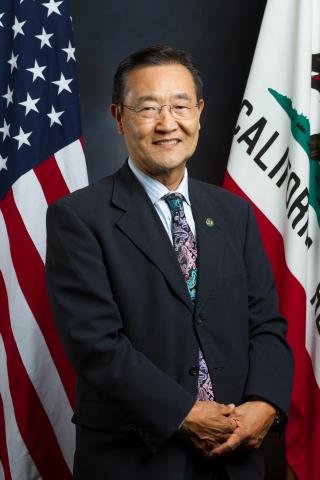
Photo of Steve Choi
R California Senate · District 37

Sen. Steve Choi

Compare
Total votes
16,057
all sessions
Attendance
84%
2,232 missed
Lower than 85% of chamber peers
With party
98%
of cast votes
Lower than 80% of chamber peers
Bipartisan score
1%
crosses aisle rarely
Higher than 95% of chamber peers
Sponsored
1,211
bills & resolutions
Near the chamber average
Committees
5
assignments
1,211 bills and resolutions

Sponsored bills

Total
1,211
Primary
190
Co-sponsor
1,021
This page
1,211
matching current filters
Primary AB 2491
In committee · California Assembly · Lead sponsor
School facilities: organic pesticides: pilot program.

The Healthy Schools Act of 2000 requires that the preferred method of managing pests at schoolsites, as defined, is to use effective, least toxic pest management practices and requires schoolsites to maintain records of all pesticides used at the schoolsite for a period of 4 years. Existing law requires schools to provide all staff and parents or guardians of pupils enrolled at a schoolsite written notification of, among other things, expected pesticide use at that schoolsite. This bill would require the State Department of Education, upon appropriation by the Legislature for these purposes, to establish a 5-year pilot program to provide funding to school districts to use only organic pesticides, both indoors and outdoors, for the purpose of determining the benefits of organic pesticide use and the financial impact on school districts of using organic pesticides instead of chemical pesticides. The bill would authorize certain school districts to apply to participate in the pilot program and would require a participating school district to conduct soil testing, as provided, and to submit reports to the department and the Legislature at the beginning and the end of the pilot program.

In committee Mar 17, 2020 0 co-sponsors
Co-sponsor AB 2359
In committee · California Assembly · Co-sponsor
Income taxes: credits: battery storage system units for solar power systems.

The Personal Income Tax Law and the Corporation Tax Law allow various credits against the taxes imposed by those laws. This bill, under both laws, for taxable years beginning on and after January 1, 2021, and before January 1, 2026, would allow a credit to a taxpayer, except as specified, that purchases a battery storage system unit for a solar energy system, as defined, in an amount equal to 50% of the costs paid or incurred by the taxpayer for that battery storage system unit, not to exceed $5,000 per taxable year, as specified. The bill would allow the credit for only one battery storage system unit per each separate legal parcel of property for which the filing taxpayer has legal ownership in the state. The bill would require the Franchise Tax Board to allow the credit to taxpayers filing for the same legal parcel of property on a first-come-first-served basis, determined by the date the taxpayer's timely filed original tax return is received by the Franchise Tax Board, except as provided. The bill would provide that the board's determination as to the date a return is received and whether a return has been timely filed for purposes of the credit is not reviewable in any administrative or judicial proceeding. Existing law requires any bill authorizing a new tax expenditure to contain, among other things, specific goals, purposes, and objectives that the tax expenditure will achieve, detailed performance indicators, and data collection requirements. This bill would also include additional information required for any bill authorizing a new tax expenditure. This bill would take effect immediately as a tax levy.

In committee Mar 17, 2020 1 co-sponsor
Co-sponsor AB 1942
In committee · California Assembly · Co-sponsor
Forestry and fire protection: reduction of emissions of greenhouse gases.

The California Global Warming Solutions Act of 2006 designates the State Air Resources Board as the state agency charged with monitoring and regulating sources of emissions of greenhouse gases. The act authorizes the state board to include the use of market-based compliance mechanisms. Existing law requires all moneys, except for fines and penalties, collected by the state board as part of a market-based compliance mechanism to be deposited in the Greenhouse Gas Reduction Fund and to be available upon appropriation. Existing law authorizes the Department of Forestry and Fire Protection to administer various programs, including grant programs, relating to forest health and wildfire protection. Existing law states that a specified amount is to be annually appropriated, through the 2023–24 fiscal year, from the Greenhouse Gas Reduction Fund to the department in the annual Budget Act for specified healthy forest and fire prevention programs and projects. Under existing law, the 2019–20 annual Budget Act appropriated $165,000,000 to the department, with at least $5,000,000 to be made available to the California Conservation Corps, as specified. This bill would appropriate $330,000,000 for the 2020–21 fiscal year from the Greenhouse Gas Reduction Fund, as specified, to the department for specified healthy forest and fire prevention programs and projects that improve forest health and reduce greenhouse gas emissions caused by uncontrolled wildfires, with not less than $10,000,000 for the California Conservation Corps' fire prevention projects and activities in, or adjacent to, the state responsibility areas.


In committee Mar 16, 2020 1 co-sponsor
Primary AB 2490
In committee · California Assembly · Lead sponsor
Information technology goods and services: Department of Motor Vehicles: message display systems.

Existing law requires contracts for the acquisition of information technology goods and services related to information technology projects, as defined, to be made by or under the supervision of the Department of Technology. Existing law authorizes the Department of Motor Vehicles (DMV) to enter into a contract with a private vendor for the purpose of acquiring and utilizing message display systems and to allow the private vendor to utilize a portion of the available time and space on the display systems for the purpose of advertising products or services. Existing law requires the extent of the access to be established under the terms of the contract, but not to exceed 15 minutes within a 60-minute period. This bill would require a DMV message display systems contract entered into or amended on or after January 1, 2021, that permits a vendor to display advertising of products or services pursuant to these provisions, to require that the state receive at lease 15 percent of the advertising revenues generated. The bill would require resulting revenue to the state to be deposited into the Motor Vehicle Account within the State Transportation Fund

In committee Mar 12, 2020 0 co-sponsors
Primary AB 2381
In committee · California Assembly · Lead sponsor
The California Beverage Container Recycling and Litter Reduction Act: processing payments and handling fees.

Existing law, the California Beverage Container Recycling and Litter Reduction Act, requires every beverage container sold or offered for sale in this state to have a minimum refund value. Under the act, the Department of Resources Recycling and Recovery is required to calculate a processing fee for each beverage container with a specified scrap value, which is required to be paid by beverage manufacturers for each beverage container sold or transferred to a distributor or dealer. The department is required to calculate the processing fee in a specified manner, so that the actual processing fee generally equals 65% of the processing payment that the department is required to pay to processors if the scrap value of the container having a refund value pursuant to the act is less than the cost of recycling. The act establishes the California Beverage Container Recycling Fund and, except for administrative costs, continuously appropriates moneys in the fund to the department for specified purposes, including the amount necessary to pay processing payments to processors and to pay handling fees to certain types of recyclers to provide an incentive for the redemption of empty beverage containers in convenience zones. This bill would require, notwithstanding the provisions establishing the calculation of processing payments and handling fees, until January 1, 2024, processing payments and handling fees to be set at the rate in effect on July 1, 2020. The bill would make an appropriation by changing the terms and conditions under which the department is authorized to make payments from a continuously appropriated fund. The bill would require the department to expend from the fund the amount necessary to pay supplemental handling fees on a per-container basis to recycling centers in prescribed amounts, thereby making an appropriation. The bill would require the department to suspend usage of surveys and calculations of recycling costs for purposes of calculating processing payments and handling fees until January 1, 2024.

In committee Mar 12, 2020 0 co-sponsors
Co-sponsor AB 2086
In committee · California Assembly · Co-sponsor
Foster care.

Existing law requires the State Department of Social Services to develop a payment system for foster family agencies that provide treatment, intensive treatment, and therapeutic foster care programs. Existing law commencing July 1, 2019, requires that the rates paid to foster family agencies, except for the rate paid to a certified family home or resource family agency, be 4.15% higher than the rates paid to foster family agencies in the 2018–19 fiscal year. This bill would, commencing July 1, 2021, require that the rates paid to foster family agencies be adjusted annually by an amount equal to the California Necessities Index, rounded to the nearest dollar. The bill would require the department to convene a workgroup with concerned stakeholders to establish a foster family agency rate structure to provide adequate funding for foster family agency social workers in order to reduce foster family agency social worker turnover and to improve permanency outcomes for foster children and youth. The bill would require the department, based on the findings of the workgroup, to submit specific recommendations to the Legislature, on or before December 31, 2022, to establish a foster family agency rate structure that ensures that foster family agency social workers are adequately compensated. The bill would require the rate adjustment described above to remain in effect until the date that the department submits those recommendations to the Legislature and the department establishes a foster family agency rate structure to ensure that foster family agency social workers are adequately compensated.

In committee Mar 10, 2020 1 co-sponsor
Co-sponsor AB 3136
In committee · California Assembly · Co-sponsor
Worker status: independent contractors: certified shorthand reporters.

Existing law, as established in the case of Dynamex Operations W. v. Superior Court (2018) 4 Cal.5th 903 (Dynamex) , creates a presumption that a worker who performs services for a hirer is an employee for purposes of claims for wages and benefits arising under wage orders issued by the Industrial Welfare Commission. Existing law requires a 3-part test, commonly known as the "ABC" test, to determine if workers are employees or independent contractors for those purposes. Existing law establishes that, for purposes of the Labor Code, the Unemployment Insurance Code, and the wage orders of the Industrial Welfare Commission, a person providing labor or services for remuneration is considered an employee rather than an independent contractor unless the hiring entity demonstrates that the person is free from the control and direction of the hiring entity in connection with the performance of the work, the person performs work that is outside the usual course of the hiring entity's business, and the person is customarily engaged in an independently established trade, occupation, or business. Existing law charges the Labor Commissioner with the enforcement of labor laws, including worker classification. Existing law exempts specified occupations and business relationships from the application of Dynamex and the provisions described above, including various professional services provided by graphic designers, grant writers, and fine artists, among others. This bill would also exempt certified shorthand reporters from the application of Dynamex and the above provisions.

In committee Mar 9, 2020 1 co-sponsor
Co-sponsor ACR 177
Passed · California Assembly · Co-sponsor
Relative to Family Justice Centers.

This measure would declare March 5, 2020, as Family Justice Center Day in California and would recognize the lifesaving and hope-giving work of the California Family Justice Center Network and its member Family Justice Centers as they work with rape crisis centers, domestic violence shelters, human trafficking agencies, prosecutors' offices, law enforcement agencies, and other professionals and community-based organizations to ensure that adult and child survivors of trauma can access all of their services in one setting.

Passed Mar 9, 2020 1 co-sponsor
Showing 661 to 670 of 1,211 bills
Previous 1 … 66 67 68 … 122 Next