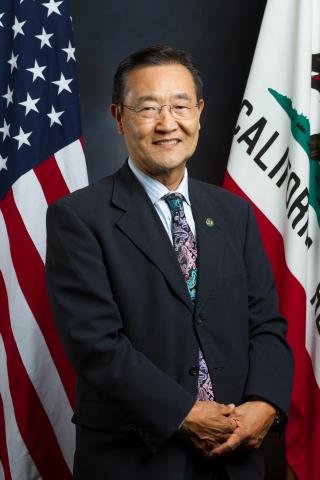
Photo of Steve Choi
R California Senate · District 37

Sen. Steve Choi

Compare
Total votes
16,057
all sessions
Attendance
84%
2,232 missed
Lower than 85% of chamber peers
With party
98%
of cast votes
Lower than 80% of chamber peers
Bipartisan score
1%
crosses aisle rarely
Higher than 95% of chamber peers
Sponsored
1,211
bills & resolutions
Near the chamber average
Committees
5
assignments
1,211 bills and resolutions

Sponsored bills

Total
1,211
Primary
190
Co-sponsor
1,021
This page
1,211
matching current filters
Co-sponsor ACR 155
Signed into law · California Assembly · Co-sponsor
Relative to Black History Month.

This measure would recognize February 2020 as Black History Month, urge all citizens to join in celebrating the accomplishments of African Americans during Black History Month, encourage the people of California to recognize the many talents of African Americans and the achievements and contributions they make to their communities to create equity and equality for education, economics, and social justice, and recognize the significance in protecting citizens' right to vote and remedying racial discrimination in voting.

Signed into law Jun 17, 2020 1 co-sponsor
Primary AJR 35
Introduced · California Assembly · Lead sponsor
Relative to Republic of Korea veterans who served in Vietnam.

This measure would urge the United States Congress and the President of the United States to permit states to extend veterans cemetery burial and memorial benefits to Republic of Korea veterans who served in the Vietnam War and who subsequently became United States citizens.

Introduced Jun 16, 2020 0 co-sponsors
Primary ACR 199
Introduced · California Assembly · Lead sponsor
Relative to Suicide Prevention Week.

This measure would proclaim the week of September 6, 2020, through September 12, 2020, as Suicide Prevention Week in California.

Introduced Jun 16, 2020 0 co-sponsors
Co-sponsor SCR 87
Passed · California Senate · Co-sponsor
Relative to Cystinuria Awareness Day.

This measure would recognize and proclaim June 24, 2020, as Cystinuria Awareness Day to promote awareness of Cystinuria and to show support for California medical research centers that take an active role in the fight against the disease.

Passed Jun 11, 2020 1 co-sponsor
Co-sponsor SCR 88
Passed · California Senate · Co-sponsor
Relative to California Peace Officers' Memorial Day.

This measure would designate Monday, May 4, 2020, as California Peace Officers' Memorial Day, urge all Californians to use that day to honor California peace officers, and recognize specified California peace officers who were killed in defense of their communities.

Passed Jun 11, 2020 1 co-sponsor
Co-sponsor SB 1071
In committee · California Senate · Co-sponsor
Personal income taxes: exclusion: uniformed services: retirement pay.

The Personal Income Tax Law imposes a tax on individual taxpayers measured by the taxpayer's taxable income for the taxable year, but excludes certain items of income from the computation of tax, including an exclusion for combat-related special compensation. This bill, for taxable years beginning on or after January 1, 2021, and before January 1, 2031, would exclude from gross income specified amounts of retirement pay received by a taxpayer from the federal government for service performed in the uniformed services, as defined, during the taxable year. Existing law requires any bill authorizing a new tax expenditure to contain, among other things, specific goals, purposes, and objectives that the tax expenditure with achieve, detailed performance indicators, and data collection requirements. The bill also would include additional information required for any bill authorizing a new income tax credit. This bill would take effect immediately as a tax levy.

In committee May 12, 2020 1 co-sponsor
Primary AB 2489
In committee · California Assembly · Lead sponsor
Worker status: employees: independent contractors: health care providers: COVID-19.

Existing law requires a 3-part test, commonly known as the "ABC" test, to determine if workers are employees or independent contractors for purposes of the Labor Code, the Unemployment Insurance Code, and the wage orders of the Industrial Welfare Commission. Under the ABC test, a person providing labor or services for remuneration is considered an employee rather than an independent contractor unless the hiring entity demonstrates that the person is free from the control and direction of the hiring entity in connection with the performance of the work, the person performs work that is outside the usual course of the hiring entity's business, and the person is customarily engaged in an independently established trade, occupation, or business. Existing law charges the Labor Commissioner with the enforcement of labor laws, including worker classification. Existing law exempts specified occupations and business relationships from the application of the ABC test described above. Existing law, instead, provides that these exempt relationships are governed by the multifactor test previously established in the case of S. G. Borello & Sons, Inc. v. Department of Industrial Relations (1989) 48 Cal.3d 341. On March 4, 2020, the Governor declared a State of Emergency in accordance with the powers vested in the Governor under the California Constitution and statutes in order to preserve public health and safety throughout the state due to the threat of COVID-19. This bill would, during the timeframe in which a state of emergency is in effect due to COVID-19 and 90 days thereafter, prohibit the application of the ABC test for respiratory therapists and other medical personnel not otherwise covered by an existing exemption from the ABC test, and would instead require that the multifactor test set forth in the case of Borello apply.

In committee May 12, 2020 0 co-sponsors
Co-sponsor AB 2457
In committee · California Assembly · Co-sponsor
Worker status: penalties and enforcement.

(1) Existing law establishes that, for purposes of the Labor Code, the Unemployment Insurance Code, and the wage orders of the Industrial Welfare Commission, a person providing labor or services for remuneration is considered an employee rather than an independent contractor unless the hiring entity demonstrates that the person is free from the control and direction of the hiring entity in connection with the performance of the work, the person performs work that is outside the usual course of the hiring entity's business, and the person is customarily engaged in an independently established trade, occupation, or business. Existing law exempts specified occupations and business relationships from these provisions. This bill would prohibit an employer from being subject to a monetary fine or penalty for a violation of the above provisions with respect to an applicant who has applied for unemployment benefits and has previously acted as an independent contractor during the past 5 years. The bill would repeal this provision on January 1, 2026. (2) The Labor Code Private Attorneys General Act of 2004 authorizes an aggrieved employee on behalf of the employee and other current or former employees to bring a civil action to recover specified civil penalties that would otherwise be assessed and collected by the Labor and Workforce Development Agency for the violation of certain provisions affecting employees. The act requires compliance with specified filing requirements by the aggrieved employee in order to bring the action, including providing notice to the agency and the employer with the specific provisions of the Labor Code alleged to have been violated, and the facts and theories that support the alleged violations. This bill would provide that the above act does not apply to an employee with respect to worker classification pursuant to a wage order if the employee has filed for unemployment insurance benefits and the employee's previous employer hired the employee as an independent contractor before January 1, 2020. The bill would repeal this provision on January 1, 2026. (3) Existing law authorizes the Employment Development Department to administer the federal-state unemployment insurance program and provides for the payment of unemployment compensation benefits to eligible individuals who are unemployed through no fault of their own. Existing law establishes procedures for the filing, determination, and payment of benefit claims, and those benefits are payable from the Unemployment Fund. Existing law requires the department to promptly pay benefits if it finds the claimant is eligible and to promptly deny benefits if it finds the claimant is ineligible for benefits. Existing law requires the department to consider facts submitted by an employer in making this determination and also provides for the department to audit claims, as specified. This bill would provide that an audit triggered pursuant to the federal Coronavirus Aid, Relief, and Economic Security Act (CARES Act) does not authorize the department or the Labor Commissioner, with respect to a claim for unemployment compensation benefits, to audit a previous determination of worker classification regarding an applicant's work for previous employers if the applicant has designated themselves as self-employed or as an independent contractor during the past 5 years. The bill would repeal this provision on January 1, 2026.


In committee May 5, 2020 1 co-sponsor
Primary AB 2496
In committee · California Assembly · Lead sponsor
Income taxes: credits: cleaning and sanitizing supplies: COVID-19.

The Personal Income Tax Law and the Corporation Tax Law allow various credits against the taxes imposed by those laws. Existing law requires any bill authorizing a new tax expenditure to contain, among other things, specific goals, purposes, and objectives the tax expenditure will achieve, detailed performance indicators, and data collection requirements. This bill would allow a credit against those taxes for each taxable year beginning on or after January 1, 2020, and before January 1, 2021, to a taxpayer that is a business with a physical location in the state in an amount equal to the costs paid or incurred by the qualified taxpayer during the taxable year for the purchase of cleaning and sanitizing supplies used at business locations in the state to prevent the transmission of the novel coronavirus (COVID-19) . The bill would also include additional information required for any bill authorizing a new tax expenditure. This bill would take effect immediately as a tax levy.

In committee May 5, 2020 0 co-sponsors
Showing 641 to 650 of 1,211 bills
Previous 1 … 64 65 66 … 122 Next