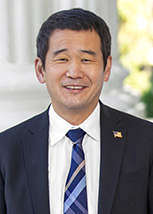
Photo of Dave Min
D California Senate · District 37

Sen. Dave Min

Compare
Total votes
8,800
all sessions
Attendance
95%
383 missed
Lower than 97% of chamber peers
With party
99%
of cast votes
Bipartisan score
0%
crosses aisle rarely
Sponsored
277
bills & resolutions
Near the chamber average
Committees
0
assignments
277 bills and resolutions

Sponsored bills

Total
277
Primary
89
Co-sponsor
188
This page
277
matching current filters
Co-sponsor SB 417
Signed into law · California Senate · Co-sponsor
Firearms: licensed dealers.

Existing law requires any sale or transfer of a firearm to be processed through a licensed dealer. Existing law requires each dealer to conspicuously post certain warnings and notices within their licensed premises, including safe storage requirements, requirements regarding the reporting of lost and stolen firearms, and information regarding the suicide prevention lifeline. This bill would revise this required posting, as specified.

Signed into law Sep 26, 2023 1 co-sponsor
Co-sponsor SB 368
Signed into law · California Senate · Co-sponsor
Firearms: requirements for licensed dealers.

Existing law regulates licensed firearms dealers and provides that a license is subject to forfeiture for a breach of specified prohibitions in existing law. Existing law authorizes the temporary transfer of a firearm without a firearms dealer's participation to a person who is 18 years of age or older for safekeeping to prevent it from being used to attempt suicide, as specified. This bill would require a licensed firearms dealer, as specified, to accept for storage a firearm transferred by an individual to prevent it from being accessed or used during periods of crisis or heightened risk to the owner of the firearm or members of their household. The bill would also authorize a licensed firearms dealer to accept for storage a firearm for a lawful purpose not otherwise stated in the law. The bill would make these provisions subject to certain conditions and would establish a procedure for the return of a firearm to the original transferor, including situations when a dealer cannot legally return a firearm. A violation of various provisions involving the transfer of firearms is a crime. By changing the scope of these offenses, this bill would impose a state-mandated local program. The bill would authorize a firearms dealer to charge a reasonable fee, as specified, for the storage of a firearm pursuant to these provisions. The bill would also state that it has no affect on the liability under existing law, if any, of a firearms dealer who returns a stored firearm to its owner, as specified. The California Constitution generally provides that the Legislature has no power to authorize lotteries and shall prohibit the sale of lottery tickets in the state, except for private, nonprofit, eligible organizations to conduct raffles as a funding mechanism to provide support for their own or another private, nonprofit, eligible organization's beneficial and charitable works, subject to certain conditions. This bill would prohibit a licensed firearms dealer from offering an opportunity to win an item of inventory in a game dominated by chance and would except from this prohibition nonprofit organizations under certain circumstances. Existing law, subject to exceptions, provides that any person who has been convicted of certain misdemeanors may not, within 10 years of the conviction, own, purchase, receive, possess, or have under their custody or control, any firearm and makes a violation of that prohibition a crime. Existing law authorizes a court in certain circumstances to reduce, eliminate, or condition that prohibition. This bill would, subject to exceptions, provide that any person convicted of a misdemeanor violation of the above-described prohibition on or after January 1, 2024, and who within 10 years of that conviction owns, purchases, receives, possesses, or has under their custody or control, any firearm guilty of a misdemeanor or a felony. Because a violation of these provisions would be a crime, and because this bill would expand the application of the crime to a larger class of potential offenders, this bill would impose a state-mandated local program. The California Constitution requires the state to reimburse local agencies and school districts for certain costs mandated by the state. Statutory provisions establish procedures for making that reimbursement. This bill would provide that no reimbursement is required by this act for a specified reason. This bill would incorporate additional changes to Section 11106 of the Penal Code proposed by AB 732 to be operative only if this bill and AB 732 are enacted and this bill is enacted last. This bill would also incorporate additional changes to Section 29805 of the Penal Code proposed by SB 2 to be operative only if this bill and SB 2 are enacted and this bill is enacted last.

Signed into law Sep 26, 2023 1 co-sponsor
Co-sponsor SB 452
Signed into law · California Senate · Co-sponsor
Firearms.

Existing law, subject to exceptions, generally makes it an offense to manufacture or sell an unsafe handgun, as defined, and requires the Department of Justice to compile a roster listing all of the handguns that have been tested and determined not to be unsafe handguns. Existing law establishes criteria for determining if a handgun is an unsafe handgun, including, for firearms manufactured after a certain date and not already listed on the roster, the lack of a chamber load indicator, magazine disconnect mechanism, and technology that transfers a microscopic array of characters from the firearm to the cartridge case when the firearm is fired, known as a microstamp. This bill would remove from the definition of an unsafe handgun a semiautomatic pistol without a microstamping component, as specified, and would prohibit, commencing on January 1, 2028, a licensed firearms dealer from selling, offering for sale, exchanging, giving, transferring, or delivering a semiautomatic pistol, as defined, unless the pistol has been verified as a microstamping-enabled pistol, if the department has determined that microstamping components or microstamping-enabled semi-automatic firearms are available, as specified. The bill would also prohibit a person from modifying a microstamping-enabled pistol or microstamping component with the intent to prevent the production of a microstamp. By creating new crimes, the bill would impose a state-mandated local program. The bill would require the Department of Justice to provide written guidance concerning qualifying criteria and performance standards for microstamping components, as defined, if the department has determined that microstamping components are technologically viable, as specified, and would require the department to accept applications for licensure of entities in order to produce microstamping components, as specified. The California Constitution requires the state to reimburse local agencies and school districts for certain costs mandated by the state. Statutory provisions establish procedures for making that reimbursement. This bill would provide that no reimbursement is required by this act for a specified reason.

Signed into law Sep 26, 2023 1 co-sponsor
Primary SB 241
Signed into law · California Senate · Lead sponsor
Firearms: dealer requirements.

Existing law prohibits any person from selling, leasing, or transferring any firearm unless the person is licensed as a firearms dealer, as specified. Existing law prescribes certain requirements and prohibitions for licensed firearms dealers. A violation of any of these requirements or prohibitions is grounds for forfeiture of a firearms dealer's license. Commencing on July 1, 2026, this bill would require a licensee and any employees that handle firearms to annually complete specified training. The bill would require the Department of Justice, on or before February 1, 2026, to develop and implement a training course, as specified, including a testing certification component. The bill would authorize the department to adopt regulations to carry out the provisions of the bill.

Signed into law Sep 26, 2023 0 co-sponsors
Co-sponsor SB 2
Signed into law · California Senate · Co-sponsor
Firearms.

Existing law prohibits a person from carrying a concealed firearm or carrying a loaded firearm in public. Existing law authorizes a licensing authority, as specified, if good cause exists for the issuance, and subject to certain other criteria including, among other things, the applicant is of good moral character and has completed a specified course of training, to issue a license to carry a concealed handgun or to carry a loaded and exposed handgun, as specified. Under existing law, the required course of training for an applicant is no more than 16 hours and covers firearm safety and laws regarding the permissible use of a firearm. This bill would require the licensing authority to issue or renew a license if the applicant is not a disqualified person for the license and the applicant is at least 21 years of age. The bill would remove the good character and good cause requirements from the issuance criteria. Under the bill, the applicant would be a disqualified person if they, among other things, are reasonably likely to be a danger to self, others, or the community at large, as specified. This bill would add the requirement that the applicant be the recorded owner, with the Department of Justice, of the pistol, revolver, or other firearm capable of being concealed upon the person. This bill would change the training requirement to be no less than 16 hours in length and would add additional subjects to the course including, among other things, the safe storage and legal transportation of firearms. The bill would require an issuing authority, prior to that issuance, renewal, or amendment to a license, if it has direct access to the designated department system to determine if the applicant is the recorded owner of the pistol, revolver, or other firearm. The bill would require an issuing authority without access to that system to confirm the ownership with the sheriff of the county in which the agency is located. By requiring local agencies to issue licenses for concealed firearms, this bill would create a state-mandated local program. The bill would require a licensing authority to provide the applicant notice if a new license or license renewal is denied or revoked. If an application is denied or a license is revoked based on a determination that the applicant is a disqualified person, the bill would permit the applicant to request a hearing to challenge the license denial or revocation, and require the licensing authority to inform the applicant of the ability to seek a hearing. If a new license or license renewal is denied or revoked for any other reason, the bill would authorize the applicant to seek a writ of mandate from a superior court within 30 days of receipt of notice of denial or revocation, and require the licensing authority to inform the applicant of the ability to seek a writ of mandate. By imposing new duties on local licensing authorities, this bill would create a state-mandated local program. Existing law requires an agency issuing a license described above to set forth specified information on the license, including, among other things, the licensee's name, occupation, and reason for desiring a license to carry the weapon. This bill would revise that information to include, among other things, the licensee's driver's license or identification number, fingerprints, and information relating to the date of expiration of the license, and would remove the requirement that the license detail the reason for desiring a license to carry the weapon. Existing law requires an applicant for a license described above to provide fingerprints, as specified. Existing law exempts an applicant from this requirement if they have previously applied to the same licensing authority and the applicant's fingerprints have previously been forwarded to the department, as specified, and instead requires that authority to note data that would provide positive identification in the files of the department, on the copy of any subsequent license submitted to the department. This bill would require the licensing authority to submit fingerprint images and related information to the department for each applicant applying for a new or renewal license. The bill would require the department to notify the licensing authority if the department is unable to ascertain, among other things, the final disposition of an arrest or criminal charge under state or federal law that would prohibit the person from possessing, receiving, owning, or purchasing a firearm. This bill would prohibit a license from being issued or renewed unless the department reports to a licensing authority that the applicant is eligible to possess, receive, own, or purchase a firearm. Existing law requires a licensing authority to charge an additional fee in an amount equal to reasonable processing costs for a new license. Existing law also prohibits a licensing authority from imposing, among other things, a requirement or condition that an applicant pay additional funds or obtain liability insurance. This bill would authorize a licensing authority to charge the additional processing cost fee for a license renewal and would permit the licensing authority to collect the first 50% of the fee upon filing of the application. The bill also removes the prohibition on licensing authority requirements for additional fees or liability insurance. Existing law requires that licenses and applications for licenses be uniform throughout the state, and to be submitted upon forms prescribed by the Attorney General. When revising the standard application form for licenses, existing law requires the Attorney General to convene a committee to review and revise the existing application form. Existing law requires the Attorney General to develop a uniform license that may be used as indicia of proof of licensure throughout the state. Existing law also requires the committee to convene to review and revise the design standard for a uniform license. This bill would authorize the Attorney General to revise the standard form for licenses and the design standard if the committee does not revise the form or issue a design standard within a specified time period. Under existing law, it is a crime to bring a firearm into a state or local building, and makes it a crime to bring a loaded firearm into, or upon the grounds of, any residence of the Governor, any other constitutional officer, or Member of the Legislature. Existing law exempts a licensee from that prohibition if, among other things, the licensee has a valid license to carry the firearm. This bill would remove those exemptions, except as specified. The bill would make it a crime to bring an unloaded firearm into, or upon the grounds of, any residence of the Governor, any other constitutional officer, or Member of the Legislature. The bill would also prohibit a licensee from carrying a firearm to specified locations, including, among other places, a building designated for a court proceeding and a place of worship, as defined, with specific exceptions. By expanding the scope of an existing crime, the bill would impose a state-mandated local program. Existing law prohibits a person from knowingly possessing a firearm in a sterile area of an airport, passenger vessel terminal, or public transit facility, as defined. This bill would additionally prohibit a person from knowingly possessing a firearm in any building, real property, or parking area under the control of an airport or passenger vessel terminal, as specified. By expanding the scope of an existing crime, the bill would impose a state-mandated local program. Existing law, the Gun-Free School Zone Act of 1995, makes it a crime to possess a firearm in a place that the person knows, or reasonably should know, is a school zone. Existing law defines a school zone as an area in, or on the grounds of, a public or private school providing instruction in kindergarten or grades 1 to 12, inclusive, or within a distance of 1,000 feet from the grounds of the public or private school. Existing law provides exceptions to that crime, including if a person with a valid concealed carry license who is carrying the firearm described in the license in an area that is not in, or on the grounds of, a public or private school and when a firearm is an unloaded pistol, revolver, or other firearm capable of being concealed on the person and is in a locked container or within the locked trunk of a motor vehicle. This bill would revise the exception for a person who has a valid concealed carry license to permit them to carry a specified firearm in an area that is not within any building, real property, or parking area under the control of a public or private school, or on a street or sidewalk immediately adjacent to a building, real property, or parking area under the control of that public or private school, as specified. Existing law requires a licensing authority to revoke a license to carry a firearm if the licensing authority is notified by the department or the licensing authority determines that a licensee is prohibited from possessing, receiving, owning, or purchasing a firearm under state or federal law. This bill would also require a licensing authority to revoke a license if, among other things, a licensee has provided inaccurate or incomplete information on their application for a new license or license renewal. Existing law authorizes a licensing authority to impose reasonable restrictions on the time, place, manner, and circumstances when a licensee may carry a firearm capable of being concealed. While carrying a firearm, this bill would prohibit a licensee from, among other things, consuming an alcoholic beverage or controlled substance and from falsely representing that the licensee is a peace officer. The bill would authorize the department to adopt emergency regulations to implement the concealed firearm licensing system, as specified. This bill would make conforming changes. The bill would additionally make various findings and declarations of the Legislature. The bill would state that its provisions are severable. This bill would incorporate additional changes to Section 29805 of the Penal Code proposed by SB 368 to be operative only if this bill and SB 368 are enacted and this bill is enacted last. This bill would also incorporate additional changes to Section 30370 of the Penal Code proposed by AB 135 and SB 135 to be operative only if this bill and either of those bills are enacted and this bill is enacted last. The California Constitution requires the state to reimburse local agencies and school districts for certain costs mandated by the state. Statutory provisions establish procedures for making that reimbursement. This bill would provide that with regard to certain mandates no reimbursement is required by this act for a specified reason. With regard to any other mandates, this bill would provide that, if the Commission on State Mandates determines that the bill contains costs so mandated by the state, reimbursement for those costs shall be made pursuant to the statutory provisions noted above.


Signed into law Sep 26, 2023 1 co-sponsor
Co-sponsor AB 1587
Signed into law · California Assembly · Co-sponsor
Financial transactions: firearms merchants: merchant category code.

Existing law, the California Financing Law, generally provides for the licensure and regulation of finance lenders, brokers, and program administrators by the Commissioner of Financial Protection and Innovation. Existing law establishes a firearm industry standard of conduct that requires a firearm industry member to establish, implement, and enforce reasonable controls and to take responsible precautions to ensure that the member does not sell, distribute, or provide a firearm-related product to a downstream distributor or retailer of firearm-related products under specified circumstances. Existing law prohibits a firearm industry member from manufacturing, marketing, importing, offering for wholesale sale, or offering for retail sale a firearm-related product that is abnormally dangerous and likely to create an unreasonable risk of harm to public health and safety in California, as specified. Existing law authorizes, among others, the Attorney General to bring a civil action against a firearm industry member for an act or omission in violation of the firearm industry standard of conduct, as specified. Existing law defines various terms for these purposes. This bill would, by July 1, 2024, require a payment card network to make the merchant category code for firearms and ammunition businesses established by the International Organization for Standardization on September 9, 2022, available for merchant acquirers that provide payment services for firearms merchants. The bill would, beginning May 1, 2025, require a merchant acquirer to assign to a firearms merchant that merchant category code. The bill would provide that the Attorney General has exclusive authority to enforce these provisions, and would authorize the Attorney General to bring a civil action to enforce these provisions and remedy harm caused by a violation of these provisions. The bill would require a court that determines that a person or entity has violated these provisions to award specified relief, including a civil penalty in the amount of $10,000 for each violation. The bill would define various terms for these purposes.

Signed into law Sep 26, 2023 1 co-sponsor
Co-sponsor AB 28
Signed into law · California Assembly · Co-sponsor
Firearms and ammunition: excise tax.

Existing law establishes the California Violence Intervention and Prevention (CalVIP) Grant Program, administered by the Board of State and Community Corrections, to award competitive grants for the purpose of violence intervention and prevention. Existing law imposes various taxes, including taxes on the privilege of engaging in certain activities. The Fee Collection Procedures Law, the violation of which is a crime, provides procedures for the collection of certain fees and surcharges. This bill, the Gun Violence Prevention and School Safety Act, would, commencing July 1, 2024, impose an excise tax in the amount of 11% of the gross receipts from the retail sale in this state of a firearm, firearm precursor part, and ammunition, as specified. The tax would be collected by the state pursuant to the Fee Collection Procedures Law. The bill would require that the revenues collected be deposited in the Gun Violence Prevention and School Safety Fund, which the bill would establish in the State Treasury. The bill would require the moneys received in the fund to be used to fund various gun violence prevention, education, research, response, and investigation programs, as specified. The bill would require the Director of Finance to transfer, as a loan, $2,400,000 from the General Fund to the California Department of Tax and Fee Administration to implement these provisions, as specified. The bill would require each licensed firearms dealer, firearms manufacturer, and ammunition vendor to register with the department for a certificate, as specified. The bill would also provide procedures for the issuance, revocation, and reinstatement of a permit. This bill would include a change in state statute that would result in a taxpayer paying a higher tax within the meaning of Section 3 of Article XIIIA of the California Constitution, and thus would require for passage the approval of 23 of the membership of each house of the Legislature. Because this bill would expand the scope of the Fee Collection Procedures Law, the violation of which is a crime, this bill would impose a state-mandated local program. The California Constitution requires the state to reimburse local agencies and school districts for certain costs mandated by the state. Statutory provisions establish procedures for making that reimbursement. This bill would provide that no reimbursement is required by this act for a specified reason.

Signed into law Sep 26, 2023 1 co-sponsor
Co-sponsor AB 342
Signed into law · California Assembly · Co-sponsor
Architects and real estate appraisers: applicants and licensees: demographic information.

Existing law, the Architects Practice Act, establishes the California Architects Board in the Department of Consumer Affairs for the licensure and regulation of persons engaged in the practice of architecture. Existing law, the Real Estate Appraisers' Licensing and Certification Law, establishes the Bureau of Real Estate Appraisers in the Department of Consumer Affairs to license and regulate real estate appraisers. This bill would authorize the California Architects Board and the Bureau of Real Estate Appraisers to request that a licensee identify their race, ethnicity, sexual orientation, gender, or gender identity when an initial license is issued or at the time of license renewal. The bill would require the board and the bureau to maintain the confidentiality of the information and would prohibit the board and the bureau from requiring a licensee to provide the information as a condition of licensure or license renewal. The bill would authorize the board and the bureau to publish the aggregate demographic data they collect on their internet websites. The bill, beginning January 1, 2025, would require the board and the bureau to submit the aggregate demographic data they collect to the department and would require the department to post the information on the department's internet website. Existing constitutional provisions require that a statute that limits the right of access to the meetings of public bodies or the writings of public officials and agencies be adopted with findings demonstrating the interest protected by the limitation and the need for protecting that interest. This bill would make legislative findings to that effect.

Signed into law Sep 22, 2023 1 co-sponsor
Co-sponsor SJR 7
Signed into law · California Senate · Co-sponsor
Relative to a federal constitutional convention.

The measure would apply to the United States Congress to call a constitutional convention under Article V of the Constitution of the United States for the purpose of proposing a constitutional amendment relating to firearms, as specified.

Signed into law Sep 21, 2023 1 co-sponsor
Showing 121 to 130 of 277 bills
Previous 1 12 13 14 28 Next