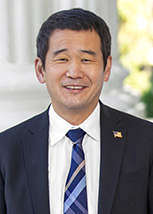
Photo of Dave Min
D California Senate · District 37

Sen. Dave Min

Compare
Total votes
8,800
all sessions
Attendance
95%
383 missed
Lower than 97% of chamber peers
With party
99%
of cast votes
Lower than 97% of chamber peers
Bipartisan score
0%
crosses aisle rarely
Near the chamber average
Sponsored
277
bills & resolutions
Near the chamber average
Committees
0
assignments
277 bills and resolutions

Sponsored bills

Total
277
Primary
89
Co-sponsor
188
This page
277
matching current filters
Co-sponsor SCR 74
Signed into law · California Senate · Co-sponsor
Relative to the Officer Jon Coutchie Memorial Bridge.

This measure would designate the Aliso Creek Bridge on State Highway Route 1 in the County of Orange as the Officer Jon Coutchie Memorial Bridge. The measure would also request the Department of Transportation to determine the cost of appropriate signs showing this special designation and, upon receiving donations from nonstate sources to cover that cost, to erect those signs.

Signed into law Jan 18, 2024 1 co-sponsor
Co-sponsor SB 44
died · California Senate · Co-sponsor
Controlled substances.

Existing law makes it a crime to possess for sale or purchase for purpose of sale, transport, import, sell, furnish, administer, give away, manufacture, compound, convert, produce, derive, process, or prepare various controlled substances, including, among others, fentanyl, peyote, and various other opiates and narcotics. This bill, Alexandra's Law, would require the court to advise a person who is convicted of, or who pleads guilty or no contest to, the above crimes, as specified, of the danger of selling or administering illicit drugs and counterfeit pills and that, if a person dies as a result of that action, the defendant can be charged with homicide. The bill would require the court to read the advisory statement in a case in which the defendant exchanged a controlled substance containing fentanyl or its analogs for anything else of value, as specified. The bill would require the advisory statement to be included in a plea form, if used, and specified on the record. The bill would require that the fact the advisory was given be recorded in the abstract of conviction and would prohibit the advisement from being used as evidence in the prosecution of a minor in juvenile court.

died Nov 29, 2023 1 co-sponsor
Primary SB 666
Signed into law · California Senate · Lead sponsor
Small business: commercial financing transactions.

Existing law generally regulates the loaning of money, including the calculation of interest rates. Existing law, the California Financing Law (CFL) , prohibits a person from engaging in the business of a finance lender or broker without obtaining a license from the Commissioner of Financial Protection and Innovation. The CFL generally regulates commercial loans made by licensees. This bill would prohibit a covered entity from charging specified fees in connection with a commercial financing transaction with a small business or small business owner, including, among others, a fee for accepting or processing a payment required by the terms of the commercial financing contract as an automated clearinghouse transfer debit, except as specified, a fee for providing a small business with documentation prepared by the covered entity that contains a statement of the amount due to satisfy the remaining debt, as specified, and a fee in addition to a loan origination fee that does not have a clear corresponding service provided for the fee, as specified. If a covered entity violates these provisions, the bill would entitle a recipient to specified relief, including actual damages, statutory damages, and attorney's fees and costs. The bill would make a waiver of these provisions contrary to public policy and void and unenforceable. The bill would define various terms for these purposes.

Signed into law Oct 13, 2023 0 co-sponsors
Primary SB 381
Signed into law · California Senate · Lead sponsor
Electric bicycles: study.

Existing law defines an electric bicycle to mean a bicycle equipped with fully operable pedals and an electric motor of less than 750 watts, and subjects a person riding an electric bicycle to provisions of law governing the operation of a bicycle. This bill would require the Mineta Transportation Institute at San Jose State University, in consultation with relevant stakeholders, to, on or before January 1, 2026, conduct a study on electric bicycles to inform efforts to improve the safety of users of the transportation system, and to submit a report of the findings from the study to the Legislature. The bill would require the study to examine, identify, and analyze available information regarding, among other things, data on injuries, crashes, emergency room visits, and deaths related to bicycles and electric bicycles and best practices for policy to promote safe use of electric bicycles.

Signed into law Oct 13, 2023 0 co-sponsors
Co-sponsor SB 331
Signed into law · California Senate · Co-sponsor
Child custody: child abuse and safety.

Existing law governs the determination of child custody and visitation in contested proceedings. Existing law requires the court, for purposes of deciding custody, to determine the best interests of the child based on certain factors, including the nature and amount of contact with both parents and, consistent with specified findings, requires the court's primary concern to be the health, safety, and welfare of the child. Existing law prohibits the ordering of family reunification services as part of a child custody or visitation rights proceeding. Existing law authorizes the court, upon making certain findings, to require the parent or parents, or any other party involved in a custody or visitation dispute, and the minor child to participate in outpatient counseling, as specified. This bill, Piqui's Law: Keeping Children Safe from Family Violence Act, would prohibit the court from ordering family reunification treatments, programs, or services, including, but not limited to, camps, workshops, therapeutic vacations, or educational programs that, as a condition of enrollment or participation, require or result in, among other things, the use of private youth transporters or private transportation agents, as specified, a no-contact order, or a transfer of physical or legal custody of the child. Existing law requires the Judicial Council to establish judicial training programs for individuals who perform duties in domestic violence matters. Existing law requires the training programs to include a domestic violence session in any orientation session for newly appointed or elected judges and an annual training session in domestic violence. Existing law requires the training programs to include instruction in all aspects of domestic violence, including, but not limited to, the detriment to children of residing with a person who perpetrates domestic violence. This bill would instead require the Judicial Council to establish judicial training programs for individuals, including judicial officers and referees, who perform duties in domestic violence or child custody matters, including, among other topics, child sexual abuse and coercive control, as specified. The bill would require the Judicial Council to submit an annual report on these training programs, commencing on or before January 1, 2025, to the Legislature and relevant policy committees, that includes the titles of the training courses being offered and the number of judicial officers that attended each training.

Signed into law Oct 13, 2023 1 co-sponsor
Co-sponsor SB 332
Signed into law · California Senate · Co-sponsor
Minor league baseball players.

Existing law provides that 8 hours of labor constitute a day's work unless it is otherwise expressly stipulated in a collective bargaining agreement, and requires that any work in excess of specified hours in one workday or one workweek be compensated at a rate higher than the regular rate of pay for the employee, as specified. Existing law authorizes, upon the proposal of an employer, employees of an employer to adopt a regularly scheduled alternative workweek that authorizes work by the affected employees for no longer than 10 hours per day within a 40-hour workweek without the payment to the affected employees of an overtime rate of compensation, as specified. Existing law prohibits an employer from employing an employee for a work period of more than 5 hours per day without providing the employee with a meal period, as specified, but, notwithstanding these provisions, existing law authorizes the Industrial Welfare Commission to adopt a working condition order permitting a meal period to commence after 6 hours of work if specified conditions are met. Under existing law, the Industrial Welfare Commission issues wage orders that regulates wages, hours, and working conditions in various occupations, including Wage Order No. 10-2001, which regulates the amusement and recreation industry. This bill would provide that these provisions do not apply to a person who is covered by a contract to play baseball at the minor league level with a labor organization that has at least 10 years of experience representing baseball players and who is compensated pursuant to the terms of a valid collective bargaining agreement that expressly provides for the wages, hours of work, working conditions of employees, payment for time worked during the off-season and spring training, and final and binding arbitration of disputes. The bill would require the Department of Industrial Relations to amend and republish Wage Order No. 10-2001 to provide that specified provisions of the wage order do not apply to a person subject to these provisions, as specified. Existing law requires an employer, semimonthly or at the time of payment of wages, to furnish an employee an accurate, itemized, written statement containing specified information regarding the amounts earned, hours worked, and the employee's identity, among other things, subject to certain variations. Existing law provides that an itemized wage statement furnished by an employer pursuant to these provisions is not required to show total hours worked by the employee if, among other things, the employee is exempt from the payment of minimum wage and overtime under specified law. This bill would provide that an itemized wage statement furnished by an employer pursuant to these provisions is not required to show total hours worked by an employee if the employee is exempt from the payment of minimum wage and overtime under the bill's provisions described above. Existing law, the Administrative Procedure Act, governs, among other things, the procedures for the adoption, amendment, or repeal of regulations by state agencies. Existing law also describes procedures for the promulgation of regulations by the Industrial Welfare Commission. This bill would exempt these provisions from the rulemaking procedures described above. Existing constitutional provisions require that a statute that limits the right of access to the meetings of public bodies or the writings of public officials and agencies be adopted with findings demonstrating the interest protected by the limitation and the need for protecting that interest. This bill would make legislative findings to that effect. This bill would declare that it is to take effect immediately as an urgency statute.

Signed into law Oct 13, 2023 1 co-sponsor
Co-sponsor SB 34
Signed into law · California Senate · Co-sponsor
Surplus land disposal: violations: County of Orange.

Existing law prescribes requirements for the disposal of land determined to be surplus land by a local agency. Those requirements include a requirement that a local agency, prior to disposing of a property or participating in negotiations to dispose of that property with a prospective transferee, send a written notice of availability of the property to specified entities, depending on the property's intended use, and send specified information in regard to the disposal of the parcel of surplus land to the Department of Housing and Community Development. Existing law, among other enforcement provisions, makes a local agency that disposes of land in violation of these disposal provisions, after receiving notification of violation from the department, liable for a penalty of 30% of the final sale price of the land sold in violation for a first violation and 50% for any subsequent violation. Under existing law, except as specified, a local agency has 60 days to cure or correct an alleged violation before an enforcement action may be brought. Existing law provides for the deposit and use of penalty revenues for housing, as prescribed. This bill, until January 1, 2030, would require the County of Orange, or any city located within the County of Orange, if notified by the department that its planned disposal of surplus land is in violation of existing law, to cure or correct the alleged violation within 60 days, as prescribed. The bill would prohibit a County of Orange jurisdiction that has not cured or corrected any alleged violation from disposing of the parcel until the department determines that it has complied with existing law or deems the alleged violation not to be a violation. The bill would authorize a local agency that receives that notice to provide to the Department of Housing and Community Development a statement describing the actions taken to cure or correct the alleged violation within 60 days of receipt of the notice, and would require the department, if it receives that statement, to make specified determinations and notify the local agency of those determinations within 30 days of receipt of the statement. This bill would make legislative findings and declarations as to the necessity of a special statute for the County of Orange. By imposing new duties on local agencies, the bill would impose a state-mandated local program. The California Constitution requires the state to reimburse local agencies and school districts for certain costs mandated by the state. Statutory provisions establish procedures for making that reimbursement. This bill would provide that, if the Commission on State Mandates determines that the bill contains costs mandated by the state, reimbursement for those costs shall be made pursuant to the statutory provisions noted above.

Signed into law Oct 11, 2023 1 co-sponsor
Co-sponsor SB 362
Signed into law · California Senate · Co-sponsor
Data broker registration: accessible deletion mechanism.

The California Consumer Privacy Act of 2018 (CCPA) grants a consumer various rights with respect to personal information that is collected or sold by a business, including the right to request that a business disclose specified information that has been collected about the consumer, to request that a business delete personal information about the consumer that the business has collected from the consumer, and to direct a business not to sell or share the consumer's personal information, as specified. The CCPA defines various terms for these purposes. The California Privacy Rights Act of 2020 (CPRA) , approved by the voters as Proposition 24 at the November 3, 2020, statewide general election, amended, added to, and reenacted the CCPA and establishes the California Privacy Protection Agency (agency) and vests the agency with full administrative power, authority, and jurisdiction to enforce the CCPA. Existing law requires a data broker to register with the Attorney General, pay a registration fee, and provide specified information on or before January 31 following each year in which a business meets the definition of data broker. Existing law defines various terms for these purposes. Existing law establishes the Data Brokers' Registry Fund and requires that these registration fees be deposited into the fund, to be available for expenditure by the Department of Justice, upon appropriation, for specified purposes. Existing law provides that a data broker that fails to register as required by these provisions is liable for civil penalties, fees, and costs in an action brought by the Attorney General, as specified, and requires these moneys be deposited in the Consumer Privacy Fund with the intent that they be used to fully offset costs incurred in connection with these provisions. Existing law requires the Attorney General to create and maintain an internet website where specified information provided by data brokers is accessible to the public. This bill would incorporate the definitions from the CCPA into the data broker provisions described above. The bill would require a data broker to register with, pay a registration fee to, and provide information to, the agency instead of the Attorney General and would require the agency to maintain the informational internet website described above. The bill would require a data broker to compile and disclose specified information relating to requests received under the CCPA. The bill would also require, on or before July 1 following each year in which a business meets the definition of a data broker, that business to provide specified information described above and make related changes. The bill would make a data broker that fails to register as required by the provisions described above liable for administrative fines and costs in an administrative action brought by the agency, as specified, instead of in an action brought by the Attorney General. This bill would require the agency to establish, by January 1, 2026, an accessible deletion mechanism that, among other things, allows a consumer, through a single verifiable consumer request, to request that every data broker that maintains any personal information delete any personal information related to that consumer held by the data broker or associated service provider or contractor. The bill would specify requirements for this accessible deletion mechanism, and would, beginning August 1, 2026, require a data broker to access the mechanism at least once every 45 days and, among other things, process all deletion requests, except as specified. Beginning August 1, 2026, after a consumer has submitted a deletion request and a data broker has deleted the consumer's data pursuant to the bill's provisions, the bill would require the data broker to delete all personal information of the consumer at least once every 45 days, as specified, and would prohibit the data broker from selling or sharing new personal information of the consumer, as specified. The bill would, beginning January 1, 2028, and every 3 years thereafter, require a data broker to undergo an audit by an independent third party to determine compliance with these provisions and would require the data broker to submit an audit report to the agency upon the agency's written request, as specified. The bill would authorize the agency to charge a fee to data brokers for accessing the accessible deletion mechanism, as specified. This bill would provide that a data broker that fails to comply with the requirements pertaining to the accessible deletion mechanism described above is liable for administrative fines, fees, expenses, and costs, as specified. The bill would require that moneys collected or received by the agency and the Department of Justice under these provisions be deposited in the Data Brokers' Registry Fund, which the bill would require to be administered by the agency, instead of the Consumer Privacy Fund and would expand the specified uses of moneys in the Data Brokers' Registry Fund to include the costs incurred by the state courts and the agency in connection with enforcing these provisions and the costs of establishing, maintaining, and providing access to the accessible deletion mechanism described above. This bill would require a data broker to provide additional information to the agency, including information related to requests received under the CCPA, whether the data broker collects specified information, and specified information regarding an audit under the provisions described above. This bill would prohibit an administrative action pursuant to these provisions from being commenced more than 5 years after the date on which a violation occurred. This bill would declare that it furthers the purposes and intent of the CPRA for specified reasons.


Signed into law Oct 10, 2023 1 co-sponsor
Co-sponsor AB 452
Signed into law · California House · Co-sponsor
Childhood sexual assault: statute of limitations.

Existing law requires that specified actions for recovery of damages suffered as a result of childhood sexual assault, as defined, be commenced within 22 years of the date the plaintiff attains the age of majority or within 5 years of the date the plaintiff discovers or reasonably should have discovered that psychological injury or illness occurring after the age of majority was caused by the sexual assault, whichever occurs later. Existing law prohibits certain of those actions from commencing on or after the plaintiff's 40th birthday unless the person or entity knew or had reason to know, or was otherwise on notice, of any misconduct that creates a risk of childhood sexual assault by an employee, volunteer, representative, or agent, or the person or entity failed to take reasonable steps or to implement reasonable safeguards to avoid acts of childhood sexual assault, as specified. Existing law revives claims that would otherwise have been barred as of January 1, 2020, because the applicable statute of limitations, claim presentation deadline, or any other time limit had expired and authorizes the claims to be commenced within specified time periods. This bill would eliminate time limits for the commencement of actions for the recovery of damages suffered as a result of childhood sexual assault, as specified. The bill would eliminate the prohibition on certain actions proceeding on or after the plaintiff's 40th birthday unless specified conditions are met. The bill would specify that its provisions apply to any claim in which the childhood sexual assult occurred on and after January 1, 2024.

Signed into law Oct 10, 2023 1 co-sponsor
Showing 91 to 100 of 277 bills
Previous 1 9 10 11 28 Next