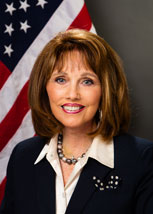
Photo of Patricia C. Bates
R California Senate · District 36

Sen. Patricia C. Bates

Compare
Total votes
46,261
all sessions
Attendance
93%
1,864 missed
Lower than 78% of chamber peers
With party
98%
of cast votes
Near the chamber average
Bipartisan score
2%
crosses aisle rarely
Higher than 81% of chamber peers
Sponsored
1,957
bills & resolutions
Near the chamber average
Committees
0
assignments
1,957 bills and resolutions

Sponsored bills

Total
1,957
Primary
271
Co-sponsor
1,686
This page
1,957
matching current filters
Primary SB 856
In committee · California Senate · Lead sponsor
Vehicles: registration.

Existing law prohibits a person from driving, moving, or leaving standing upon a highway any motor vehicle, as defined, unless it has been registered, as specified. This bill would make technical, nonsubstantive changes to those provisions.

In committee Jan 22, 2020 0 co-sponsors
Co-sponsor AB 211
Vetoed · California Assembly · Co-sponsor
Personal income taxes: deduction: California qualified tuition program.

The Personal Income Tax Law, in modified conformity with federal income tax law, excludes from the gross income of a beneficiary of, or contributor to, a qualified tuition program, which includes a Golden State Scholarshare College Savings Trust, distributions or earnings under that program, as specified. This bill, for taxable years beginning on or after January 1, 2020, and before January 1, 2025, would allow under that law a deduction against gross income in the amount equal to the monetary contribution made by a qualified taxpayer, as defined, to the California qualified tuition program established pursuant to the Golden State Scholarshare Trust Act not to exceed either $5,000 or $10,000, as provided. The bill would require, with exceptions, in the case of any distribution in excess of qualified higher education expenses, as defined, the aggregate amount of the deduction allowed that reduced the qualified taxpayer's gross income in any taxable year to be added to the gross income of the qualified taxpayer in the taxable year of the distribution, as provided. The bill would require the Scholarshare Investment Board to report to the Legislature, on an annual basis, specified data related to this deduction and Scholarshare accounts and would require the Franchise Tax Board to provide certain information to the Scholarshare Investment Board upon request. This bill would take effect immediately as a tax levy.

Vetoed Jan 21, 2020 1 co-sponsor
Co-sponsor AB 734
Vetoed · California Assembly · Co-sponsor
Resource families: supportive services pilot program.

Existing law provides for the implementation, by counties and foster family agencies, of the resource family approval process, which is a unified, family-friendly, and child-centered approval process that replaces the multiple processes for licensing foster family homes, approving relatives and nonrelative extended family members as foster care providers, and approving adoptive families. This bill would require the State Department of Social Services to establish and facilitate a pilot program in up to 5 counties that voluntarily apply and are selected by the department, to increase placement stability for foster youth and facilitate greater resource family retention through the provision of strengths-based, skills-based, trauma-informed coaching. The bill would specify that the pilot program is not intended to supplant any existing obligation on counties to provide core services, or to duplicate services already available to foster children in the community. The bill would set forth the pilot program responsibilities of the department and the participating counties, and would require the department, by June 30, 2020, to consult with relevant stakeholders and to consider the stakeholders' recommendations to the department regarding certain parameters of the pilot program, as specified. The bill would require a county that elects to participate in the pilot program to conduct at least one evaluation of the program's impact and effectiveness on increasing placement stability for foster youth and retaining resource families in accordance with, and upon issuance of guidance from, the department, and to submit the evaluation to the department no later than December 31, 2022. The bill would require the department to report the information provided by the counties to the Legislature, as prescribed. The bill would require the pilot program to be implemented only if the Legislature appropriates sufficient funding. The provisions of the bill would be repealed on January 1, 2023.

Vetoed Jan 21, 2020 1 co-sponsor
Co-sponsor AB 1393
Vetoed · California Assembly · Co-sponsor
Pupil instruction: model curriculum: Laotian history and cultural studies.

Existing law requires the adopted course of study for grades 1 to 12, inclusive, to include, among other subjects, the social sciences. Existing law encourages instruction in the area of social sciences for grades 7 to 12, inclusive, which may include instruction on the Vietnam War, including a component drawn from personal testimony of Southeast Asians who were involved in the Vietnam War and men and women who contributed to the war effort on the homefront, as specified. Existing law requires the State Board of Education, with the assistance of the Superintendent of Public Instruction, to establish a list of textbooks and other instructional materials that highlight the contributions of minorities in the development of California and the United States. Existing law establishes the Instructional Quality Commission and requires the commission to, among other things, recommend curriculum frameworks to the state board. Existing law requires the commission to develop and submit to the state board a model curriculum in Hmong history and cultural studies, as specified. Existing law requires the commission, on or before December 31, 2022, to submit the model curriculum to the state board for adoption, and requires the state board to adopt, modify, or reject the model curriculum on or before March 31, 2023. Existing law requires the Superintendent, following the adoption of the model curriculum, to post the model curriculum on the State Department of Education's internet website for use on a voluntary basis by educators. Existing law requires, if the state board modifies the model curriculum, that the state board explain, in writing, the reasons for the modifications to the Governor and certain committees of the Legislature. Existing law also requires the state board to provide, in a public meeting, written reasons for modifying the model curriculum, as specified. Existing law, beginning in the school year following the adoption of the model curriculum, encourages local educational agencies, as defined, to use the model curriculum to provide instruction in kindergarten and grades 1 to 12, inclusive. Existing law provides that implementation of these provisions is subject to the receipt of grants, donations, or other financial support from private or public sources for its purposes, including, but not limited to, an appropriation in the annual Budget Act or another statute. This bill would require that model curriculum to additionally cover Laotian history and cultural studies, as provided. The bill would delay by one year the deadlines for the commission to submit the model curriculum to the state board, and for the state board to adopt, modify, or reject the model curriculum, and would set those deadlines at December 31, 2023, and March 31, 2024, respectively. The bill would delete the provisions requiring the state board to provide written reasons for modifying the model curriculum submitted by the commission.


Vetoed Jan 21, 2020 1 co-sponsor
Co-sponsor AB 920
Vetoed · California Assembly · Co-sponsor
Substance abuse recovery or treatment providers.

Existing law requires the State Department of Health Care Services to license and regulate alcoholism or drug abuse recovery or treatment facilities serving adults. Existing law authorizes the department to certify qualified alcoholism or drug abuse recovery or treatment programs, as prescribed. Under existing law, the department regulates the quality of these programs, taking into consideration the significance of community-based programs to alcohol and other drug abuse recovery and the need to encourage opportunities for low-income and special needs populations to receive alcohol and other drug abuse recovery or treatment services. This bill would, beginning January 1, 2021, require an outpatient alcoholism or drug abuse recovery or treatment program that provides those services to the public and is not otherwise licensed under existing law to be licensed by the department, except as specified. The bill would require the department to develop regulations to establish program licensure standards and would integrate existing quality assurance provisions into the licensure requirements. The bill would require the department to charge a fee that does not exceed the reasonable regulatory costs of administering the licensing program and issuing a license under these provisions. The bill would prohibit the practice or operation of an outpatient alcoholism or drug abuse recovery or treatment program without obtaining a current valid license and would impose specified penalties for violations of that prohibition. Existing law requires the department to implement the Medi-Cal 2020 demonstration project, including the Drug Medi-Cal organized delivery system (DMC-ODS) that provides alcohol and drug use services to eligible persons and authorizes the department to enter into a Drug Medi-Cal Treatment Program contract with a county for the provision of those services within a county service area. This bill would deem a county DMC-ODS to be in compliance with the bill's licensure requirements and would exempt a Drug Medi-Cal Treatment Program contractor from those licensure requirements until January 1, 2023, or the date that the county becomes a DMC-ODS, whichever is earlier. This bill would incorporate additional changes to Section 11831.7 of the Health and Safety Code proposed by AB 919 to be operative only if this bill and AB 919 are enacted and this bill is enacted last.

Vetoed Jan 21, 2020 1 co-sponsor
Co-sponsor ACR 148
In committee · California Assembly · Co-sponsor
Relative to Chinese American Day.

This measure would designate October 23, 2020, as Chinese American Day in California to highlight the important historical contributions of Chinese Americans to California and to the United States of America.

In committee Jan 13, 2020 1 co-sponsor
Primary SB 589
Vetoed · California Senate · Lead sponsor
Alcohol and other drug abuse recovery services: advertising and marketing.

Existing law makes the State Department of Health Care Services the sole authority in state government to license adult alcoholism or drug abuse recovery or treatment facilities and prohibits a person, firm, corporation, or other specified entity from operating that type of facility without a valid license. Existing law also prohibits specified persons, programs, or entities from giving or receiving remuneration or anything of value for the referral of a person who is seeking alcoholism or drug abuse recovery and treatment services. Existing law authorizes the department to investigate allegations of violations of that prohibition and to impose sanctions for a violation, including assessing a penalty upon, or suspending or revoking the license or certification of, a facility. This bill would prohibit an operator of a licensed alcoholism or drug abuse recovery or treatment facility, a certified alcohol or other drug program, a recovery residence, or a third party that provides any form of advertising or marketing services to any of those entities, from engaging in various acts, including making a false or misleading statement about the entity's products, goods, services, or geographical locations. The bill would also prohibit a picture, description, staff information, or the location of an entity from being included on an internet website along with false contact information that surreptitiously directs the reader to a business that does not have a contract with the entity. The bill would authorize the department to investigate allegations of a violation of these provisions and, upon finding a violation, to impose the sanctions available pursuant to existing law, as specified.

Vetoed Jan 13, 2020 0 co-sponsors
Co-sponsor SB 232
Vetoed · California Senate · Co-sponsor
Hazardous substances: regulated metals: packaging materials.

The Toxics in Packaging Prevention Act, as part of the hazardous waste control laws, prohibits a person from offering for sale or for promotional purposes in this state a package, packaging component, or product in a package if the sum of the incidental total concentration levels of all regulated metals, defined as lead, cadmium, mercury, or hexavalent chromium, present in a single-component package or in an individual packaging component exceeds 100 parts per million by weight. This bill would exempt from that prohibition a glass package or packaging component that would not exceed that maximum regulated metal concentration level but for the addition of recycled material, provided that the sum of the incidental total concentration levels of all regulated metals present in the glass package or packaging component does not exceed 200 parts per million by weight. This exemption would be repealed on January 1, 2024.

Vetoed Jan 13, 2020 1 co-sponsor
Primary SB 541
Signed into law · California Senate · Lead sponsor
School safety: lockdown drills and multioption response drills: report.

Existing law requires school districts and county offices of education to be responsible for the overall development of a comprehensive school safety plan for each of its schools operating a kindergarten or any of grades 1 to 12, inclusive. Existing law requires, except as provided for a small school district, the schoolsite council of a school to write and develop the comprehensive school safety plan relevant to the needs and resources of that particular school. Existing law requires the comprehensive school safety plan to include certain things, including the development of certain school safety policies and procedures, including procedures for conducting tactical responses to criminal incidents. This bill would require the State Department of Education to collect, and local educational agencies to provide, data pertaining to lockdown or multioption response drills conducted at schoolsites within school districts, county offices of education, and charter schools, as provided. To the extent the bill would impose additional duties on a local educational agency, the bill would impose a state-mandated local program. The bill would require the department to conduct, or contract to conduct, a study that identifies, among other things, best practices for age-appropriate drills. The bill would require the data and the study to be submitted to the Governor and relevant policy committees of the Legislature on or before November 1, 2021, as provided. The California Constitution requires the state to reimburse local agencies and school districts for certain costs mandated by the state. Statutory provisions establish procedures for making that reimbursement. This bill would provide that, if the Commission on State Mandates determines that the bill contains costs mandated by the state, reimbursement for those costs shall be made pursuant to the statutory provisions noted above.

Signed into law Oct 12, 2019 0 co-sponsors
Co-sponsor SB 601
Signed into law · California Senate · Co-sponsor
State agencies: licenses: fee waiver.

Existing law requires various licenses to be obtained by a person before engaging in certain professions or vocations or business activities, including licensure as a healing arts professional by various boards within the Department of Consumer Affairs. This bill would authorize any state agency that issues any business license to establish a process for a person or business that has been displaced or is experiencing economic hardship as a result of an emergency, as defined, to submit an application for reduction or waiver of fees required by the agency to obtain a license, renew or activate a license, or replace a physical license for display.

Signed into law Oct 12, 2019 1 co-sponsor
Showing 211 to 220 of 1,957 bills
Previous 1 … 21 22 23 … 196 Next