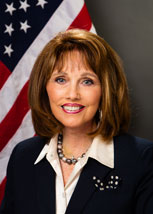
Photo of Patricia C. Bates
R California Senate · District 36

Sen. Patricia C. Bates

Compare
Total votes
46,261
all sessions
Attendance
93%
1,864 missed
Lower than 78% of chamber peers
With party
98%
of cast votes
Near the chamber average
Bipartisan score
2%
crosses aisle rarely
Higher than 81% of chamber peers
Sponsored
1,957
bills & resolutions
Near the chamber average
Committees
0
assignments
1,957 bills and resolutions

Sponsored bills

Total
1,957
Primary
271
Co-sponsor
1,686
This page
1,957
matching current filters
Primary SB 1373
Passed · California Senate · Lead sponsor
State highways: State Route 241: reduction.

Existing law establishes the state highway system throughout the state and designates State Route 241 from State Route 5 south of the City of San Clemente to State Route 91 in the City of Anaheim. This bill would delete from the state highway system the portion of State Route 241 from State Route 5 south of the City of San Clemente to Oso Parkway east of the City of Mission Viejo.

Passed Jul 27, 2020 0 co-sponsors
Co-sponsor SB 943
In committee · California Senate · Co-sponsor
Paid family leave: COVID-19.

Existing law establishes within the state disability insurance program a family temporary disability insurance program, also known as the Paid Family Leave program, for the provision of wage replacement benefits to workers who take time off work to care for a seriously ill family member or to bond with a minor child within one year of birth or placement, as specified. This bill would, until December 31, 2020, also authorize wage replacement benefits to specified workers who take time off work to care for a child or other family member, including a child or adult with disabilities, for whom the employee is responsible for providing care if that person's school or place of care has been closed, or the care provider of that person is unavailable, due to the COVID-19 virus outbreak. The bill would require that any additional costs associated with the extension of wage replacement benefits in these provisions be paid from the General Fund, upon appropriation by the Legislature. This bill would declare that it is to take effect immediately as an urgency statute.

In committee Jun 18, 2020 1 co-sponsor
Co-sponsor SCR 88
Passed · California Senate · Co-sponsor
Relative to California Peace Officers' Memorial Day.

This measure would designate Monday, May 4, 2020, as California Peace Officers' Memorial Day, urge all Californians to use that day to honor California peace officers, and recognize specified California peace officers who were killed in defense of their communities.

Passed Jun 11, 2020 1 co-sponsor
Primary SB 1319
died · California Senate · Lead sponsor
Property taxation: change in ownership.

The California Constitution generally limits ad valorem taxes on real property to 1% of the full cash value of that property. For purposes of this limitation, "full cash value" is defined as the assessor's valuation of real property as shown on the 1975–76 tax bill under "full cash value" or, thereafter, the appraised value of that real property when purchased, newly constructed, or a change in ownership has occurred. Existing law specifies those circumstances in which the transfer of ownership interests in a corporation, partnership, limited liability company, or other legal entity results in a change in ownership of the real property owned by that entity, and generally provides that a change in ownership as so described occurs if a legal entity or other person obtains a controlling or majority ownership interest in the legal entity. Existing law requires the Franchise Tax Board to include a question on returns for partnerships, banks, and corporations to assist in the determination of whether a change in ownership under the circumstances described above has occurred. This bill would additionally specify that if 90% or more of the direct or indirect ownership interests in a legal entity are sold or transferred in a single transaction, as defined, the real property owned by that legal entity has changed ownership whether or not any one legal entity or person that is a party to the transaction obtains control, as defined. The bill would require the Franchise Tax Board to include an additional question on returns for partnerships, banks, and corporations to assist in the determination of whether a change in ownership as so described has occurred. The bill would require the State Board of Equalization to prescribe regulations as may be necessary to carry out the purposes of this act. The bill would also require the State Board of Equalization to report to the Legislature, no later than January 1, 2023, regarding the implementation of these changes in ownership, including, but not limited to, the revenue impact and frequency of reassessments of real property owned by legal entities. The bill would require the Legislative Analyst's Office to report to the Legislature no later than January 1, 2023, regarding the economic impact of this bill. Existing law requires, upon a change in control or change in ownership of a legal entity that owns an interest in real property in this state, or when requested by the State Board of Equalization, that the person or legal entity acquiring ownership or control, or the legal entity that has undergone a change in ownership, file a change in ownership statement with the board, as specified. Existing law requires a penalty of 10% of the taxes applicable to the new base year value, as specified, or 10% of the current year's taxes on the property, as specified, to be added to the assessment made on the roll if a person or legal entity required to file a change in ownership statement fails to do so, including a change in ownership of a floating home. This bill would require a person or legal entity acquiring ownership interests in a legal entity, if 90% or more of the ownership interests in the legal entity are sold or transferred, as described above, to file a change in ownership statement signed under penalty of perjury with the State Board of Equalization. The bill would increase the penalties for failure to file a change in ownership statement, as described above, from 10% to 15%, would provide that the penalty shall apply for failure to file a complete statement with the State Board of Equalization following a transfer of legal entity ownership interests, but would eliminate the application of these penalties to a change in ownership of a floating home. This bill would require the State Board of Equalization to notify assessors if a change in control or a change in ownership of a legal entity has occurred. By expanding the crime of perjury and by imposing new duties upon local county officials with respect to changes in ownership, this bill would impose a state-mandated local program. The California Constitution requires the state to reimburse local agencies and school districts for certain costs mandated by the state. Statutory provisions establish procedures for making that reimbursement. This bill would provide that with regard to certain mandates no reimbursement is required by this act for a specified reason. With regard to any other mandates, this bill would provide that, if the Commission on State Mandates determines that the bill contains costs so mandated by the state, reimbursement for those costs shall be made pursuant to the statutory provisions noted above. This bill would declare that it is to take effect immediately as an urgency statute.


died Jun 3, 2020 0 co-sponsors
Primary SB 1090
In committee · California Senate · Lead sponsor
Coastal erosion: installation of shoreline protective devices: application process.

The California Coastal Act of 1976 provides for the planning and regulation of development within the coastal zone, as defined. The act requires construction that alters natural shoreline processes to be permitted by the California Coastal Commission or a local government with an approved local coastal program when required to serve coastal-dependent uses or to protect existing structures or public beaches in danger from erosion and when designed to eliminate or mitigate adverse impacts on local shoreline sand supply. The act further provides that certain marine structures should be phased out or upgraded, where feasible. This bill would, except as provided, require the commission or a local government with an approved local coastal program to approve the repair, maintenance, or construction of retaining walls, return walls, seawalls, revetments, or similar shoreline protective devices for beaches or adjacent existing residential properties in the coastal zone in the Counties of Orange and San Diego that are designed to mitigate or protect against coastal erosion. If a local government denies the application for a shoreline protective device, the bill would require the local government to inform the commission, in writing, of its decision with supporting evidence. The bill would require the commission, if it denies an application or if it receives notice of a local government's denial, to submit a report to the Legislature of its denial or the report from the local government. By imposing additional duties on a local government, this bill would impose a state-mandated local program. The bill would authorize the commission or a local government to charge a fee for the processing of an application for a shoreline protective device, as provided. The bill would specify the procedure for seeking judicial review for action taken by the commission or a local government for applications for shoreline protective devices and would provide that a decision denying the application is subject to de novo review by a court. The bill would require the commission to identify native plant species for areas in the coastal zone of the Counties of Orange and San Diego, as specified, and would specify that a property owner would not be required to obtain approval from the commission or a local government for the planting of those identified species. The California Environmental Quality Act (CEQA) requires a lead agency, as defined, to prepare, or cause to be prepared, and certify the completion of an environmental impact report on a project that it proposes to carry out or approve that may have a significant effect on the environment or to adopt a negative declaration if it finds that the project will not have that effect. CEQA also requires a lead agency to prepare a mitigated negative declaration for a project that may have a significant effect on the environment if revisions in the project would avoid or mitigate that effect and there is no substantial evidence that the project, as revised, would have a significant effect on the environment. This bill would exempt from CEQA actions taken by a public agency implementing the provisions of this bill. The California Constitution requires the state to reimburse local agencies and school districts for certain costs mandated by the state. Statutory provisions establish procedures for making that reimbursement. This bill would provide that no reimbursement is required by this act for a specified reason. This bill would make legislative findings and declarations as to the necessity of a special statute for the Counties of Orange and San Diego.

In committee May 26, 2020 0 co-sponsors
Co-sponsor SB 990
died · California Senate · Co-sponsor
Worker status: independent contractors: transportation network companies.

Existing law requires a 3-part test, commonly known as the "ABC" test, to determine if workers are employees or independent contractors for purposes of the Labor Code, the Unemployment Insurance Code, and the wage orders of the Industrial Welfare Commission. Under the ABC test, a person providing labor or services for remuneration is considered an employee rather than an independent contractor unless the hiring entity demonstrates that the person is free from the control and direction of the hiring entity in connection with the performance of the work, the person performs work that is outside the usual course of the hiring entity's business, and the person is customarily engaged in an independently established trade, occupation, or business. Existing law charges the Labor Commissioner with the enforcement of labor laws, including worker classification. Existing law exempts specified occupations and business relationships from the application of the ABC test described above. Existing law, instead, provides that these exempt relationships are governed by the multifactor test previously established in the case of S. G. Borello & Sons, Inc. v. Department of Industrial Relations (1989) 48 Cal.3d 341. This bill would repeal these existing ABC test provisions and instead makes them operative on January 1, 2022.

died May 18, 2020 1 co-sponsor
Showing 131 to 140 of 1,957 bills
Previous 1 … 13 14 15 … 196 Next