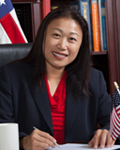
Photo of Janet Nguyen
R California Senate · District 36

Sen. Janet Nguyen

Contact Email
Compare
Total votes
17,486
all sessions
Attendance
90%
1,423 missed
Near the chamber average
With party
97%
of cast votes
Near the chamber average
Bipartisan score
2%
crosses aisle rarely
Near the chamber average
Sponsored
706
bills & resolutions
Near the chamber average
Committees
0
assignments
706 bills and resolutions

Sponsored bills

Total
706
Primary
159
Co-sponsor
547
This page
706
matching current filters
Co-sponsor AB 1762
Signed into law · California Assembly · Co-sponsor
State parks: visitors: animals: dogs.

Under existing law, the Department of Parks and Recreation administers and manages the state park system. Existing law permits visitors to bring animals into units of the state park system when the Director of Parks and Recreation determines that it is in the public interest, subject to certain conditions. This bill would require the department to establish and maintain on its Internet Web site a comprehensive, up-to-date list of each unit with information on whether the unit or a portion of the unit allows dogs and additional specified information.

Signed into law Sep 29, 2018 1 co-sponsor
Co-sponsor SB 970
Signed into law · California Senate · Co-sponsor
Employment: human trafficking awareness.

Existing law requires specified businesses and other establishments to post a notice, as developed by the Department of Justice, that contains information relating to slavery and human trafficking, including information regarding specified nonprofit organizations that a person can call for services or support in the elimination of slavery and human trafficking. The California Fair Employment and Housing Act (FEHA) makes specified employment practices unlawful, including the harassment of an employee directly by the employer or indirectly by agents of the employer with the employer's knowledge. FEHA requires employers with 50 or more employees to provide at least 2 hours of prescribed training and education regarding sexual harassment to all supervisory employees within 6 months of their assumption of a supervisory position and once every 2 years, as specified. This bill would amend FEHA to require specified employers to provide at least 20 minutes of prescribed training and education regarding human trafficking awareness to employees who are likely to interact or come into contact with victims of human trafficking, as defined. The bill would establish a schedule for compliance commencing January 1, 2020. The bill would authorize the Department of Fair Employment and Housing, in the case of an employer violation of the bill's requirements, to seek an order requiring compliance.

Signed into law Sep 27, 2018 1 co-sponsor
Co-sponsor SB 1007
Signed into law · California Senate · Co-sponsor
Sales and use taxes: exemption: military and veteran medical facilities.

Existing state sales and use tax laws impose a tax on retailers measured by the gross receipts from the sale of tangible personal property sold at retail in this state, or on the storage, use, or other consumption in this state of tangible personal property purchased from a retailer for storage, use, or other consumption in this state. The Sales and Use Tax Law provides various exemptions from those taxes, including an exemption for the sale of, or the storage, use, or other consumption of, meals and food products that are furnished or served by any nonprofit veteran's organization for purposes of fundraising, as specified. This bill, on and after January 1, 2019, and before January 1, 2025, would exempt from these taxes the gross receipts from the sale of, and the storage, use, or other consumption in this state of, building materials and supplies purchased by a qualified person for use by that qualified person in the construction of specified military and veteran medical facilities. The Bradley-Burns Uniform Local Sales and Use Tax Law authorizes cities and counties to impose local sales and use taxes in conformity with the Sales and Use Tax Law, and existing laws authorize districts, as specified, to impose transactions and use taxes in accordance with the Transactions and Use Tax Law, which generally conforms to the Sales and Use Tax Law. Amendments to the Sales and Use Tax Law are automatically incorporated into the local tax laws. Existing law requires the state to reimburse cities and counties for revenue losses caused by the enactment of sales and use tax exemptions. This bill would provide that, notwithstanding these provisions, no appropriation is made and the state shall not reimburse cities and counties for sales and use tax revenues lost by them pursuant to this bill. This bill would take effect immediately as a tax levy.

Signed into law Sep 26, 2018 1 co-sponsor
Co-sponsor SB 1109
Signed into law · California Senate · Co-sponsor
Controlled substances: Schedule II drugs: opioids.

(1) The Medical Practice Act provides for the licensure and regulation of physicians and surgeons by the Medical Board of California. Under that act, the board is required to adopt and administer standards for the continuing education of physicians and surgeons. Existing law requires a physician and surgeon to complete a mandatory continuing education course in the subjects of pain management and the treatment of terminally ill and dying patients. That act requires the board to give its highest priority to considering a course in pain management among its continuing education requirements for licensees, and requires the board to periodically develop and disseminate information and educational material on pain management techniques and procedures to licensees and general acute care hospitals. This bill would require, for physicians and surgeons licensed on or after January 1, 2019, the mandatory continuing education course to also include the subject of the risks of addiction associated with the use of Schedule II drugs. The bill would require the board to give its highest priority to considering a course in the risks of addiction associated with the use of Schedule II drugs among its continuing education requirements for physicians and surgeons and would require the board to periodically develop and disseminate information and educational material on the risks of addiction associated with the use of Schedule II drugs to physicians and surgeons and general acute care hospitals. (2) The Nursing Practice Act provides for the licensure and regulation of the practice of nursing by the Board of Registered Nursing and makes a violation of its provisions a crime. Existing law authorizes a certified nurse-midwife to furnish or order drugs or devices under specified circumstances, including board certification that the certified nurse-midwife has completed a course in pharmacology, as specified. This bill would require the pharmacology course to include the risks of addiction and neonatal abstinence syndrome associated with the use of opioids. Existing law also authorizes a nurse practitioner to furnish or order drugs or devices under specified circumstances, including board certification that the nurse practitioner has completed a course in pharmacology, as specified. Existing law requires nurse practitioners who are authorized to furnish Schedule II controlled substances to complete a mandatory continuing education course in Schedule II controlled substances. This bill would require the mandatory continuing education course to include the risks of addiction associated with their use. By expanding the scope of a crime under the Nursing Practice Act, the bill would impose a state-mandated local program. (3) The Physician Assistant Practice Act provides for licensure and regulation of physician assistants by the Physician Assistant Board and authorizes a physician assistant to perform medical services as set forth by regulations when those services are rendered under the supervision of a licensed physician and surgeon, as specified. The act prohibits a physician assistant from administering, providing, or issuing a drug order to a patient for Schedule II through Schedule V controlled substances without advance approval by a supervising physician and surgeon for that particular patient unless the physician assistant has completed an education course that meets specific standards. This bill would require that course to include the risks of addiction associated with the use of Schedule II controlled substances. (4) The Pharmacy Law provides for the licensure and regulation of pharmacists, pharmacy technicians, and pharmacies by the California State Board of Pharmacy. Existing law requires the board to promulgate regulations that require a standardized, patient-centered, prescription drug label on all prescription medicine dispensed to patients in California. The act makes a violation of its provisions a crime. This bill would require a pharmacy or practitioner dispensing an opioid to a patient for outpatient use to prominently display on the label or container a notice that warns of the risk of overdose and addiction, as specified. Because a violation of that requirement would be a crime, the bill would impose a state-mandated local program. (5) The Dental Practice Act provides for the licensure and regulation of persons engaged in the practice of dentistry by the Dental Board of California, which is within the Department of Consumer Affairs. The act authorizes the board, as a condition of license renewal, to require licentiates to successfully complete a portion of required continuing education hours in specific areas, including patient care, health and safety, and law and ethics. This bill would include the risks of addiction associated with the use of Schedule II drugs in those specific areas of continuing education. (6) Existing law, the Osteopathic Act, establishes the Osteopathic Medical Board of California, which issues certificates to, and regulates, osteopathic physicians and surgeons. Existing law requires the board to require each licensed osteopathic physician and surgeon to complete a minimum of 100 hours of American Osteopathic Association continuing education hours during each 2-year cycle, of which 40 hours must be completed in American Osteopathic Association Category 1 continuing education hours as a condition for renewal of an active license. This bill would additionally require licensed osteopathic physician and surgeons to complete a course on the risks of addiction associated with the use of Schedule II drugs. (7) The Optometry Practice Act provides for the licensure and regulation of the practice of optometry by the State Board of Optometry. The act requires an optometrist certified to use therapeutic pharmaceutical agents to complete a total of 50 hours of continuing education every 2 years in order to renew his or her certificate. Existing law requires 35 of the 50 hours of continuing education to be on the diagnosis, treatment, and management of ocular disease in any combination of specified areas, including pain medication. This bill would expand the areas of continuing education to include risks of addiction associated with the use of Schedule II drugs. (8) The California Uniform Controlled Substances Act classifies opioids as Schedule II controlled substances and places restrictions on the prescription of those drugs, including prohibiting refills and specifying the requirements of a prescription for these drugs. The act makes a violation of its provisions a crime. This bill would require a prescriber to discuss specified information with the minor, the minor's parent or guardian, or other adult authorized to consent to the minor's medical treatment before directly dispensing or issuing for a minor the first prescription in a single course of treatment for a controlled substance containing an opioid. This bill would provide that a violation of these requirements is not a criminal offense. (9) Existing law requires a school district, charter school, or private school that elects to offer an athletic program to take specified actions if an athlete is suspected to have sustained a concussion and to obtain a signed concussion and head injury information sheet from the athlete and athlete's parent or guardian before the athlete initiates practice or competition. This bill would require a youth sports organization, as defined, that elects to offer an athletic program to annually give a specified Opioid Factsheet for Patients to each athlete, and would require each athlete and his or her parent to sign a document acknowledging receipt of that factsheet, as specified. (10) Existing law requires a youth sports organization, as defined, that elects to offer an athletic program to, among other things, annually give a concussion and head injury information sheet to each athlete and requires that the sheet be signed, as specified. This bill would also require a youth sports organization that elects to offer an athletic program to annually give a specified Opioid Factsheet for Patients to each athlete, and would require each athlete and his or her parent to sign a document verifying receipt of that factsheet, as specified. This bill would incorporate additional changes to Section 1645 of the Business and Professions Code proposed by SB 1491 to be operative only if this bill and SB 1491 are enacted and this bill is enacted last. The California Constitution requires the state to reimburse local agencies and school districts for certain costs mandated by the state. Statutory provisions establish procedures for making that reimbursement. This bill would provide that no reimbursement is required by this act for a specified reason.

Signed into law Sep 22, 2018 1 co-sponsor
Primary SB 895
Signed into law · California Senate · Lead sponsor
Pupil instruction: model curricula: Vietnamese American refugee experience, the Cambodian genocide, and Hmong history and cultural studies.

Existing law requires the adopted course of study for grades 1 to 12, inclusive, to include, among other subjects, the social sciences. Existing law encourages instruction in the area of social sciences for grades 7 to 12, inclusive, that may include instruction on the Vietnam War, including a component drawn from personal testimony of Southeast Asians who were involved in the Vietnam War and men and women who contributed to the war effort on the homefront, as specified. Existing law requires the State Board of Education, with the assistance of the Superintendent of Public Instruction, to establish a list of textbooks and other instructional materials that highlight the contributions of minorities in the development of California and the United States. Existing law establishes the Instructional Quality Commission and requires the commission to, among other things, recommend curriculum frameworks to the state board. This bill would require the commission to develop and submit to the state board, on or before December 31, 2022, and the state board to adopt, modify, or revise, on or before March 31, 2023, a model curriculum relative to the Vietnamese American refugee experience and a model curriculum relative to the Cambodian genocide, as specified, for use in elementary schools, middle schools, and high schools. The bill would encourage a school district, charter school, or county office of education that maintains kindergarten or any of grades 1 to 12, inclusive, that does not otherwise offer a standards-based curriculum relative to the Vietnamese American refugee experience, Vietnamese boat people, and the Republic of Vietnam Armed Forces, or that does not otherwise offer a standards-based curriculum relative to the Cambodian genocide, to offer a course of study based on the respective model curriculum. The bill would require the model curricula to be developed with participation from specified entities and individuals. The bill would provide that implementation of its provisions is subject to the receipt of grants, donations, or other financial support from private or public sources for its purposes, including, but not limited to, an appropriation in the annual Budget Act or another statute. The bill would require the commission to develop a model curriculum in Hmong history and cultural studies, as provided. The bill would require the commission, on or before December 31, 2022, to submit the model curriculum to the state board for adoption, and would require the state board to adopt, modify, or reject the model curriculum on or before March 31, 2023. The bill would require the Superintendent, following the adoption of the model curriculum, to post the model curriculum on the State Department of Education's Internet Web site for use on a voluntary basis by educators. The bill, beginning in the school year following the adoption of the model curriculum, would encourage local educational agencies, as defined, to use the model curriculum to provide instruction in kindergarten and grades 1 to 12, inclusive. The bill would provide that implementation of its provisions is subject to the receipt of grants, donations, or other financial support from private or public sources for its purposes, including, but not limited to, an appropriation in the annual Budget Act or another statute.


Signed into law Sep 22, 2018 0 co-sponsors
Co-sponsor SCR 115
Signed into law · California Senate · Co-sponsor
Relative to the opioid crisis.

This measure would recognize the impact opioid-related deaths have had on California communities and would support groups and organizations working in California to combat the epidemic.

Signed into law Sep 12, 2018 1 co-sponsor
Co-sponsor SCR 159
Signed into law · California Senate · Co-sponsor
Relative to the Long Beach Fire Captain David Rosa Memorial Highway.

This measure would designate the portion of Interstate 5 between Camino Las Ramblas and the Ortega Highway in the County of Orange as the Long Beach Fire Captain David Rosa Memorial Highway. The measure would also request the Department of Transportation to determine the cost for appropriate signs showing this special designation and, upon receiving donations from nonstate sources covering that cost, to erect those signs.

Signed into law Sep 11, 2018 1 co-sponsor
Co-sponsor AB 448
Signed into law · California Assembly · Co-sponsor
Joint powers authorities: Orange County Housing Finance Trust.

Existing law authorizes 2 or more public agencies, by agreement, to form a joint powers authority to exercise any power common to the contracting parties, as specified. Existing law authorizes the agreement to set forth the manner by which the joint powers authority will be governed. This bill would authorize the creation of the Orange County Housing Finance Trust, a joint powers authority, for the purposes of funding housing specifically assisting the homeless population and persons and families of extremely low, very low, and low income within the County of Orange, as specified. This bill would make legislative findings and declarations as to the necessity of a special statute for the County of Orange.

Signed into law Sep 11, 2018 1 co-sponsor
Showing 421 to 430 of 706 bills
Previous 1 … 42 43 44 … 71 Next