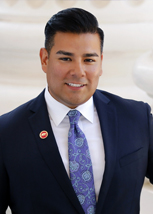
Photo of Ricardo Lara
D California Senate · District 33

Sen. Ricardo Lara

Compare
Total votes
22,880
all sessions
Attendance
80%
3,261 missed
Lower than 100% of chamber peers
With party
99%
of cast votes
Higher than 96% of chamber peers
Bipartisan score
0%
crosses aisle rarely
Lower than 100% of chamber peers
Sponsored
603
bills & resolutions
Lower than 100% of chamber peers
Committees
0
assignments
603 bills and resolutions

Sponsored bills

Total
603
Primary
214
Co-sponsor
389
This page
603
matching current filters
Co-sponsor SCR 114
Signed into law · California Senate · Co-sponsor
Relative to World Cup 2026.

This measure would declare that the State of California welcomes the hosting of World Cup 2026, would declare the state's full support of local organizing committees in the San Francisco Bay area and Los Angeles area to be selected as World Cup 2026 sites, and would encourage the Governor and all affected state departments to cooperate with those committees.

Signed into law Sep 11, 2018 1 co-sponsor
Co-sponsor SCR 159
Signed into law · California Senate · Co-sponsor
Relative to the Long Beach Fire Captain David Rosa Memorial Highway.

This measure would designate the portion of Interstate 5 between Camino Las Ramblas and the Ortega Highway in the County of Orange as the Long Beach Fire Captain David Rosa Memorial Highway. The measure would also request the Department of Transportation to determine the cost for appropriate signs showing this special designation and, upon receiving donations from nonstate sources covering that cost, to erect those signs.

Signed into law Sep 11, 2018 1 co-sponsor
Co-sponsor SCR 110
Signed into law · California Senate · Co-sponsor
Relative to sex characteristics.

This measure would, among other things, call upon stakeholders in the health professions to foster the well-being of children born with variations of sex characteristics through the enactment of policies and procedures that ensure individualized, multidisciplinary care, as provided.

Signed into law Sep 11, 2018 1 co-sponsor
Co-sponsor SB 100
Signed into law · California Senate · Co-sponsor
California Renewables Portfolio Standard Program: emissions of greenhouse gases.

(1) Under existing law, the Public Utilities Commission (PUC) has regulatory authority over public utilities, including electrical corporations, while local publicly owned electric utilities, as defined, are under the direction of their governing boards. The California Renewables Portfolio Standard Program requires the PUC to establish a renewables portfolio standard requiring all retail sellers, as defined, to procure a minimum quantity of electricity products from eligible renewable energy resources, as defined, so that the total kilowatthours of those products sold to their retail end-use customers achieve 25% of retail sales by December 31, 2016, 33% by December 31, 2020, 40% by December 31, 2024, 45% by December 31, 2027, and 50% by December 31, 2030. The program additionally requires each local publicly owned electric utility, as defined, to procure a minimum quantity of electricity products from eligible renewable energy resources to achieve the procurement requirements established by the program. The Legislature has found and declared that its intent in implementing the program is to attain, among other targets for sale of eligible renewable resources, the target of 50% of total retail sales of electricity by December 31, 2030. This bill would revise the above-described legislative findings and declarations to state that the goal of the program is to achieve that 50% renewable resources target by December 31, 2026, and to achieve a 60% target by December 31, 2030. The bill would require that retail sellers and local publicly owned electric utilities procure a minimum quantity of electricity products from eligible renewable energy resources so that the total kilowatthours of those products sold to their retail end-use customers achieve 44% of retail sales by December 31, 2024, 52% by December 31, 2027, and 60% by December 31, 2030. Under existing law, a local publicly owned electric utility is not required to procure more than a specified minimum quantity of eligible renewable energy resources under the program if it receives more than 50% of its retail sales from hydroelectric generation, as specified. This bill would revise those provisions, limit the applicability of this exception to large hydroelectric generation, and reduce that threshold to 40%. (2) Existing law establishes the California Environmental Protection Agency, establishes the State Air Resources Board within the agency as the entity with responsibility for control of emissions from motor vehicles, and designates the state board as the air pollution control agency for all purposes set forth in federal law. The California Global Warming Solutions Act of 2006 establishes the state board as the state agency charged with monitoring and regulating sources of emissions of greenhouse gases that cause global warming. The Warren-Alquist State Energy Resources Conservation and Development Act establishes the State Energy Resources Conservation and Development Commission (Energy Commission) and requires it to conduct an ongoing assessment of the opportunities and constraints presented by all forms of energy, to encourage the balanced use of all sources of energy to meet the state's needs, and to seek to avoid possible undesirable consequences of reliance on a single source of energy. This bill would state that it is the policy of the state that eligible renewable energy resources and zero-carbon resources supply 100% of retail sales of electricity to California end-use customers and 100% of electricity procured to serve all state agencies by December 31, 2045. The bill would require that the achievement of this policy for California not increase carbon emissions elsewhere in the western grid and that the achievement not allow resource shuffling. The bill would require the PUC and the Energy Commission, in consultation with the state board, to take steps to ensure that a transition to a zero-carbon electric system for the State of California does not cause or contribute to greenhouse gas emissions increases elsewhere in the western grid. The bill would require the PUC, Energy Commission, state board, and all other state agencies to incorporate that policy into all relevant planning. The bill would require the PUC, Energy Commission, state board, and all other state agencies to ensure actions taken in furtherance of these purposes achieve specified objectives. The bill would require the PUC, Energy Commission, and state board to utilize programs authorized under existing statutes to achieve that policy and, as part of a public process, issue a joint report to the Legislature by January 1, 2021, and every 4 years thereafter, that includes specified information relating to the implementation of the policy. (3) Under existing law, a violation of the Public Utilities Act or any order, decision, rule, direction, demand, or requirement of the PUC is a crime. Because certain of the provisions of this bill would be a part of the act and because a violation of an order or decision of the PUC implementing its requirements would be a crime, the bill would impose a state-mandated local program. By expanding the requirements placed upon a local publicly owned electric utility, the bill would impose a state-mandated local program. The California Constitution requires the state to reimburse local agencies and school districts for certain costs mandated by the state. Statutory provisions establish procedures for making that reimbursement. This bill would provide that no reimbursement is required by this act for specified reasons.


Signed into law Sep 10, 2018 1 co-sponsor
Co-sponsor SB 834
Signed into law · California Senate · Co-sponsor
State lands: leasing: oil and gas.

Existing law vests exclusive jurisdiction over ungranted tidelands and submerged lands owned by the state to the State Lands Commission. Existing law confers the powers of the commission as to leasing or granting of rights or privileges to lands owned by the state upon a local trustee of granted public trust lands to which those lands have been granted. Existing law authorizes the commission to let leases for the extraction of oil and gas from coastal tidelands or submerged lands in state waters and beds of navigable rivers and lakes within the state in accordance with specified provisions of law. Existing law, notwithstanding those provisions or any other provision of law, prohibits a state agency or state officer from entering into any new lease for the extraction of oil or gas from the California Coastal Sanctuary, which includes certain state waters subject to tidal influence, unless either (1) the President of the United States has found a severe energy supply interruption and has ordered distribution of the Strategic Petroleum Reserve, the Governor finds that the energy resources of the sanctuary will contribute significantly to the alleviation of that interruption, and the Legislature subsequently acts to amend the law to allow the extraction, or (2) the commission determines that the oil or gas deposits are being drained by means of producing wells upon adjacent federal lands and the lease is in the best interest of the state. This bill would prohibit the commission or a local trustee, as defined, of granted public trust lands from entering into any new lease or other conveyance authorizing new construction of oil- and gas-related infrastructure upon tidelands and submerged lands within state waters associated with Pacific Outer Continental Shelf leases issued after January 1, 2018. The bill would require the commission or a local trustee when approving or disapproving any lease renewal, extension, amendment, or modification authorizing new construction of oil- and gas-related infrastructure upon tidelands and submerged lands within state waters associated with Pacific Outer Continental Shelf leases issued after January 1, 2018, to follow a specified process. The bill would provide that these provisions do not prevent specified activities, including, among others, issuance by the commission of leases pursuant to exceptions applicable to the California Coastal Sanctuary described above. The bill would authorize the commission to establish regulations for the implementation of these provisions. By adding to the duties of local agencies when approving or disapproving leases, this bill would impose a state-mandated local program. The California Constitution requires the state to reimburse local agencies and school districts for certain costs mandated by the state. Statutory provisions establish procedures for making that reimbursement. This bill would provide that, if the Commission on State Mandates determines that the bill contains costs mandated by the state, reimbursement for those costs shall be made pursuant to the statutory provisions noted above.

Signed into law Sep 8, 2018 1 co-sponsor
Co-sponsor AJR 46
Signed into law · California House · Co-sponsor
Federal zero tolerance immigration policy: family separation.

This measure would urge President Trump, United States Attorney General Sessions, the United States Department of Justice, the United States Department of Homeland Security, and all other relevant federal departments to immediately cease the implementation of the "zero tolerance" federal immigration policy and to not propose any additional inhumane immigration policies in the future. The measure would further call for compassion and decency for all individuals, families, and children who arrive at our borders seeking a better life.

Signed into law Sep 6, 2018 1 co-sponsor
Co-sponsor ACR 260
Signed into law · California House · Co-sponsor
Statutes: gender-neutral language: pronouns.

This measure would encourage the Legislature to engage in a coordinated effort to revise existing statutes and introduce new legislation with inclusive language by using gender-neutral pronouns or reusing nouns to avoid the use of gendered pronouns. The measure would also encourage state agencies to engage in similar efforts to use gender-neutral pronouns and avoid the use of gendered pronouns when drafting policies, regulations, and other guidance.

Signed into law Sep 5, 2018 1 co-sponsor
Co-sponsor SCR 161
Signed into law · California Senate · Co-sponsor
Relative to California Runaway and Homeless Youth Prevention Month.

This measure would designate the month of November 2018 as California Runaway and Homeless Youth Prevention Month and would recognize the need for individuals, schools, communities, businesses, local governments, and the state to take action on behalf of runaway and homeless youth in California.

Signed into law Sep 4, 2018 1 co-sponsor
Showing 41 to 50 of 603 bills
Previous 1 4 5 6 61 Next