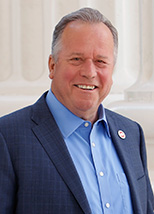
Photo of Bill Dodd
D California Senate · District 3

Sen. Bill Dodd

Contact Email
Compare
Total votes
20,491
all sessions
Attendance
97%
423 missed
Lower than 97% of chamber peers
With party
99%
of cast votes
Bipartisan score
0%
crosses aisle rarely
Sponsored
1,151
bills & resolutions
Near the chamber average
Committees
0
assignments
1,151 bills and resolutions

Sponsored bills

Total
1,151
Primary
250
Co-sponsor
901
This page
1,151
matching current filters
Primary SCR 65
Signed into law · California Senate · Lead sponsor
Relative to Child Passenger Safety Week.

This measure would recognize the 3rd week of September 2019, and the 3rd week of September each year thereafter, as Child Passenger Safety Week.

Signed into law Sep 19, 2019 0 co-sponsors
Co-sponsor SB 39
Signed into law · California Senate · Co-sponsor
Tobacco products.

Existing law, the Stop Tobacco Access to Kids Enforcement (STAKE) Act, prohibits the sale, distribution, or nonsale distribution of tobacco products, as defined, directly or indirectly to any person under 21 years of age through the United States Postal Service or through any other public or private postal or package delivery service. Existing law requires a person selling or distributing tobacco products directly to a consumer through the United States Postal Service or by another postal or package delivery service to comply with specified age-verification policies and deliver only to the consumer's verified mailing or billing address, as applicable. Existing law authorizes enforcing agencies to assess civil penalties for violations of the STAKE Act. This bill would additionally require sellers, distributors, and nonsale distributors to deliver tobacco products only in conspicuously marked containers, as specified, and to obtain the signature of a person 21 years of age or older before delivering a tobacco product. The bill would allow a person to designate an address for delivery that is different from the person's mailing or billing address, if the person's mailing or billing address has been verified in accordance with specified provisions.

Signed into law Sep 16, 2019 1 co-sponsor
Co-sponsor SB 230
Signed into law · California Senate · Co-sponsor
Law enforcement: use of deadly force: training: policies.

(1) Existing law requires each law enforcement agency to annually furnish specified information to the Department of Justice regarding the use of force by a peace officer. Existing law requires the Department of Justice, once per year, to update a summary of information contained in the reports received on its internet website. Existing law requires a department or agency that employs peace officers or custodial officers to establish a procedure to investigate complaints by members of the public against those officers. This bill would, by no later than January 1, 2021, require each law enforcement agency to maintain a policy that provides guidelines on the use of force, utilizing deescalation techniques and other alternatives to force when feasible, specific guidelines for the application of deadly force, and factors for evaluating and reviewing all use of force incidents, among other things. The bill would require each agency to make their use of force policy accessible to the public. By imposing additional duties on local agencies, this bill would create a state-mandated local program. (2) Existing law establishes the Commission on Peace Officer Standards and Training in the Department of Justice and requires the commission to adopt rules establishing minimum standards regarding the recruitment of peace officers. Existing law requires the commission to develop guidelines and implement courses of instruction regarding racial profiling, domestic violence, hate crimes, vehicle pursuits, and human trafficking, among others. This bill would require the commission to implement a course or courses of instruction for the regular and periodic training of law enforcement officers in the use of force. The bill would require the commission to develop uniform, minimum guidelines for adoption and promulgation by California law enforcement agencies for the use of force, as specified. The bill would require law enforcement agencies to adopt and promulgate a use of force policy and would state the intent of the Legislature that each law enforcement agency adopt, promulgate, and require regular and periodic training consistent with the agency's policy that complies with the guidelines developed under this bill. This bill would make findings and declarations regarding the intent of the bill, as it pertains to law enforcement agencies' use of force polices, including that those policies may be introduced in legal proceedings and may be considered as a factor in determining the reasonableness of an officer's actions, but do not impose a legal duty on an officer to act in accordance with the policy. (3) The California Constitution requires the state to reimburse local agencies and school districts for certain costs mandated by the state. Statutory provisions establish procedures for making that reimbursement. This bill would provide that, if the Commission on State Mandates determines that the bill contains costs mandated by the state, reimbursement for those costs shall be made pursuant to the statutory provisions noted above. (4) This bill would also make its provisions operative contingent on the enactment of Assembly Bill 392 of the 2019–20 Regular Session.

Signed into law Sep 13, 2019 1 co-sponsor
Co-sponsor ACR 122
Signed into law · California Assembly · Co-sponsor
Relative to Diaper Need Awareness Week.

This measure would proclaim the week of September 23, 2019, to September 29, 2019, as Diaper Need Awareness Week and encourage California citizens to support organizations that help alleviate diaper need.

Signed into law Sep 11, 2019 1 co-sponsor
Primary SCR 70
Signed into law · California Senate · Lead sponsor
Relative to Sacramento-San Joaquin Delta Week.

This measure, among other things, would declare the week of September 21, 2019, as Sacramento-San Joaquin Delta Week, with the purpose of expanding the acknowledgment of the Sacramento-San Joaquin Delta region's contributions to a higher quality of life for all Californians.

Signed into law Sep 11, 2019 0 co-sponsors
Co-sponsor SB 66
Passed · California Senate · Co-sponsor
Medi-Cal: federally qualified health center and rural health clinic services.

Existing law provides for the Medi-Cal program, which is administered by the State Department of Health Care Services, under which qualified low-income individuals receive health care services. The Medi-Cal program is, in part, governed and funded by federal Medicaid program provisions. Existing law provides that federally qualified health center (FQHC) services and rural health clinic (RHC) services, as defined, are covered benefits under the Medi-Cal program, to be reimbursed, to the extent that federal financial participation is obtained, to providers on a per-visit basis. "Visit" is defined as a face-to-face encounter between a patient of an FQHC or RHC and specified health care professionals, including a physician and marriage and family therapist. Under existing law, "physician," for these purposes, includes, but is not limited to, a physician and surgeon, an osteopath, and a podiatrist. This bill would authorize reimbursement for a maximum of 2 visits taking place on the same day at a single location if after the first visit the patient suffers illness or injury requiring additional diagnosis or treatment, or if the patient has a medical visit and a mental health visit or a dental visit, as defined. The bill would authorize an FQHC or RHC that currently includes the cost of a medical visit and a mental health visit that take place on the same day at a single location as a single visit for purposes of establishing the FQHC's or RHC's rate to apply for an adjustment to its per-visit rate, and after the department has approved that rate adjustment, to bill a medical visit and a mental health visit that take place on the same day at a single location as separate visits, in accordance with the bill. This bill would also include a licensed acupuncturist within those health care professionals covered under the definition of "visit." The bill would require the department, by July 1, 2020, to submit a state plan amendment to the federal Centers for Medicare and Medicaid Services to reflect certain changes described in the bill, and to seek necessary federal approvals. The bill would also make conforming and technical changes.


Passed Sep 11, 2019 1 co-sponsor
Co-sponsor SJR 5
Signed into law · California Senate · Co-sponsor
Relative to California transportation infrastructure.

This measure would urge the Congress and the President of the United States to work together to enact the robust bipartisan federal infrastructure legislation necessary to restore California's and other states' crumbling road and freight infrastructure, respond to growing traffic congestion, and increase investment in public transportation, most particularly, by expanding paratransit services for the elderly and those with special needs. The measure would additionally urge the Congress and the President of the United States to address the shortfall in the federal Highway Trust Fund by restoring the lost purchasing power of the federal fuel tax, in order to provide the long-term funding stability necessary for California and other states.

Signed into law Sep 9, 2019 1 co-sponsor
Showing 481 to 490 of 1,151 bills
Previous 1 … 48 49 50 … 116 Next