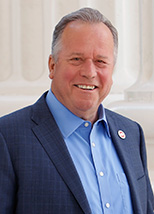
Photo of Bill Dodd
D California Senate · District 3

Sen. Bill Dodd

Contact Email
Compare
Total votes
20,491
all sessions
Attendance
97%
423 missed
Lower than 97% of chamber peers
With party
99%
of cast votes
Bipartisan score
0%
crosses aisle rarely
Sponsored
1,151
bills & resolutions
Near the chamber average
Committees
0
assignments
1,151 bills and resolutions

Sponsored bills

Total
1,151
Primary
250
Co-sponsor
901
This page
1,151
matching current filters
Co-sponsor SB 1363
Passed · California Senate · Co-sponsor
Adopted course of study: Asian Americans and Pacific Islanders.

Existing law requires the adopted course of study for grades 1 to 6, inclusive, and the adopted course of study for grades 7 to 12, inclusive, to include certain areas of study, including, among others, English, mathematics, social sciences, science, and visual and performing arts, as specified. This bill, with respect to both of the above-referenced adopted courses of study, would encourage the instruction in the social sciences area of study to include Asian American and Pacific Islander individual and community contributions, as provided.

Passed Jun 6, 2022 1 co-sponsor
Primary SB 1049
Passed · California Senate · Lead sponsor
Transportation Resilience Program.

Existing law generally provides for programming and allocation of state and federal transportation capital improvement program funds pursuant to the state transportation improvement program process administered by the California Transportation Commission. Existing law provides for allocation of certain other transportation capital improvement funds outside the state transportation improvement program process, including funds set aside for state highway rehabilitation under the state highway operation and protection program and funds from various other sources. This bill would establish the Transportation Resilience Program in the Department of Transportation, to be funded in the annual Budget Act from 15% of the available federal National Highway Performance Program funds and 100% of the available federal Promoting Resilient Operations for Transformative, Efficient, and Cost-Saving Transportation program funds. The bill would provide for funds to be allocated by the California Transportation Commission for climate adaptation planning and resilience improvements, as defined, that address or mitigate the risk of recurring damage to, or closures of, the state highway system, other federal-aid roads, public transit facilities, and other surface transportation assets from extreme weather events, sea level rise, or other climate change-fueled natural hazards. The bill would establish specified eligibility criteria for projects to receive funding under the program and would require the commission to prioritize projects that meet certain criteria.

Passed Jun 2, 2022 0 co-sponsors
Primary SB 417
Passed · California Senate · Lead sponsor
Alcoholic beverages: import.

Existing law permits alcoholic beverages to be brought into this state for delivery or use within the state only by common carriers and only when the alcoholic beverages are consigned to a licensed importer, as specified. Existing law specifies that a violation of these provisions is a misdemeanor. Existing law prohibits a railroad, sleeping car, dining car, boat, or steamship company or air common carrier carrying interstate or foreign passengers from being deemed an importer or made subject to an importer's license for bringing into the state alcoholic beverages for the purpose of sale under specified circumstances. This bill would expand that provision to include a railroad, sleeping car, dining car, boat, or steamship company or air common carrier that brings into the state alcoholic beverages for the purpose of service, as specified. The bill would also allow an air common carrier to purchase all or a portion of its alcoholic beverage inventory outside of the state and to not be deemed an importer or made subject to an importer's license for bringing alcoholic beverages by truck into the state for the purpose of sale or service within the state on the air common carrier's airplanes, as specified.

Passed May 27, 2022 0 co-sponsors
Co-sponsor SB 830
Passed · California Senate · Co-sponsor
Education finance: additional education funding.

Existing law establishes a public school financing system that requires state funding for county superintendents of schools, school districts, and charter schools to be calculated pursuant to a local control funding formula, as specified, that includes average daily attendance as a component of that calculation for these local educational agencies. Existing law requires the Superintendent of Public Instruction, on or before February 20 of each year, to make a first principal apportionment of funds and, on or before July 2 of each year, to make a 2nd principal apportionment of funds to each local educational agency. This bill would define "average daily membership" as the quotient of the aggregate enrollment days for all pupils in a school district, county office of education, or charter school, from transitional kindergarten to grade 12, inclusive, as applicable, divided by the total number of instructional days for the local educational agency in an academic year. The bill would require a local educational agency's average daily membership to be calculated using data from the same fiscal year or years that the local educational agency used to calculate its average daily attendance for purposes of state apportionment, as provided. For any fiscal year before the 2022–23 fiscal year for which average daily membership data is not available, the bill would require the Superintendent to use a local educational agency's census day enrollment count, as provided. The bill, commencing with the 2022–23 fiscal year, would require a local educational agency that submits enrollment data to the Superintendent and demonstrates a maintenance of effort to address chronic absenteeism, as provided, to receive as additional education funding the difference between what the local educational agency would have received under the local control funding formula based on average daily membership and what the local educational agency received under the local control funding formula based on average daily attendance for that fiscal year, as provided. The bill would make that maintenance of effort requirement subject to an annual audit and would provide that failure to meet the maintenance of effort requirement shall result in the loss of the additional education funding. The bill would require local educational agencies to use at least 30% of their additional education funding for local educational agency expenditures to address chronic absenteeism and habitual truancy, as provided. This bill would, for purposes of calculating a local educational agency's average daily membership, require the Superintendent to issue directives and guidance on determining the date of withdrawal for a pupil deemed habitually truant. The bill would require the Legislative Analyst's Office to submit a report to the Legislature, on or before November 1, 2028, on the implementation of the average daily membership funding in local educational agencies selected by the Legislative Analyst's Office, as provided. The bill would expressly state that funds to implement these provisions would be continuously appropriated in the annual Budget Act.


Passed May 27, 2022 1 co-sponsor
Primary SCR 88
Signed into law · California Senate · Lead sponsor
Relative to California Wines: Down to Earth Month.

This measure would proclaim, in perpetuity, the month of April as California Wines: Down to Earth Month, to celebrate the sustainable leadership of California wineries and winegrape growers throughout the month of April.

Signed into law May 24, 2022 0 co-sponsors
Primary SB 832
In committee · California Senate · Lead sponsor
Water rights: measurement of diversion.

(1) Existing law defines various terms applicable to the Water Code. This bill would define "water year," unless otherwise specified, to mean the 12-month period beginning October 1 and ending September 30. (2) Existing law requires a person who diverts 10 acre-feet or more of water per year under a permit or license to install and maintain a device or employ a method capable of measuring the rate of direct diversion, rate of collection to storage, and rate of withdrawal or release from storage. Existing law requires the measurements to be made using the best available technologies and best professional practices using a device or methods satisfactory to the State Water Resources Control Board, as specified in regulations adopted by the state board. Existing law requires a permittee or licensee to maintain a record of all diversion monitoring, as provided, and to include those records with annual reports required to be submitted to the state board. Existing law authorizes the state board to modify these requirements if the state board finds that strict compliance with these requirements is infeasible, is unreasonably expensive, would unreasonably affect public trust uses, or would result in the waste or unreasonable use of water, or that the need for monitoring and reporting is adequately addressed by other conditions of the permit or license. This bill, among other things, would clarify existing law that a diverter, as defined, diverting 10 acre-feet or more of water per year is subject to these water diversion measurement, recording, and reporting requirements, as specified. This bill would require the state board to develop and administer a study to determine the ability of evapotranspiration alone, or in combination with other methodologies, to provide the information needed to monitor water diversions, as specified. The bill would require the state board to provide the Legislature with a report documenting the study, its results, and the findings of an independent review on or before January 1, 2028.

In committee May 19, 2022 0 co-sponsors
Primary SB 839
In committee · California Senate · Lead sponsor
Electricity: demand response.

Under existing law, the Public Utilities Commission has regulatory authority over public utilities, including electrical corporations. Existing law requires each load-serving entity, defined as including electrical corporations, electric service providers, and community choice aggregators, to maintain physical generating capacity and electrical demand response adequate to meet its electrical demand requirements. Existing law requires the commission to establish rules for how and when backup generation may be used within a demand response program and to establish reporting and data collection requirements to verify compliance with those rules. Pursuant to existing law, the commission has authorized the state's 3 largest electrical corporations to offer reliability-based demand response programs, including the base interruptible program, which is available to qualifying nonresidential customers of an electrical corporation. This bill would expressly require each of those large electrical corporations to administer the base interruptible program, except as specified. The bill would require each of those large electrical corporations to make its base interruptible program available to its qualifying commercial, agricultural, and industrial customers regardless of the load-serving entity that is those customers' supplier of electricity. Because the bill would require actions by those load-serving entities that are community choice aggregators, the bill would impose a state-mandated local program. The bill would require the commission to implement a pilot economic demand response program or optional rate design, to be administered by those large electrical corporations, in which base interruptible program participants may elect to participate, to operate for a 4-year period, as specified. Under existing law, the Scheduled Load Reduction Program requires each electrical corporation to develop and offer to its customers the opportunity to participate in a demand reduction program and requires the commission to develop appropriate incentives for customers to participate in the program. This bill would repeal that program. Under existing law, a violation of the Public Utilities Act or any order, decision, rule, direction, demand, or requirement of the commission is a crime. Because the provisions of this bill would be a part of the act and because a violation of a commission action implementing its requirements would be a crime, the bill would impose a state-mandated local program. The California Constitution requires the state to reimburse local agencies and school districts for certain costs mandated by the state. Statutory provisions establish procedures for making that reimbursement. This bill would provide that no reimbursement is required by this act for specified reasons.

In committee May 19, 2022 0 co-sponsors
Showing 281 to 290 of 1,151 bills
Previous 1 … 28 29 30 … 116 Next