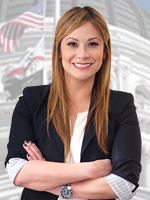
Photo of Ling Ling Chang
R California Senate · District 29

Sen. Ling Ling Chang

Compare
Total votes
10,779
all sessions
Attendance
92%
576 missed
Lower than 90% of chamber peers
With party
96%
of cast votes
Lower than 98% of chamber peers
Bipartisan score
3%
crosses aisle rarely
Higher than 95% of chamber peers
Sponsored
511
bills & resolutions
Near the chamber average
Committees
0
assignments
511 bills and resolutions

Sponsored bills

Total
511
Primary
69
Co-sponsor
442
This page
511
matching current filters
Co-sponsor AB 427
Failed · California Assembly · Co-sponsor
Personal income taxes: exclusion: uniformed services: retirement pay.

The Personal Income Tax Law imposes a tax on individual taxpayers measured by the taxpayer's taxable income for the taxable year, but excludes certain items of income from the computation of tax, including an exclusion for combat-related special compensation. This bill, for taxable years beginning on or after January 1, 2020, and before January 1, 2030, would exclude from gross income specified amounts of retirement pay received by a taxpayer from the federal government for service performed in the uniformed services, as defined, during the taxable year. This bill would take effect immediately as a tax levy.

Failed Feb 3, 2020 1 co-sponsor
Co-sponsor AB 459
Failed · California Assembly · Co-sponsor
State government: Artificial Intelligence in State Government Services Commission: report.

Existing law establishes within the Government Operations Agency the Department of Technology under the supervision of the Director of Technology, who also serves as the State Chief Information Officer. The department is generally responsible for the approval and oversight of information technology projects by, among other things, consulting with state agencies during initial project planning to ensure that project proposals are based on well-defined programmatic needs. This bill would require the Artificial Intelligence in State Government Services Commission, which would be established if AB 976 of the 2018–19 Regular Session is enacted, to report to the Legislature on the commission's recommended minimum standards for the use of artificial intelligence that includes specified information, including fostering accountability in state government services and prioritizing the safety and security of artificial intelligence technologies used by state government. The bill would make its operation contingent on the enactment of AB 976 of the 2018–19 Regular Session on or before January 1, 2020, and establishes the artificial intelligence commission described above.

Failed Feb 3, 2020 1 co-sponsor
Co-sponsor AB 55
Failed · California Assembly · Co-sponsor
Department of Veterans Affairs: veterans' services.

Existing law requires the Department of Veterans Affairs to disburse funds, appropriated to the department for the purpose of supporting county veterans service officers pursuant to the annual Budget Act, on a pro rata basis, to counties that have established and maintain a county veterans service officer in accordance with the staffing level and workload of each county veterans service officer under a formula based upon performance developed by the department. This bill would define a workload unit for purposes of these provisions to mean a specific claim activity that is used to allocate subvention funds to counties, which is approved by the department, and performed by county veterans service officers. The bill would appropriate on an annual basis the sum of $11,000,000 from the General Fund to the Department of Veterans Affairs to be available for allocation to counties to fund the activities of county veterans service officers, as specified. The bill would also delete obsolete provisions and would make conforming changes. This bill would declare that it is to take effect immediately as an urgency statute.

Failed Feb 3, 2020 1 co-sponsor
Co-sponsor AB 856
Failed · California Assembly · Co-sponsor
Personal income tax: credit: home care services.

The Personal Income Tax Law allows various credits against the taxes imposed by that law. This bill would allow a credit against those taxes for each taxable year beginning on or after January 1, 2020, and before January 1, 2024, in an amount equal to 25% of the amount paid or incurred during the taxable year, not compensated for by insurance or otherwise, by a qualified taxpayer, as defined, for home care services, not to exceed $5,000. The bill would define "home care services" to mean specified nonmedical services and assistance provided by a registered home care aide, as defined, a licensed home health agency, or a licensed hospice to a qualified taxpayer who, because of advanced age or physical or mental disability, cannot perform these services that enable the qualified taxpayer to remain in the qualified taxpayer's residence. This bill would take effect immediately as a tax levy.

Failed Feb 3, 2020 1 co-sponsor
Co-sponsor AB 200
Failed · California Assembly · Co-sponsor
State veterans cemeteries: Hmong veterans.

Existing law authorizes the Department of Veterans Affairs to design, develop, and construct state-owned and state-operated veterans cemeteries, as specified, in northern, southern, and central California. Existing law makes honorably discharged veterans, their spouses, and dependent children eligible for internment in those cemeteries, as specified. This bill would additionally authorize the remains of a person to be buried in those cemeteries if the person was naturalized pursuant to the federal Hmong Veterans' Naturalization Act of 2000, as specified, and resided in the State of California at the time of the person's death.

Failed Feb 3, 2020 1 co-sponsor
Co-sponsor SB 710
died · California Senate · Co-sponsor
Crimes: parole, theft, and DNA collection.

(1) Existing law, as amended by the DNA Fingerprint, Unsolved Crime and Innocence Protection Act, Proposition 69, approved by the voters at the November 2, 2004, statewide general election (the DNA act) , requires a person who has been convicted of a felony offense to provide buccal swab samples, right thumbprints, and a full palm print impression of each hand, and any blood specimens or other biological samples required for law enforcement identification analysis. Existing law makes this requirement retroactive, regardless of when the crime charged or committed became a qualifying offense. Existing law authorizes amendments to the DNA act that are consistent with its purposes. This bill would also require persons convicted of specified misdemeanors to provide buccal swab samples, right thumbprints, and a full palm print impression of each hand, and any blood specimens or other biological samples required for law enforcement identification analysis. By imposing additional duties on local law enforcement agencies to collect and forward these samples, this bill would impose a state-mandated local program. (2) Existing law, the Safe Neighborhoods and Schools Act, enacted as an initiative statute by Proposition 47, as approved by the electors at the November 4, 2014, statewide general election, makes the theft of money, labor, or property petty theft, punishable as a misdemeanor, whenever the value of the property taken does not exceed $950. Proposition 47 requires shoplifting, defined as entering a commercial establishment with the intent to commit larceny if the value of the property taken does not exceed $950, to be punished as a misdemeanor. Proposition 47 requires the crime of shoplifting to be charged as shoplifting and prohibits a person who is charged with shoplifting from being charged with burglary or theft of the same property. Existing law authorizes the Legislature to amend the provisions of the act by a 23 vote of each house of the Legislature if it is consistent with, and furthers the purpose of, the act. This bill would recast the shoplifting provisions as entering a commercial establishment with the intent to steal retail property or merchandise, as defined. By amending the definition of shoplifting enacted by Proposition 47, this bill would require a23 vote. Existing law, the Safe Neighborhoods and Schools Act, makes a registered sex offender or a person with a prior conviction for certain serious or violent felonies, such as a sexually violent offense, who commits petty theft, subject to imprisonment in the county jail for up to one year or in the state prison for 16 months, or 2 or 3 years. This bill would apply that penalty to a person who has 2 prior convictions for specified offenses, including certain felonies, and including petty theft and shoplifting, who is subsequently convicted of petty theft or shoplifting if the value of the money, labor, or real or personal property taken exceeds $250. (3) Existing provisions of the California Constitution make a person who was convicted of a nonviolent offense and sentenced to state prison eligible for parole consideration after completing the full term of the person's primary offense. Existing law enumerates various felonies as violent. This bill would classify other existing felonies as "violent felonies" for those purposes, and would apply that definition to persons currently incarcerated in state prison, regardless of the date on which their sentence was imposed. Existing law provides for postrelease community supervision of felons, as provided, including the imposition of intermediate sanctions for noncompliant offender activity, including, among other things, incarceration in jail not exceeding 10 days, mandatory community service, and the revocation of postrelease community supervision by a court or a revocation hearing officer. Existing law requires the supervising county agency who has determined, following application of its assessment processes, that intermediate sanctions are not appropriate, to petition the court to revoke, modify, or terminate postrelease community supervision. This bill would apply that requirement to the circumstance of a supervised offender who has violated the offender's conditions of release 3 times. The bill would also require a county probation department, upon a decision to impose a period of flash incarceration, to notify the court, public defender, district attorney, and sheriff of each imposition of flash incarceration. By imposing additional duties on local governments, this bill would impose a state-mandated local program. (4) The California Constitution requires the state to reimburse local agencies and school districts for certain costs mandated by the state. Statutory provisions establish procedures for making that reimbursement. This bill would provide that with regard to certain mandates no reimbursement is required by this act for a specified reason. With regard to any other mandates, this bill would provide that, if the Commission on State Mandates determines that the bill contains costs so mandated by the state, reimbursement for those costs shall be made pursuant to the statutory provisions noted above.


died Feb 3, 2020 1 co-sponsor
Co-sponsor AB 251
Failed · California Assembly · Co-sponsor
Personal income taxes: credit: family caregiver.

The Personal Income Tax Law allows various credits against the taxes imposed by that law. This bill, for each taxable year beginning on or after January 1, 2020, and before January 1, 2025, would allow a credit against those taxes in an amount equal to 50% of the amount paid or incurred by a family caregiver during the taxable year for eligible expenses related to the care of an eligible family member, not to exceed $5,000. The bill would limit the aggregate amount of these credits to be allocated in each calendar year to $150,000,000 as well as any unused credit amount, if any, allocated in the preceding calendar year. The bill would require the Franchise Tax Board to allocate and certify these tax credits to taxpayers on a first-come-first-served basis. The bill would make these provisions operative on the effective date of any budget measure specifically appropriating funds to the Franchise Tax Board for its costs to administer these provisions. The bill would require an eligible family member to be certified by a physician, registered nurse, advanced practice registered nurse, or physician assistant, under penalty of perjury, as being an individual with long-term care needs and would require the family caregiver to retain, and make available to the Franchise Tax Board upon request, that certification. By expanding the scope of the crime of perjury, this bill would impose a state-mandated local program. The bill would make specified findings detailing the goals, purposes, and objectives of the above-described tax credit, performance indicators for determining whether the credit meets those goals, purposes, and objectives, and data collection requirements. The California Constitution requires the state to reimburse local agencies and school districts for certain costs mandated by the state. Statutory provisions establish procedures for making that reimbursement. This bill would provide that no reimbursement is required by this act for a specified reason. This bill would take effect immediately as a tax levy.

Failed Feb 3, 2020 1 co-sponsor
Primary SB 675
In committee · California Senate · Lead sponsor
Education finance: Computer Occupations and Developing Education (CODE) Act: State Lottery Fund.

(1) The California State Lottery Act of 1984, enacted by initiative, authorizes a California State Lottery and provides for its operation and administration by the California State Lottery Commission and the Director of the California State Lottery, with certain limitations. The act requires revenues of the state lottery to be allocated so as to maximize the amount of funding allocated to public education, and requires that not less than a designated percentage of the total annual revenues from the sale of state lottery tickets or shares be returned to the public in the form of prizes and net revenues to benefit public education, and that no more than a designated percentage of those revenues be used for expenses of the lottery. The act establishes the State Lottery Fund, a continuously appropriated fund for carrying out the purposes of the act. A provision of the California State Lottery Act requires, to ensure continued growth in lottery net revenues allocated to public education, the commission to require that the net lottery revenues allocated to public schools are at least as much as were allocated on average in the prior 5 fiscal years, and increased in proportion to any upward increases in lottery net revenues. This bill would change the act to require that the net lottery revenues allocated pursuant to this provision be at least as much as were allocated on average in the prior 5 fiscal years, or at least as much as were allocated for the 2018–19 fiscal year, whichever amount is greater. (2) Existing law establishes the State Department of Education, under the administration of the Superintendent of Public Instruction, and assigns the department numerous duties relating to the governance and funding of the public elementary and secondary schools in this state. Existing law establishes the State Board of Education for, among other things, the adoption of rules and regulations not inconsistent with the laws of this state for its own government, for the government of its appointees and employees, and for the government of the day and evening elementary schools, the day and evening secondary schools, and the technical and vocational schools of the state, and for the determination of all questions of policy within its powers. This bill would enact the Computer Occupations and Developing Education (CODE) Act, pursuant to which the State Department of Education, in consultation with the State Board of Education, would administer a grant program promoting the teaching of computer science courses in public secondary schools. The bill would authorize the department to adopt forms, standards, and procedures for the solicitation and evaluation of grant applications from local educational agencies, as defined. Under the bill, the grants allocated by the department to local educational agencies would be used for purposes including, but not necessarily limited to, obtaining resources for the offering of computer science courses and related teacher professional development, as specified. The bill would authorize these grants to be made for the 2020–21, 2021–22, and 2022–23 school years. The bill would require the transfer of between $50,000,000 and $100,000,000 from the State Lottery Fund to the department for purposes of the grant program established by the bill. By requiring this transfer, the bill would change the purposes for which the funds of a continuously appropriated fund may be appropriated, and thereby would make an appropriation. The bill would require local educational agencies receiving grants under the bill to submit reports to the department as prescribed, and would require the department to submit a written report to the Legislature and the Governor that would include the department's findings and recommendations relating to the grant program and additional information as specified. (3) The California State Lottery Act of 1984, an initiative measure, specifies that none of its provisions may be changed except to further its purpose by a bill passed by a 23 vote of each house of the Legislature and signed by the Governor. This bill would declare that its provisions further the purposes of the act.

In committee Feb 3, 2020 0 co-sponsors
Co-sponsor AB 1210
Failed · California Assembly · Co-sponsor
Crimes: package theft.

Under existing law, a person who enters a house, room, apartment, or other specified structure, with intent to commit larceny or any felony, is guilty of burglary in the first or 2nd degree, as specified. Burglary in the first degree is punishable by imprisonment in the state prison for 2, 4, or 6 years, and burglary in the 2nd degree is punishable as a misdemeanor by imprisonment in a county jail not exceeding one year, or as a felony by imprisonment in a county jail for 16 months, or 2 or 3 years. This bill would prohibit a person from entering the curtilage of a home, as defined, with the intent to commit theft of a package shipped through the mail or delivered by a public or private carrier. The bill would make a violation of that prohibition punishable as a misdemeanor by imprisonment in a county jail not exceeding 6 months or by a fine not exceeding $1,000, or by both that imprisonment and fine, or, under specified circumstances, as a misdemeanor by imprisonment in a county jail for a term not exceeding one year or by a fine not exceeding $1,000, or both that imprisonment and fine, or as a felony by imprisonment in a county jail for 16 months, or 2 or 3 years. By creating a new crime, the bill would impose a state-mandated local program. The California Constitution requires the state to reimburse local agencies and school districts for certain costs mandated by the state. Statutory provisions establish procedures for making that reimbursement. The bill would provide that no reimbursement is required by this act for a specified reason.

Failed Feb 3, 2020 1 co-sponsor
Co-sponsor AB 534
Failed · California Assembly · Co-sponsor
Social services: access to food.

Existing law provides for the federal Supplemental Nutrition Assistance Program (SNAP) , administered in California as CalFresh, under which each county distributes nutrition assistance benefits provided by the federal government to eligible households. Existing state law authorizes a county to deliver CalFresh benefits through the use of an electronic benefits transfer (EBT) acceptance system. Existing law, until January 1, 2022, encourages the Regents of the University of California, requires the Trustees of the California State University, and authorizes the Board of Governors of the California Community Colleges, to designate as a "hunger-free campus" each of the institutions' respective campuses that meet specified criteria, including having a campus employee designated to help ensure that students have the information they need to enroll in CalFresh. This bill would require the State Department of Social Services, the State Department of Public Health, the State Department of Education, and the Department of Food and Agriculture, to develop a plan to end hunger. The bill would require the State Department of Social Services to serve as the lead agency for the development of the plan. The bill would require the plan to be distributed to the Legislature no later than January 1, 2021, and would establish criteria for the plan, including that the plan establish a budget of $11,500,000, contingent upon an appropriation in the annual Budget Act or other measure, for the Department of Food and Agriculture to support local food hub efforts. The bill would also require the plan to request the Regents of the University of California, and direct the Trustees of the California State University and the Board of Governors of the California Community Colleges, to develop systems that allow EBT cards to be used on their respective campuses, and present a report to the Assembly Select Committee on Campus Climate on the progress that has been made, by July 1, 2020.

Failed Feb 3, 2020 1 co-sponsor
Showing 71 to 80 of 511 bills
Previous 1 … 7 8 9 … 52 Next