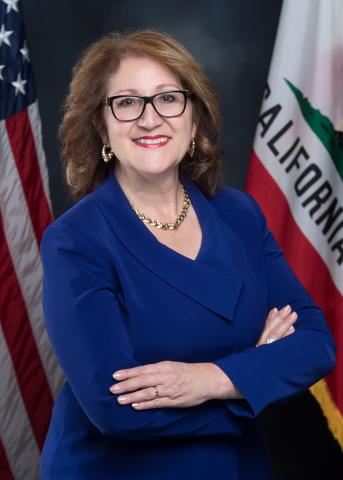
Photo of Eloise Reyes
D California Senate · District 29

Sen. Eloise Reyes

Compare
Total votes
40,295
all sessions
Attendance
93%
2,258 missed
Among the lowest in the chamber
With party
99%
of cast votes
Higher than 82% of chamber peers
Bipartisan score
0%
crosses aisle rarely
Lower than 88% of chamber peers
Sponsored
2,637
bills & resolutions
Lower than 93% of chamber peers
Committees
10
assignments
2,637 bills and resolutions

Sponsored bills

Total
2,637
Primary
384
Co-sponsor
2,253
This page
2,637
matching current filters
Co-sponsor ACR 140
Passed · California Assembly · Co-sponsor
Freight transportation: supply chain.

This measure would declare and recognize that the state is currently suffering a supply chain crisis. The measure would urge the state's public agencies, departments, and local governments to provide all due and proper assistance to carriers, cargo owners, public seaports, terminals, workers, and facilities to facilitate the essential service of delivering goods to Californians.

Passed Aug 16, 2022 1 co-sponsor
Co-sponsor ACR 206
Passed · California Assembly · Co-sponsor
Relative to India's Independence Day.

This measure would recognize August 15, 2022, as India's Independence Day and urge all Californians to join in celebrating India's independence.

Passed Aug 16, 2022 1 co-sponsor
Primary AB 2738
Passed · California Assembly · Lead sponsor
Public postsecondary education: community colleges: matriculation: assessment.

Existing law establishes the California Community Colleges, under the administration of the Board of Governors of the California Community Colleges, as one of the segments of public postsecondary education in this state. Existing law, the Seymour-Campbell Student Success Act of 2012, provides that the purpose of the act is to increase California community college student access and success by providing effective core matriculation services of orientation, assessment and placement, counseling, and other education planning services, and academic interventions. This bill would require, on or before January 1, 2024, the governing board of each community college district to make available to the public, as specified, the schedule of courses that must be completed to obtain, and the number of academic years, months, semesters, or terms that it takes to obtain, each associate degree and certificate offered by a community college maintained by the district. The bill would require, on or before January 1, 2024, the governing board of each community college district to offer each course required for the completion of each associate degree and each certificate offered by a college, as specified, and, to the extent that compliance with this requirement is not practicable, would require the governing board to hold a public hearing and make findings on why its compliance with the requirement is not practicable. By imposing new duties on community college districts, this bill would impose a state-mandated local program. The California Constitution requires the state to reimburse local agencies and school districts for certain costs mandated by the state. Statutory provisions establish procedures for making that reimbursement. This bill would provide that, if the Commission on State Mandates determines that the bill contains costs mandated by the state, reimbursement for those costs shall be made pursuant to the statutory provisions noted above.


Passed Aug 11, 2022 0 co-sponsors
Co-sponsor SB 364
Passed · California Senate · Co-sponsor
Pupil meals.

(1) Existing law establishes a system of public elementary and secondary schools in this state. This system comprises local educational agencies throughout the state that provide instruction to pupils in kindergarten and grades 1 to 12, inclusive, at schoolsites operated by these agencies. Existing law requires the governing board of a school district and the county superintendent of schools to make applications for free or reduced-price meals available to pupils at all times during each regular schoolday. Existing law authorizes the governing boards of school districts and county superintendents of schools to make applications for free or reduced-price meals electronically available online. Existing law specifies requirements to be met by the governing boards of school districts, county offices of education, and school food authorities that choose to provide access to an online application. This bill would require applications for free or reduced-price meals made electronically available online by school district governing boards or county offices of education to comply with specified requirements, including provisions prohibiting the misuse of information provided online by applicants. The bill would require applications for free and reduced-price meals, which are authorized to be submitted at any time during a schoolday, to be processed within 10 days of submission. To the extent that this provision would impose new duties on local educational agencies, it would constitute a state-mandated local program. The bill would make private third-party vendors who violate its provisions subject to specified civil penalties. The bill would specify that its provisions would not prevent the use of information provided by a school meal applicant from being used by a governmental entity to increase access to a government-administered anti-hunger program. The bill would authorize each school district and county superintendent of schools to establish a secured internet website providing access to an online data collection form as part of the annual enrollment process, and would require the department to host a sample application by July 1, 2024, unless the Superintendent of Public Instruction determines that use of the form would negatively impact the local control funding formula. (2) Existing law provides for the federal Supplemental Nutrition Assistance Program (SNAP) , administered in California as CalFresh, under which each county distributes nutrition assistance benefits provided by the federal government to eligible households. Existing law establishes the California Work Opportunity and Responsibility to Kids (CalWORKs) program, under which each county provides cash assistance and other benefits to qualified low-income families using federal, state, and county funds. Existing law establishes the Medi-Cal program, which is administered by the State Department of Health Care Services and under which qualified low-income persons receive health care benefits. Existing federal law provides for the Pandemic Electronic Benefit Transfer (P-EBT) program, under which the Secretary of Agriculture of the United States is authorized to approve state plans to provide eligible children with temporary emergency nutrition assistance benefits during fiscal years 2020 and 2021 in any case in which a school is closed or has reduced the number of days or hours that students attend the school during a public health emergency designation during which the school would otherwise be in session. This bill would establish the Better Out of School Time (BOOST) Nutrition EBT Program, to be administered by the State Department of Social Services, to provide benefits to eligible pupils during regularly scheduled summer breaks. The bill would make eligible pupils who receive benefits under Medi-Cal, CalFresh, or CalWORKs, or are in foster care. The bill would make implementation of the BOOST Nutrition EBT Program contingent upon an appropriation in the annual Budget Act or another statute for its purposes. The bill would require the department to seek all available funding for, and maximize participation in, the P-EBT program. The bill would also require the department to issue BOOST Nutrition EBT benefits to any pupil who was eligible to receive benefits under the P-EBT program, as of July 1, 2021, for the 5-month period following the end of the P-EBT program, and any child who was eligible to receive benefits under the P-EBT program, as of July 1, 2021, for the 5-month period following the end of the P-EBT program and who also receives benefits under Medi-Cal, CalFresh, or CalWORKs, or is in foster care. By imposing new duties on local educational agencies, the bill would impose a state-mandated local program. (3) The California Constitution requires the state to reimburse local agencies and school districts for certain costs mandated by the state. Statutory provisions establish procedures for making that reimbursement. This bill would provide that, if the Commission on State Mandates determines that the bill contains costs mandated by the state, reimbursement for those costs shall be made pursuant to the statutory provisions noted above.
Passed Aug 11, 2022 1 co-sponsor
Co-sponsor AB 4
Passed · California Assembly · Co-sponsor
Medi-Cal: eligibility.

Existing law provides for the Medi-Cal program, which is administered by the State Department of Health Care Services, under which qualified low-income individuals receive health care services. The Medi-Cal program is, in part, governed and funded by federal Medicaid program provisions. The federal Medicaid program provisions prohibit payment to a state for medical assistance furnished to an alien who is not lawfully admitted for permanent residence or otherwise permanently residing in the United States under color of law. Existing law requires individuals under 19 years of age enrolled in restricted-scope Medi-Cal at the time the Director of Health Care Services makes a determination that systems have been programmed for implementation of these provisions to be enrolled in the full scope of Medi-Cal benefits, if otherwise eligible, pursuant to an eligibility and enrollment plan, and extends eligibility for full scope Medi-Cal benefits to individuals who are under 25 years of age, and who are otherwise eligible for those benefits but for their immigration status. Existing law makes the effective date of enrollment for those individuals the same day that systems are operational to begin processing new applications pursuant to the director's determination. Existing law requires an individual eligible for Medi-Cal under these provisions to enroll in a Medi-Cal managed care health plan. Existing law provides that Medi-Cal benefits for individuals who are 65 years of age or older, and who do not have satisfactory immigration statuses or are unable to establish satisfactory immigration statuses, as specified, are to be prioritized in the Budget Act for the upcoming fiscal year if the Department of Finance projects a positive ending balance in the Special Fund for Economic Uncertainties for the upcoming fiscal year and each of the ensuing 3 fiscal years that exceeds the cost of providing those individuals full scope Medi-Cal benefits. Effective January 1, 2022, this bill would instead extend eligibility for full scope Medi-Cal benefits to anyone regardless of age, and who is otherwise eligible for those benefits but for their immigration status, pursuant to an eligibility and enrollment plan. The bill would delete the above-specified provisions regarding individuals who are under 25 years of age or 65 years of age or older and delaying implementation until the director makes the determination described above. The bill would require the eligibility and enrollment plan to ensure that an individual maintains continuity of care with respect to their primary care provider, as prescribed, would provide that an individual is not limited in their ability to select a different health care provider or Medi-Cal managed care health plan, and would require the department to provide monthly updates to the appropriate policy and fiscal committees of the Legislature on the status of the implementation of these provisions. Because counties are required to make Medi-Cal eligibility determinations and this bill would expand Medi-Cal eligibility, the bill would impose a state-mandated local program. The California Constitution requires the state to reimburse local agencies and school districts for certain costs mandated by the state. Statutory provisions establish procedures for making that reimbursement. This bill would provide that, if the Commission on State Mandates determines that the bill contains costs mandated by the state, reimbursement for those costs shall be made pursuant to the statutory provisions noted above.

Passed Aug 11, 2022 1 co-sponsor
Showing 681 to 690 of 2,637 bills
Previous 1 … 68 69 70 … 264 Next