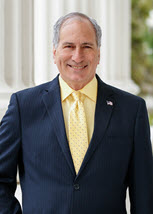
Photo of Jeff Stone
R California Senate · District 28 · Former member

Sen. Jeff Stone

Compare
Total votes
10,476
all sessions
Attendance
97%
292 missed
Near the chamber average
With party
97%
of cast votes
Lower than 86% of chamber peers
Bipartisan score
1%
crosses aisle rarely
Higher than 83% of chamber peers
Sponsored
300
bills & resolutions
Lower than 93% of chamber peers
Committees
0
assignments
300 bills and resolutions

Sponsored bills

Total
300
Primary
111
Co-sponsor
189
This page
300
matching current filters
Primary SCR 66
Signed into law · California Senate · Lead sponsor
Relative to the 71st anniversary of D-Day, the invasion of Normandy.

This measure would recognize June 6, 2015, as the 71st anniversary of the invasion of Normandy, also known as D-Day. This measure would express the gratitude and appreciation of the Legislature to the members of the United States Armed Forces who participated in D-Day, and would call upon the people of California to observe the anniversary with appropriate reflections and recognition.

Signed into law Jul 14, 2015 0 co-sponsors
Co-sponsor SCA 2
In committee · California Senate · Co-sponsor
A resolution to propose to the people of the State of California an amendment to the Constitution of the State, by adding Section 10 to Article IX thereof, relating to public postsecondary education.

Existing law establishes the University of California, under the administration of the Regents of the University of California, the California State University, under the administration of the Trustees of the California State University, and the California Community Colleges, under the administration of the Board of Governors of the California Community Colleges, as the 3 segments of public postsecondary education in this state. This measure would provide that the display of the Flag of the United States of America on the grounds of a campus of the University of California, the California State University, or the California Community Colleges shall not be prohibited.

In committee Jul 14, 2015 1 co-sponsor
Co-sponsor SB 2
Passed · California Senate · Co-sponsor
Property taxation: exemptions: veterans' organizations.

Existing property tax law establishes a veterans' organization exemption under which property is exempt from taxation if, among other things, that property is used exclusively for charitable purposes and is owned by a veterans' organization. This bill would provide that the veterans' organization exemption shall not be denied to a property on the basis that the property is used for fraternal, lodge, or social club purposes, and would make specific findings and declarations in that regard. The bill would also provide that the exemption shall not apply to any portion of a property that consists of a bar where alcoholic beverages are served. Section 2229 of the Revenue and Taxation Code requires the Legislature to reimburse local agencies annually for certain property tax revenues lost as a result of any exemption or classification of property for purposes of ad valorem property taxation. This bill would provide that, notwithstanding Section 2229 of the Revenue and Taxation Code, no appropriation is made and the state shall not reimburse local agencies for property tax revenues lost by them pursuant to the bill. This bill would take effect immediately as a tax levy.

Passed Jul 13, 2015 1 co-sponsor
Co-sponsor SB 140
Passed · California Senate · Co-sponsor
Electronic cigarettes.

Existing law, the Stop Tobacco Access to Kids Enforcement (STAKE) Act, prohibits a person from selling or otherwise furnishing tobacco products to minors. Existing law permits enforcing agencies to assess various civil penalties for violations of the STAKE Act. Existing law makes it a crime to furnish tobacco products to minors. Existing law also prohibits a person from selling or otherwise furnishing an electronic cigarette to minors, and makes a violation punishable as an infraction. This bill would define the term "smoking" for purposes of the STAKE Act. The bill would also change the STAKE Act's definition of tobacco products to include electronic devices, such as electronic cigarettes, that deliver nicotine or other vaporized liquids, and make furnishing such a tobacco product to a minor a misdemeanor. Existing law, the Cigarette and Tobacco Products Tax Law, imposes a tax on the distribution of cigarettes and tobacco products at specified rates, and defines tobacco products for those purposes. Existing law, the Cigarette and Tobacco Products Licensing Act of 2003, requires the State Board of Equalization to administer a statewide program to license manufacturers, importers, distributors, wholesalers, and retailers of cigarettes and tobacco products, as defined. Under existing law, a violation of this act is a misdemeanor. Existing law requires a retailer to have in place and maintain a license to engage in the sale of cigarettes or tobacco products, as defined, and prescribes procedures for the issuance of and grounds for revocation or suspension of a license. Existing law requires a retailer who seeks to obtain a license to engage in the sale of cigarettes and tobacco products to pay a one-time license fee of $100, as specified. Existing law authorizes the State Board of Equalization or a law enforcement agency that discovers that a retailer or other person possesses, stores, owns, or has made a retail sale of tobacco products on which a tax is due but has not been paid to seize those products, and deems those products forfeited, as specified. This bill would include in the definition of tobacco products for the purposes of those provisions relating to licenses for retailers the STAKE Act's new definition of tobacco products. This bill would require a retailer that seeks to sell a tobacco product that is not subject to imposition of a tax under the Cigarette and Tobacco Products Tax Law to pay a one-time license fee to engage in the sale of that product, as specified. The bill would except the STAKE Act's new definition of tobacco products from the provision authorizing seizure of tobacco products described above. The bill would make these provisions operative on October 1, 2016. Existing law makes it a crime for a person or entity to engage in the business of selling cigarettes or tobacco products without a valid license or after a license has been suspended or revoked, as specified. Existing law also makes it a crime for a person to continue selling or gifting cigarettes or tobacco products without a valid license or after a notification of suspension or revocation, as specified. This bill would include in the definition of tobacco products for the purposes of those provisions the STAKE Act's new definition of tobacco products. The bill would make that provision operative on October 1, 2016. Existing law prohibits the smoking of cigarettes and other tobacco products in a variety of specified areas. Under existing law, a violation of some of these prohibitions is punishable as an infraction. This bill would change the location restrictions for smoking cigarettes and other tobacco products to reflect the STAKE Act's definitions of smoking and tobacco products. The bill would make the use of electronic cigarettes in some of these restricted locations a violation punishable as an infraction. Existing law prohibits the smoking of medical marijuana in any place where smoking is prohibited by law. This bill would declare that its provisions do not affect any law or regulation regarding medical marijuana. By expanding the scope of a crime, the bill would impose a state-mandated local program. The California Constitution requires the state to reimburse local agencies and school districts for certain costs mandated by the state. Statutory provisions establish procedures for making that reimbursement. This bill would provide that no reimbursement is required by this act for a specified reason.

Passed Jul 8, 2015 1 co-sponsor
Co-sponsor SB 277
Signed into law · California Senate · Co-sponsor
Public health: vaccinations.

Existing law prohibits the governing authority of a school or other institution from unconditionally admitting any person as a pupil of any public or private elementary or secondary school, child care center, day nursery, nursery school, family day care home, or development center, unless prior to his or her admission to that institution he or she has been fully immunized against various diseases, including measles, mumps, and pertussis, subject to any specific age criteria. Existing law authorizes an exemption from those provisions for medical reasons or because of personal beliefs, if specified forms are submitted to the governing authority. Existing law requires the governing authority of a school or other institution to require documentary proof of each entrant's immunization status. Existing law authorizes the governing authority of a school or other institution to temporarily exclude a child from the school or institution if the authority has good cause to believe that the child has been exposed to one of those diseases, as specified. This bill would eliminate the exemption from existing specified immunization requirements based upon personal beliefs, but would allow exemption from future immunization requirements deemed appropriate by the State Department of Public Health for either medical reasons or personal beliefs. The bill would exempt pupils in a home-based private school and students enrolled in an independent study program and who do not receive classroom-based instruction, pursuant to specified law from the prohibition described above. The bill would allow pupils who, prior to January 1, 2016, have a letter or affidavit on file at a private or public elementary or secondary school, child day care center, day nursery, nursery school, family day care home, or development center stating beliefs opposed to immunization, to be enrolled in any private or public elementary or secondary school, child day care center, day nursery, nursery school, family day care home, or development center within the state until the pupil enrolls in the next grade span, as defined. Except as under the circumstances described above, on and after July 1, 2016, the bill would prohibit a governing authority from unconditionally admitting to any of those institutions for the first time or admitting or advancing any pupil to the 7th grade level, unless the pupil has been immunized as required by the bill. The bill would specify that its provisions do not prohibit a pupil who qualifies for an individualized education program, pursuant to specified laws, from accessing any special education and related services required by his or her individualized education program. The bill would narrow the authorization for temporary exclusion from a school or other institution to make it applicable only to a child who has been exposed to a specified disease and whose documentary proof of immunization status does not show proof of immunization against one of the diseases described above. The bill would make conforming changes to related provisions.


Signed into law Jun 30, 2015 1 co-sponsor
Co-sponsor SCR 39
Signed into law · California Senate · Co-sponsor
Relative to Jewish American Heritage Month.

This measure would state that the Legislature recognizes May 2015 as Jewish American Heritage Month, encourages all Californians to participate in appropriate observances with activities that celebrate and commemorate Jewish American Heritage Month, and commends Jewish Americans for their notable accomplishments and outstanding service to the state and the nation.

Signed into law Jun 26, 2015 1 co-sponsor
Primary SJR 6
Passed · California Senate · Lead sponsor
Iran: negotiations: nuclear program.

This measure would declare that the Legislature of the State of California supports finding the best long-term solution for peace and security in the Middle East and a nuclear-free Iran, and believes that any agreement signed with Iran should provide for ongoing international oversight.

Passed Jun 18, 2015 0 co-sponsors
Showing 241 to 250 of 300 bills
Previous 1 … 24 25 26 … 30 Next