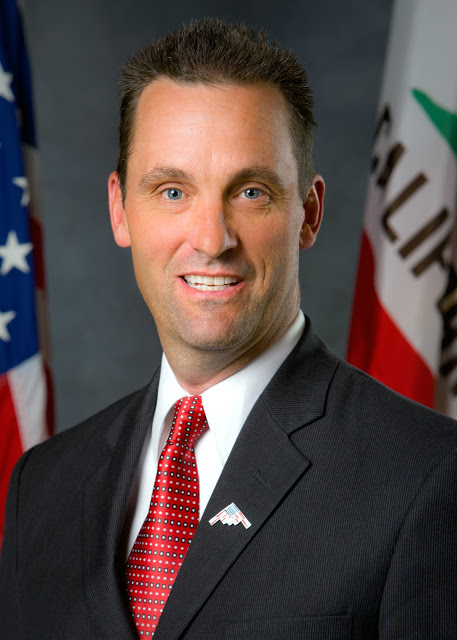
Photo of Steve Knight
R California Senate · District 21

Sen. Steve Knight

Compare
Total votes
26,442
all sessions
Attendance
93%
1,574 missed
Higher than 96% of chamber peers
With party
98%
of cast votes
Higher than 96% of chamber peers
Bipartisan score
1%
crosses aisle rarely
Lower than 99% of chamber peers
Sponsored
1,015
bills & resolutions
Lower than 79% of chamber peers
Committees
0
assignments
1,015 bills and resolutions

Sponsored bills

Total
1,015
Primary
276
Co-sponsor
739
This page
1,015
matching current filters
Co-sponsor ACR 68
Signed into law · California Assembly · Co-sponsor
Relative to the Detective Jeremiah MacKay Memorial Highway.

This measure would designate a portion of State Highway Route 38 in San Bernardino County as the Detective Jeremiah MacKay Memorial Highway. The measure would also request the Department of Transportation to determine the cost of appropriate signs showing this special designation and, upon receiving donations from nonstate sources covering the cost, to erect those signs.

Signed into law Sep 27, 2013 1 co-sponsor
Co-sponsor SB 105
Signed into law · California Senate · Co-sponsor
Corrections.

(1) Existing law requires the Department of Corrections and Rehabilitation to close the California Rehabilitation Center located in Norco, California, no later than either December 31, 2016, or 6 months after the construction of three Level II dorm facilities. This bill would suspend this requirement pending a review by the Department of Finance and the Department of Corrections and Rehabilitation that determines the facility can be closed. (2) The California Constitution establishes the civil service, to include every officer and employee of the state, except as provided, and requires permanent appointment and promotion in the civil service to be made under a general system based on merit ascertained by competitive examination. Existing law requires the appointing power in all cases not exempted by the California Constitution to fill positions by appointment, including cases of transfers, reinstatements, promotions, and demotions, in strict accordance with specified provisions of law, and requires that appointments to vacant positions be made from employment lists. Existing law, subject to the approval of the State Personnel Board, allows an appointing agency to enter into arrangements with personnel agencies in other jurisdictions for the purpose of exchanging services and effecting transfers of employees. This bill would, until January 1, 2017, make the private California City Correctional Center in California City an agency or jurisdiction for the purpose of exchanging services pursuant to the above provision and all related rules. (3) Existing law allows the State Personnel Board to prescribe rules governing the temporary assignment or loan of employees within an agency or between agencies not to exceed 2 years, or between jurisdictions not to exceed 4 years, for specified purposes. This bill would, until January 1, 2017, make the private California City Correctional Center in California City an agency or jurisdiction for the purpose of the above provision and all related rules for a period not to exceed 2 years. (4) Existing law allows the Secretary of the Department of Corrections and Rehabilitation to enter into an agreement with a city, county, or city and county, to permit transfer of prisoners in the custody of the secretary to a jail or other adult correctional facility. Under existing law, prisoners transferred to a local facility remain under the legal custody of the department. Existing law prohibits any agreement pursuant to these provisions unless the cost per inmate in the facility is no greater than the average costs of keeping an inmate in a comparable facility of the department. This bill would, until January 1, 2017, for purposes of entering into agreements pursuant to the above provisions, waive any process, regulation, or requirement relating to entering into those agreements. The bill would, until January 1, 2017, delete the provision requiring that prisoners transferred to a local facility remain under the legal custody of the department and would delete the requirement that no agreement be entered into unless the cost per inmate in the facility is no greater than the average costs of keeping an inmate in a comparable facility of the department. The bill would, until January 1, 2017, allow a transfer of prisoners to include inmates who have been sentenced to the department but remain housed in a county jail, and would specify that these prisoners shall be under the sole legal custody and jurisdiction of the sheriff or other official having jurisdiction over the facility and not under the legal custody and jurisdiction of the department. The bill would also, until January 1, 2017, allow the secretary to enter into one or more agreements in the form of a lease or operating agreement with private entities to obtain secure housing capacity in the state or in another state, upon terms and conditions deemed necessary and appropriate to the secretary. The bill would, until January 1, 2017, waive any process, regulation, or requirement that relates to the procurement or implementation of those agreements, except as specified. The bill would make the provisions of the California Environmental Quality Act inapplicable to these provisions. (5) Existing law allows the Secretary of the Department of Corrections and Rehabilitation to establish and operate community correctional centers. This bill would, until January 1, 2017, allow the secretary to enter into agreements for the transfer of prisoners to community correctional centers, and to enter into contracts to provide housing, sustenance, and supervision for inmates placed in community correctional centers. The bill would, until January 1, 2017, waive any process, regulation, or requirement that relates to entering into those agreements. (6) Existing law allows any court or other agency or officer of this state having power to commit or transfer an inmate to any institution for confinement to commit or transfer that inmate to any institution outside this state if this state has entered into a contract or contracts for the confinement of inmates in that institution and the inmate, if he or she was sentenced under California law, has executed written consent to the transfer. This bill would, until January 1, 2017, allow the secretary to transfer an inmate to a facility in another state without the consent of the inmate. (7) Existing law establishes the Commission on Correctional Peace Officer Standards and Training (CPOST) within the Department of Corrections and Rehabilitation and requires the CPOST to develop, approve, and monitor standards for the selection and training of state correctional peace officers. Existing law allows for the use of training academies and centers, as specified. This bill would, until January 1, 2017, allow the department to use a training academy established for the private California City Correctional Center. (8) Existing law, the California Community Corrections Performance Incentives Act of 2009, authorizes each county to establish a Community Corrections Performance Incentives Fund, and authorizes the state to annually allocate moneys into a State Community Corrections Performance Incentives Fund to be used for specified purposes relating to improving local probation supervision practices and capacities. As part of the California Community Corrections Performance Incentives Act of 2009, existing law requires the Director of Finance to make certain calculations, including the cost to the state to incarcerate in prison and supervise on parole an offender who fails local supervision and is sent to prison. Existing law requires the Director of Finance to calculate a probation failure reduction incentive payment based on the estimated number of probationers successfully prevented from being incarcerated, multiplied by a specified percentage of the cost to the state to incarcerate in prison and supervise on parole a probationer who was sent to prison. Existing law requires the Department of Finance to calculate 5% of the total statewide estimated number of probationers successfully prevented from being incarcerated for counties that successfully reduce the number of adult felony probationers incarcerated multiplied by the costs to the state to incarcerate in prison and supervise on parole a probationer who was sent to prison to be used to provide high performance grants to county probation departments. This bill would, beginning July 1, 2014, remove the requirement that the Director of Finance calculate the cost to the state to incarcerate in prison and supervise on parole an offender who fails local supervision and is sent to prison, and would instead require the Director of Finance to calculate the cost to the state to incarcerate in a contract facility and supervise on parole an offender who fails local supervision and is sent to prison. The bill would require the probation failure reduction incentive payment to be based on the estimated number of probationers successfully prevented from being incarcerated multiplied by a percentage of the state's cost of housing an inmate in a contract facility, and to supervise on parole a probationer who was sent to prison. The bill would require the Department of Finance to calculate high performance grants to county probation departments as 5% of the total statewide estimated number of probationers successfully prevented from being incarcerated multiplied by the state's cost of housing an inmate in a contract facility, and to supervise on parole a probationer who was sent to prison. The bill would create the Recidivism Reduction Fund in the State Treasury to be available upon appropriation by the Legislature for activities designed to reduce the state's prison population, and would allow funds available in the Recidivism Reduction Fund to be transferred to the State Community Corrections Performance Incentives Fund. (9) The bill would appropriate $315,000,000 from the General Fund to the Department of Corrections and Rehabilitation for the purposes of this measure. The bill would require the department to spend the funds only to the extent needed to avoid early release. The bill would require any amounts not encumbered by June 30, 2014 to be transferred to the Recidivism Reduction Fund, except as provided. The bill would require the Secretary of the Department of Corrections and Rehabilitation to report no later than April 1, 2014, and again on April 1, 2015, to the Director of Finance and specified legislative committees detailing the number of inmates housed in leased beds and in contracted beds both inside and outside of the state pursuant to this measure. The bill would require the administration to assess the state prison system, including capacity needs, prison population levels, recidivism rates, and factors effecting crime levels, and to develop recommendations on balanced solutions that are cost effective and protect public safety. The bill would require the Department of Finance to submit the administration's interim report to the Legislature not later than April 1, 2014, and to submit the final report to the Legislature not later than January 10, 2015. (10) This bill would declare that it is to take effect immediately as a bill providing for appropriations related to the Budget Bill.


Signed into law Sep 12, 2013 1 co-sponsor
Co-sponsor SJR 9
Signed into law · California Senate · Co-sponsor
Relative to the Startup Act 3.0.

This measure would urge the United States Congress and the President to establish new entrepreneur and science, technology, engineering, or mathematics-related visa categories for legal immigrants as part of comprehensive federal immigration reform, that would, among other things, create an Entrepreneur's Visa for legal immigrants, provide authorization to adjust the status of not more than 50,000 aliens who have earned a master's degree or a doctorate degree, as specified, to that of aliens conditionally admitted for permanent residence, and eliminate per-country caps for employment-based immigrant visas.

Signed into law Sep 10, 2013 1 co-sponsor
Co-sponsor AB 65
Signed into law · California Assembly · Co-sponsor
Crimes: sex crimes.

Existing law provides various circumstances that constitute rape, including an act of sexual intercourse accomplished with a person who is not the spouse of the perpetrator where the person submits under the belief that the person committing the act is the victim's spouse, and this belief is induced by artifice, pretense, or concealment practiced by the accused, with the intent to induce the belief. Existing law provides various circumstances that constitute sodomy against an individual's will, including an act accomplished with an individual who is not the spouse of the perpetrator where the individual submits under the belief that the individual committing the act is the victim's spouse, and this belief is induced by artifice, pretense, or concealment practiced by the accused, with the intent to induce the belief. This bill would instead provide that these types of rape and sodomy occur where the person submits under the belief that the person committing the act is someone known to the victim other than the accused. By expanding the definition of a crime, this bill would impose a state-mandated local program. The California Constitution requires the state to reimburse local agencies and school districts for certain costs mandated by the state. Statutory provisions establish procedures for making that reimbursement. This bill would provide that no reimbursement is required by this act for a specified reason. This bill would declare that it is to take effect immediately as an urgency statute.

Signed into law Sep 9, 2013 1 co-sponsor
Co-sponsor AB 703
Signed into law · California Assembly · Co-sponsor
Peace officers: firearms.

(1) Existing law requires a retired peace officer who was authorized to, and did, carry a firearm during the course and scope of employment as a peace officer to have an endorsement on his or her identification certificate stating that the issuing agency approves of the officer's carrying of a concealed and loaded firearm. Existing law provides that a retired peace officer may have the privilege to carry a concealed and loaded firearm revoked or denied by violating any departmental rule, or state or federal law that, if violated by an officer on active duty, would result in that officer's arrest, suspension, or removal from the agency. Existing law permits an identification certificate authorizing the officer to carry a concealed and loaded firearm or an endorsement on the certificate to be immediately and temporarily revoked by the issuing agency when the conduct of a retired peace officer compromises public safety. This bill would make these provisions applicable to a retired reserve officer if the retired reserve officer carried a firearm during the course and scope of his or her appointment, was a level I reserve officer, and served in the aggregate the minimum amount of time as specified by the retiree's agency's policy as a level I reserve peace officer. The bill would prohibit the policy from setting an aggregate term requirement that is less than 10 years or more than 20 years. The bill would prohibit service as a reserve officer, other than a level I reserve officer prior to January 1, 1997, from counting toward that aggregate term requirement. The bill would authorize a law enforcement agency to revoke or deny an endorsement issued to a retired reserve peace officer. (2) Under existing law, the prohibitions on carrying a concealed weapon and on carrying a loaded firearm do not apply to honorably retired peace officers who were authorized to carry firearms during the course and scope of their employment as peace officers. This bill would state that the above exemption applies to honorably retired peace officers who were authorized to carry firearms during the course and scope of their appointment, rather than employment, as peace officers.

Signed into law Sep 9, 2013 1 co-sponsor
Co-sponsor AB 526
Signed into law · California Assembly · Co-sponsor
Military service: benefits.

Existing law authorizes, to the extent permitted by federal law, members of the United States Military Reserve and National Guard who are called to active duty as a result of the Iraq or Afghanistan conflicts, to defer payments on mortgages, credit cards, retail installment accounts and contracts, real property taxes and assessments, and vehicle leases for the period of active duty, plus 60 calendar days, or 180 days, whichever is the lesser, as specified. Existing law also requires any entity that was providing any type of health care coverage to a member of the United States Military Reserve or National Guard who is called to active duty as a result of the Iraq or Afghanistan conflicts to reinstate the health care coverage without waiting periods or exclusion of coverage for preexisting conditions, and makes a violation of this requirement subject to enforcement under the Knox-Keene Health Care Service Plan Act of 1975, a willful violation of which is a crime. Existing law also provides that a spouse or legal dependent, or both, of a member is entitled to the benefits accorded to a member, if the member is eligible for those benefits. This bill would extend those deferral provisions and reinstatement of health care coverage provisions to a reservist, as defined, who is called to active duty on and after January 1, 2014, and to a spouse or legal dependent, as specified. This bill would also authorize the deferral of payments on any obligations owed to a utility company. The bill would limit the deferment period on financial obligations to not more than 180 days within a 365-day period. This bill would also require a copy of the activation or deployment orders and any other information that substantiates the duration of the service member's military service to be delivered to an obligor in order for an obligation of a reservist to be deferred, as provided. This bill would expand the scope of an existing crime by requiring a reservist to provide information under the penalty of perjury, and by making violations of the reinstatement of health care coverage for reservists requirement subject to enforcement under the Knox-Keene Health Care Service Plan Act of 1975, thereby imposing a state‑mandated local program. This bill would additionally impose a state‑mandated local program by imposing new duties upon local tax officials with respect to the deferral of any payment of property tax or any special assessment. The California Constitution requires the state to reimburse local agencies and school districts for certain costs mandated by the state. Statutory provisions establish procedures for making that reimbursement. This bill would provide that with regard to certain mandates no reimbursement is required by this act for a specified reason. With regard to any other mandates, this bill would provide that, if the Commission on State Mandates determines that the bill contains costs so mandated by the state, reimbursement for those costs shall be made pursuant to the statutory provisions noted above.

Signed into law Sep 6, 2013 1 co-sponsor
Co-sponsor SCR 39
Signed into law · California Senate · Co-sponsor
California Peace Officers' Memorial Day.

This measure would designate Monday, May 6, 2013, as California Peace Officers' Memorial Day, urge all Californians to use that day to honor California peace officers, and recognize specified California peace officers who were killed in defense of their communities.

Signed into law Aug 29, 2013 1 co-sponsor
Co-sponsor AB 20
Signed into law · California Assembly · Co-sponsor
Obscene matter: minors.

Existing law generally prohibits the production, distribution, and production of any representation of information, data, or image, as specified, of any obscene matter that depicts a person under 18 years of age personally engaging in or personally simulating sexual conduct, as defined. Violations of these provisions are crimes. This bill would provide that every person who is convicted of a violation of specified offenses relating to obscene matter involving minors, as specified, in which the violation is committed on, or via, a government-owned computer or via a government-owned computer network, or in which the production, transportation, or distribution of which involves the use, possession, or control of government-owned property shall, in addition to any imprisonment of fine imposed for the commission of the underlying offense, be punished by a fine not exceeding $2,000, unless the court determines that the defendant does not have the ability to pay. The bill would provide that revenue from any fines collected would be transferred for deposit into a county fund established for that purpose and allocated for sexual assault investigator training, public agencies and nonprofit corporations that provide shelter, counseling, or other direct services for victims of human trafficking, and multidisciplinary teams involved in the prosecution of child abuse cases, as specified. Existing law allows for the release from all penalties and disabilities resulting from an offense for which the person was convicted if specified criteria are met. Existing law excludes certain sex offenses from these provisions. This bill would additionally exclude specified offenses relating to obscene matter involving minors from these provisions.

Signed into law Aug 26, 2013 1 co-sponsor
Primary SB 303
Signed into law · California Senate · Lead sponsor
Peace officers: identification certificates: concealed weapon endorsement.

Existing law requires that any peace officer who has been honorably retired be issued an identification certificate by the law enforcement agency from which the officer has retired. This bill would require that if the agency from which the officer has retired is no longer providing law enforcement services or the relevant governmental body is dissolved, the agency that subsequently provides law enforcement services for that jurisdiction shall issue the identification certificate to that peace officer, if prescribed conditions are met, and would make conforming changes. By imposing additional duties on local law enforcement agencies, this bill would impose a state-mandated local program. The California Constitution requires the state to reimburse local agencies and school districts for certain costs mandated by the state. Statutory provisions establish procedures for making that reimbursement. This bill would provide that no reimbursement is required by this act for a specified reason.

Signed into law Aug 26, 2013 0 co-sponsors
Showing 91 to 100 of 1,015 bills
Previous 1 … 9 10 11 … 102 Next