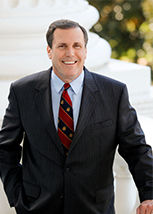
Photo of Scott Wilk
R California Senate · District 21

Sen. Scott Wilk

Contact Email
Compare
Total votes
25,318
all sessions
Attendance
96%
859 missed
Near the chamber average
With party
95%
of cast votes
Near the chamber average
Bipartisan score
3%
crosses aisle rarely
Near the chamber average
Sponsored
1,250
bills & resolutions
Near the chamber average
Committees
0
assignments
1,250 bills and resolutions

Sponsored bills

Total
1,250
Primary
196
Co-sponsor
1,054
This page
1,250
matching current filters
Co-sponsor ACR 147
Signed into law · California Assembly · Co-sponsor
Relative to the Jeffrey "Jef" Dye Memorial Highway.

This measure would designate a specified portion of Interstate 5 in the County of Los Angeles as the Jeffrey "Jef" Dye Memorial Highway. The measure would also request the Department of Transportation to determine the cost of appropriate signs showing this special designation and, upon receiving donations from nonstate sources covering that cost, to erect those signs.

Signed into law Sep 14, 2020 1 co-sponsor
Co-sponsor SB 38
Signed into law · California Senate · Co-sponsor
Sales and use taxes: consumer designation: all volunteer fire department.

Existing sales and use tax laws, among other things, impose a tax on retailers measured by the gross receipts from their sales of tangible personal property sold at retail in this state. The Sales and Use Tax Law designates that certain sellers of tangible personal property are consumers, and not retailers, of the tangible personal property they sell, including, until January 1, 2021, that an all volunteer fire department, as defined, is a consumer, and not a retailer, of all tangible personal property sold by it, if the profits are used solely and exclusively in furtherance of the purposes of the all volunteer fire department, subject to specified limitations, so that the retail sale subject to tax is the sale of tangible personal property to the all volunteer fire department. This bill would extend the operation of that consumer designation for all volunteer fire departments until January 1, 2026. Existing law requires any bill authorizing a new tax expenditure to contain, among other things, specific goals, purposes, and objectives that the tax expenditure will achieve, detailed performance indicators, and data collection requirements. The bill also would include additional information required for any bill authorizing a new tax expenditure. The Bradley-Burns Uniform Local Sales and Use Tax Law authorizes counties and cities to impose local sales and use taxes in conformity with the Sales and Use Tax Law, and existing laws authorize districts, as specified, to impose transactions and use taxes in accordance with the Transactions and Use Tax Law, which generally conforms to the Sales and Use Tax Law. Amendments to the Sales and Use Tax Law are automatically incorporated into the local tax laws. Existing law requires the state to reimburse counties and cities for revenue losses caused by the enactment of sales and use tax exemptions. This bill would provide that, notwithstanding Section 2230 of the Revenue and Taxation Code, no appropriation is made and the state shall not reimburse any local agencies for sales and use tax revenues lost by them pursuant to this bill. This bill would take effect immediately as a tax levy.

Signed into law Sep 11, 2020 1 co-sponsor
Co-sponsor ACA 14
Failed · California Assembly · Co-sponsor
A resolution to propose to the people of the State of California an amendment to the Constitution of the State, by adding Section 9.5 to Article IX thereof, relating to the University of California.

Existing provisions of the California Constitution establish the University of California as a public trust under the administration of the Regents of the University of California. The California Constitution grants to the regents all the powers necessary or convenient for the effective administration of this public trust. Pursuant to the California Constitution, there are 7 ex officio members of the regents and 18 appointive members appointed by the Governor and approved by the Senate, a majority of the membership concurring. This measure would enact the University of California Equal Employment Opportunity Standards Act, which would, effective January 1, 2021, except as specified, require the regents to ensure that all contract workers, as defined, who are paid to perform support services for students, faculty, patients, or the general public at any campus, dining hall, medical center, clinic, research facility, laboratory, or other university location, are at all times subject to and afforded the same equal employment opportunity standards, as defined, as university employees performing similar services. The measure would authorize the regents, or any campus or other entity of the University of California, to contract for, or otherwise arrange to use, contract labor, as defined, to perform support services only under specified conditions, only if authorized to do so by statute, and only to the extent necessary to address one or more of prescribed needs. The measure would authorize the Legislature to enact statutes to further the purposes of, and to aid the enforcement of, this measure.

Failed Sep 1, 2020 1 co-sponsor
Primary SB 580
Passed · California Senate · Lead sponsor
Animal abuse: probation: treatment.

Existing law makes it a crime to maliciously and intentionally maim, mutilate, torture, wound, or kill a living animal. If a defendant is granted probation for a conviction of this offense, existing law requires the court to order the defendant to complete counseling designed to evaluate and treat behavior or conduct disorders. This bill would delete the requirement that a defendant granted probation complete counseling and would instead require a defendant convicted of specified offenses against animals and granted probation to undergo a mental health evaluation by an evaluator chosen by the court. The court would require the defendant to complete mandatory counseling if, upon evaluation of the defendant, the mental health professional deems it necessary. The court would require the defendant to pay for the mental health evaluation and any subsequent treatment, but would authorize the court to establish a sliding fee schedule based on the defendant's ability to pay. The bill would additionally make records related to this evaluation and treatment confidential, as specified. Existing constitutional provisions require that a statute that limits the right of access to the meetings of public bodies or the writings of public officials and agencies be adopted with findings demonstrating the interest protected by the limitation and the need for protecting that interest. This bill would make legislative findings to that effect.

Passed Aug 20, 2020 0 co-sponsors
Co-sponsor SB 884
Passed · California Senate · Co-sponsor
Education finance: emergencies: public safety power shutoffs.

Existing law prohibits a school district from receiving a state apportionment based upon average daily attendance unless it has maintained the regular day schools of the district for at least 175 days during the next preceding fiscal year. Existing law exempts from this prohibition a school district, county office of education, or charter school that is prevented from maintaining its schools during a fiscal year for at least 175 days because of a specified emergency or other extraordinary condition. If the average daily attendance of a school district, county office of education, or charter school has been materially decreased during a fiscal year because of a specified emergency, existing law requires the Superintendent of Public Instruction to estimate the average daily attendance in a manner that credits to the school district, county office of education, or charter school approximately the total average daily attendance that would have been credited to the school district, county office of education, or charter school had the emergency not occurred. This bill would add public safety power shutoffs to the list of emergencies for which the above-described provisions apply.

Passed Aug 20, 2020 1 co-sponsor
Primary SB 409
Passed · California Senate · Lead sponsor
Illegal dumping.

(1) Existing law makes it unlawful to dump waste matter in certain locations, such as upon a public or private highway or road, upon private property without the consent of the owner, or in or upon a public park or other public property, as specified. Existing law also makes it unlawful to place, deposit, or dump rocks, concrete, asphalt, or dirt in certain locations, as specified. A person who violates these provisions is guilty of an infraction punishable by specified fines. Existing law also makes it a misdemeanor to place, deposit, or dump waste matter in commercial quantities, as defined, in certain locations. This bill would make it a crime to transport waste matter, rocks, concrete, asphalt, or dirt for the purpose of dumping it in the locations described above. The bill would make it a crime for a property owner or agent to receive waste matter, rocks, concrete, asphalt, or dirt if a permit or license is required from a state or a local agency and was not obtained prior to receiving the waste matter, rocks, concrete, asphalt, or dirt. The bill would also make it unlawful to transport waste matter in commercial quantities for the purpose of dumping it in the locations described above. Because this bill would expand the scope of a crime, it would impose a state-mandated local program. (2) The California Constitution requires the state to reimburse local agencies and school districts for certain costs mandated by the state. Statutory provisions establish procedures for making that reimbursement. This bill would provide that no reimbursement is required by this act for a specified reason.

Passed Aug 20, 2020 0 co-sponsors
Co-sponsor SB 431
Passed · California Senate · Co-sponsor
Telecommunications service: backup electrical supply rules.

Under existing law, the Public Utilities Commission has regulatory authority over public utilities, including telephone corporations. Existing law requires the commission to develop and implement performance reliability standards for backup power systems installed on the property of residential and small commercial customers by a facilities-based provider of telephony services upon determining that the benefits of the standards exceed the costs. This bill would require the commission, in consultation with the Office of Emergency Services and the telecommunications industry, by July 1, 2021, to develop and implement backup electrical supply rules, as specified, for telecommunications service, as defined, that is provided within a commission-designated Tier 2 or Tier 3 High Fire Threat District. Under existing law, a violation of the Public Utilities Act or any order, decision, rule, direction, demand, or requirement of the commission is a crime. Because the provisions of this bill would be a part of the act and because a violation of a commission action implementing the bill's requirements would be a crime, the bill would impose a state-mandated local program. The California Constitution requires the state to reimburse local agencies and school districts for certain costs mandated by the state. Statutory provisions establish procedures for making that reimbursement. This bill would provide that no reimbursement is required by this act for a specified reason.

Passed Aug 20, 2020 1 co-sponsor
Co-sponsor AB 1450
Failed · California Assembly · Co-sponsor
Child Abuse Central Index.

Existing law designates certain individuals, such as teachers, peace officers, physicians, and clergy members, among others, as mandated reporters and requires them to report suspected child abuse or neglect to specified agencies whenever the mandated reporter, in their professional capacity or within the scope of their employment, knows of, or observes, a child whom the mandated reporter knows or reasonably suspects has been the victim of child abuse or neglect. Existing law requires specified local agencies to forward those reports to the Department of Justice in writing of all cases the agencies investigate of known or suspected child abuse or severe neglect that are determined to be substantiated. Existing law requires the Department of Justice to be a repository of reports of suspected child abuse and severe neglect and to maintain those reports in the Child Abuse Central Index (CACI) . Existing law prohibits a police or sheriff's department from forwarding to the Department of Justice a report of a case the police or sheriff's department investigates of known or suspected child abuse or neglect. This bill would authorize a police or sheriff's department to which a report of suspected child abuse or severe neglect is made on or after January 1, 2021, or that is investigating an open case for which a report of suspected child abuse or severe neglect was made on or before January 1, 2021, to forward to the Department of Justice a report in writing of its investigation of known or suspected child abuse or severe neglect that is determined to be substantiated. The bill would require a police or sheriff's department that forwards a report to comply with the same requirements placed on other reporting agencies and would require the police or sheriff's department to adopt notification and grievance procedures. The bill would prescribe minimum requirements for the notification and grievance procedures, including specifying timelines and rules governing the grievance hearing. The bill would also make conforming changes.

Failed Aug 7, 2020 1 co-sponsor
Co-sponsor SB 794
died · California Senate · Co-sponsor
Emergency services: telecommunications.

The California Emergency Services Act establishes the Office of Emergency Services in the office of the Governor and provides that the office is responsible for the state's emergency and disaster response services for natural, technological, or manmade disasters and emergencies, including responsibility for activities necessary to prevent, respond to, recover from, and mitigate the effects of emergencies and disasters to people and property. Existing law authorizes each county, including a city and county, to enter into an agreement to access the contact information of resident accountholders through the records of a public utility or other agency responsible for water service, waste and recycling services, or other property-related services for the sole purpose of enrolling county residents in a county-operated public emergency warning system. Existing law requires any county that enters into such an agreement to include procedures to enable any resident to opt out of the warning system and a process to terminate the receiving agency's access to the resident's contact information. Existing law prohibits the use of the information gathered for any purpose other than for emergency notification. This bill would expand these provisions to authorize a city to enter into an agreement to access the contact information of resident accountholders through the records of a public utility, as specified. The bill would also expand the types of public utilities that can enter into these agreements by defining public utility to include, among others, a local publicly owned electric utility, mobile telephony services, a public water agency, and an agency responsible for solid waste or recycling services. The bill would require a local government that enters into an agreement to access information of resident accountholders to, upon receipt of that information, notify residents that they have been entered into the public emergency warning system. The bill would require a local government that enters into an agreement to access information to include procedures to enable any resident to opt out of the warning system and a process to terminate the receiving agency's access to the contact information of the resident from a public utility. The bill would also authorize a governing body of a postsecondary institution that receives state funds, including funds for student financial assistance, to use its own enrollment, registration, and personnel records to access the contact information of students and employees for the sole purpose of enrolling students and employees in a university- or college-operated public emergency warning system. The bill would require the governing body of a postsecondary institution that receives state funds, including funds for student financial assistance, to notify students and employees that they have been entered into the public emergency warning system and include procedures to enable them to opt out of the warning system. Existing law requires a county, upon the next update to its emergency plan, to integrate access and functional needs into its emergency plan by addressing, at a minimum, how the access and functional needs population is served by emergency communications, emergency evacuation for individuals who are dependent on public transportation, and accessible emergency sheltering. Existing law permits an authorized employee of a county social services department to disclose the name and residential address of elderly or disabled clients to police, fire, or paramedical personnel, or other designated emergency services personnel, in the event of a public safety emergency that necessitates the possible evacuation of the area in which those elderly or disabled clients reside. Existing law requires the Director of Social Services to seek any federal approval necessary to implement these provisions, and prohibits these provisions from being implemented unless the director executes a declaration stating that any required federal approval has been obtained, and only for the duration of that approval. Existing law defines "public safety emergency" for these purposes to include, but not be limited to, specified events that jeopardize the immediate physical safety of county residents. This bill would authorize a local government to enter into an agreement with a, or to use the records of its own, social services department to access the contact information of persons from the access and functional needs population, and the contact information of the designated emergency contacts of those persons, if any, for the sole purpose of enrolling those individuals, who are residents of that local government, in a city-operated, county-operated, or city-and-county-operated public emergency warning system, as specified. The bill would require a local government that enters into an agreement to access information of resident accountholders or designated emergency contacts to, upon receipt of that information, notify residents and designated emergency contacts that they have been entered into the public emergency warning system. The bill would require a local government that enters into an agreement to access information to include procedures to enable any resident or designated emergency contact to opt out of the warning system and a process to terminate the receiving agency's access to the contact information of the resident or designated emergency contact from a county social services department. Existing law permits an authorized employee of a county social services department to disclose the name and residential address of elderly or disabled clients to police, fire, or paramedical personnel, or other designated emergency services personnel, in the event of a public safety emergency that necessitates the possible evacuation of the area in which those elderly or disabled clients reside. Existing law specifies that public safety emergencies include, but are not limited to, events that jeopardize the immediate physical safety of county residents. This bill would additionally permit those individuals' telephone numbers and email addresses to be disclosed and would specifically identify a public safety power shutoff as a public safety emergency. The bill would require a county social services agency that intends to disclose information as described above to notify elderly or disabled individuals receiving services of that fact and give the individual the option to opt out of having that information disclosed. The bill would limit the use of the disclosed information to providing emergency services in the event of a public safety emergency described above.


died Aug 3, 2020 1 co-sponsor
Showing 251 to 260 of 1,250 bills
Previous 1 … 25 26 27 … 125 Next