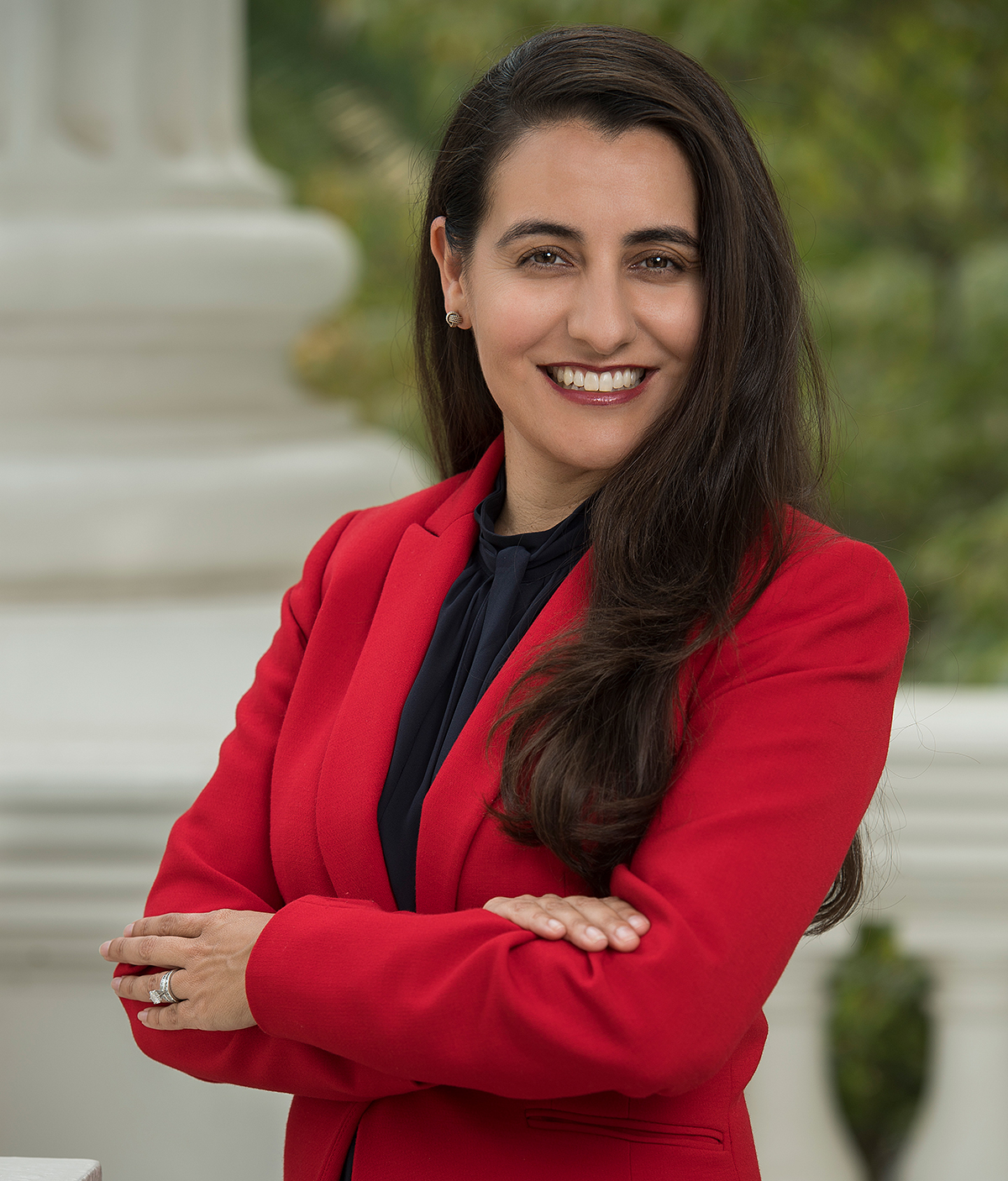
Photo of Monique Limón
D California Senate · District 21

Sen. Monique Limón

Compare
Total votes
20,781
all sessions
Attendance
92%
1,339 missed
Near the chamber average
With party
99%
of cast votes
Near the chamber average
Bipartisan score
0%
crosses aisle rarely
Near the chamber average
Sponsored
1,106
bills & resolutions
Near the chamber average
Committees
4
assignments
1,106 bills and resolutions

Sponsored bills

Total
1,106
Primary
238
Co-sponsor
868
This page
1,106
matching current filters
Primary ACR 135
Signed into law · California Assembly · Lead sponsor
Relative to the Ventura County Fire Engineer Ryan Osler Memorial Highway.

This measure would designate a specified portion of U.S. Highway 101 located in the County of Ventura as the Ventura County Fire Engineer Ryan Osler Memorial Highway. The measure would also request the Department of Transportation to determine the cost for appropriate signs showing this special designation and, upon receiving donations from nonstate sources covering that cost, to erect those signs.

Signed into law Aug 17, 2018 0 co-sponsors
Co-sponsor ACR 242
Signed into law · California Assembly · Co-sponsor
Relative to California Manufacturing Day.

This measure would declare Friday, October 5, 2018, as California Manufacturing Day and would recognize the importance of California's manufacturing sector. The measure would also commemorate California's manufacturers as they continue to push the bounds of clean technologies that reduce emissions and increase energy efficiency in products and processes.

Signed into law Aug 17, 2018 1 co-sponsor
Primary AB 2211
Passed · California Assembly · Lead sponsor
California Green Business Program.

Existing law creates the California Environmental Protection Agency, consisting of various boards, offices, and departments, including the State Air Resources Board and the Department of Toxic Substances Control. The California Global Warming Solutions Act of 2006 establishes the State Air Resources Board as the state agency responsible for monitoring and regulating sources emitting greenhouse gases. The act authorizes the state board to include the use of market-based compliance mechanisms. Existing law requires all moneys, except for fines and penalties, collected by the state board as part of a market-based compliance mechanism to be deposited in the Greenhouse Gas Reduction Fund and to be available upon appropriation by the Legislature. This bill would establish the California Green Business Program within the California Environmental Protection Agency. The bill would require the California Green Business Program to, among other things, develop baseline, beyond compliance environmental standards, as defined, for green business certification programs operated by local governments. The bill would also provide for the establishment of these local programs, which would certify small- and medium-sized businesses and public agencies as California green businesses, or an equivalent designation of the local program's choosing, for voluntarily adopting environmentally preferable business practices, including, but not limited to, increased energy efficiency, pollution prevention, reduced greenhouse gas emissions reduction, water conservation, and waste reduction practices. The bill would delete an existing authorization for the Department of Toxic Substances Control to create a similar program.

Passed Aug 16, 2018 0 co-sponsors
Co-sponsor SB 1190
Passed · California Senate · Co-sponsor
Eugenics Sterilization Compensation Program.

(1) Existing law prohibits sterilization of a person with developmental disabilities without his or her consent, if he or she has the ability to consent to sterilization, as defined, unless a limited conservator authorized to consent to the sterilization of an adult with a developmental disability is appointed and obtains court authorization to consent to the sterilization, as specified. Existing law prohibits sterilization for the purpose of birth control in county jails and state prison facilities, as specified. Existing law provides for the compensation of victims and derivative victims of specified types of crimes by the California Victim Compensation and Government Claims Board from the Restitution Fund, a continuously appropriated fund consisting of General Fund moneys, for specified losses suffered as a result of those crimes. Existing law sets forth eligibility requirements and specified limits on the amount of compensation the board may award, and requires applications for compensation to be verified under penalty of perjury. Under existing law, certain property is exempt from enforcement of money judgments, including benefits from a disability or health insurance policy or program. This bill would establish the Eugenics Sterilization Compensation Program, to be implemented by the California Victim Compensation Board for the purpose of providing victim compensation to any survivor of state-sponsored sterilization conducted pursuant to eugenics laws that existed in the State of California between 1909 and 1979. The bill would require the board, in consultation with community-based organizations, to conduct outreach to locate any qualified recipient, as defined, notify that person of the process to apply for victim compensation, and review and verify all applications for victim compensation, as specified. The bill would require the board to keep confidential and not disclose to the public any record pertaining to an individual's application for victim compensation or the board's verification of the application. The bill would exempt victim compensation payments from, among other things, being considered taxable income for state tax purposes or being subject to enforcement of a money judgment, as specified. The bill would provide that its provisions shall become operative only upon an appropriation to the board, the State Department of State Hospitals, and the State Department of Developmental Services for the purpose of implementing the program. The bill would also require the board and departments to post a notice on its Internet Web site once the appropriation described above is made to inform the public of the operative date of the program. (2) Existing law provides that information and records obtained in the course of providing specified mental health and developmental services are confidential, but allows the disclosure of the information and records under specified circumstances. This bill would additionally authorize the State Department of Developmental Services and the State Department of State Hospitals to disclose the above-described information and records to authorized employees of the board for the purposes of verifying the identity and eligibility of individuals claiming compensation under the Eugenics Sterilization Compensation Program. The bill would require the board to maintain the confidentiality of the information and records received from the departments. (3) Existing constitutional provisions require that a statute that limits the right of access to the meetings of public bodies or the writings of public officials and agencies be adopted with findings demonstrating the interest protected by the limitation and the need for protecting that interest. This bill would make legislative findings to that effect.

Passed Aug 16, 2018 1 co-sponsor
Primary AB 1037
Passed · California Assembly · Lead sponsor
Postsecondary education: student financial aid: Cal Grant B Service Incentive Grant Program.

Existing law establishes the Student Aid Commission to administer state student financial aid programs, including, among other programs, the Cal Grant Program, the Assumption Program of Loans for Education, and the Middle Class Scholarship Program. Existing law also requires that a person, other than a nonimmigrant alien, as defined, who has attended high school in California for 3 or more years, who has graduated from a California high school or attained the equivalent thereof, who has registered at or attends an accredited institution of higher education in California not earlier than the fall semester or quarter of the 2001–02 academic year, and who, if he or she is an alien without lawful immigration status, has filed a prescribed affidavit, is exempt from paying nonresident tuition at the California Community Colleges and the California State University. Existing law, known as the California Dream Act of 2011, provides that a student attending the California State University, the California Community Colleges, or the University of California who is exempt from paying nonresident tuition under the provision described above is eligible to receive a scholarship derived from nonstate funds received, for the purpose of scholarships, by the public postsecondary educational segment at which he or she is a student. This bill would establish, commencing with the 2018–19 academic year, the Cal Grant B Service Incentive Grant Program under the administration of the Student Aid Commission. The bill would require a participating student, in order to receive a grant award under the program, among other requirements, to be a recipient of a Cal Grant B award; to be enrolled as a student at a campus of the University of California, the California State University, or the California Community Colleges, or at an independent institution of higher education, as defined; and to perform at least 100 hours per quarter or 150 hours per semester of community or volunteer service, as appropriate. The bill would specify the amount of the grants to be awarded under the program, and would require that the grants awarded under this program not offset or replace any other source of grant aid, as specified. The bill would limit to 2,500 the number of eligible students simultaneously receiving grants under the program, as specified. The bill would specify the eligibility requirements for students participating in the program, including the submission of a California Dream Act application to the commission and the meeting of all of the requirements for an exemption from paying nonresident tuition as described above. The bill would also specify the requirements for the community or volunteer service performed by participating students to be applied toward the earning of grant awards under the program.

Passed Aug 16, 2018 0 co-sponsors
Co-sponsor AB 2934
Passed · California Assembly · Co-sponsor
Residential lead-based paint hazard reduction program: county health departments: certification.

(1) Existing law requires the State Department of Public Health to implement and administer a residential lead-based paint hazard reduction program, as specified, including adopting regulations regarding accreditation of providers of health and safety training to employees who engage in or supervise lead-related construction work, as defined, and certification of employees who have successfully completed that training. Existing law requires specified persons engaged in lead construction work to have a certificate issued by the department. This bill would require the department, by February 1, 2019, to request permission from the federal Environmental Protection Agency to modify its Lead Related Construction Program agreement to expand its authority and authorize a county to implement and administer the certification program for persons engaged in lead construction work described above. The bill would authorize the department, if it receives this permission from the federal Environmental Protection Agency, to authorize, upon request of the county, a county health department to implement and administer the certification program. The bill would require specified persons engaged in lead construction work to have a certificate issued either by the department or by a county health department, if applicable. (2) Existing regulations promulgated by the Division of Occupational Safety and Health require an employer to ensure that an employee is not exposed to lead at concentrations greater than 50 micrograms per cubic meter of air averaged over an 8-hour period. This bill would require the division to complete rulemaking to establish a revised permissible exposure limit for lead in the regulations described above by July 1, 2019. The bill would authorize the division to promulgate emergency regulations as necessary to implement these provisions.

Passed Aug 16, 2018 1 co-sponsor
Primary AB 3207
Passed · California Assembly · Lead sponsor
California Financing Law.

(1) Existing law, the California Financing Law (CFL) , provides for the licensure and regulation of finance lenders and brokers, and, beginning on January 1, 2019, program administrators, by the Commissioner of Business Oversight. The CFL prohibits anyone from engaging in the business of a finance lender or broker without obtaining a license. A willful violation of the CFL is a crime, except as specified. The CFL defines a broker to include anyone who is engaged in the business of negotiating or performing any act as a broker in connection with loans made by a finance lender. This bill would revise the definition of a broker to include anyone who, among other things, transmits confidential data about a prospective borrower to a finance lender with the expectation of compensation in connection with making a referral unless a specified exception applies, makes a referral under an agreement with a finance lender that meets certain requirements with the expectation of compensation if the finance lender enters into the loan with the prospective borrower unless a specified exception applies, participates in any loan negotiation between a finance lender and prospective borrower, participates in the preparation of loan documents, communicates lending decisions or inquiries to a borrower, or charges a fee to a prospective borrower for any services related to an application for a loan from a finance lender. The bill would exempt specified persons from the definition of broker, including the operator of an Internet search engine or social media platform. Because the bill would expand the definition of an existing crime by broadening the definition of a broker for purposes of the CFL, the bill would impose a state-mandated local program. The bill would prohibit a licensed broker from performing an act that falls within the definition of a broker without first obtaining the borrower's express consent. (2) Existing law exempts specified entities from the CFL. Under existing federal law, a federally recognized Indian tribe is immune from suit on the basis of tribal sovereign immunity, and the California Supreme Court held in People ex rel. Owen v. Miami Nation Enterprises (2016) 2 Cal.5th 222 that tribal sovereign immunity can extend to an entity that is acting as an arm of the tribe provided the entity meets 5 factors articulated in that case. The bill would state that the provisions of the CFL should not be interpreted to impose licensing or regulatory obligations on federally recognized Indian tribes or business entities that are considered "arms of the tribe", under the test articulated in the California Supreme Court case described above and any superseding case law. The bill would clarify that a licensed broker is not prohibited from performing any act that falls within the definition of broker in connection with loans made by a person not required to be licensed as a finance lender under this division. (3) Existing law prohibits a finance lender, broker, or mortgage loan originator licensee from paying any commission, fee, or other compensation to an unlicensed individual for conducting activities related to a consumer loan that require a license, unless that unlicensed individual is exempt from licensure. Existing law authorizes a licensed finance lender to compensate an unlicensed person in connection with the referral of one or more prospective borrowers to the licensee for a commercial loan if certain requirements are met. This bill would prohibit a finance lender from compensating a person for any of the acts that fall within the definition of a broker, as described above, unless that person is a licensed broker, is not required to be licensed as a broker under the CFL, or if that compensation is made in connection with the referral of one or more prospective borrowers when specified conditions are met. The bill would prohibit an unlicensed person who receives compensation pursuant to that exception from collecting a prospective borrower's confidential data for the purpose of making a referral without first obtaining the borrower's express consent, and would also require that person to provide a written disclosure to the prospective borrower before making the referral that shows the method of compensation to the licensed broker. The bill would prohibit a licensed finance lender from compensating a broker for specified acts that fall within the definition of broker if the finance lender has actual knowledge at the time the compensation is to be made that the broker has committed any violation of the CFL or any rule or order adopted under the CFL in connection with that loan. The bill would prohibit a licensed finance lender who enters into a loan with a prospective borrower in which the finance lender paid or would pay a referral fee from passing through an additional fee attributable to the referral fee, but would authorize a licensed finance lender to charge additional fees or costs attributable to the performance of other acts that fall within the definition of a broker if the finance lender pays another person for performing any of those acts for a consumer loan made under the CFL. The bill would require a licensed broker who compensates unlicensed persons for referrals as described above to develop, implement, and enforce policies and procedures to ensure that the unlicensed person does not engage in acts that would have been a violation of the CFL had those acts been committed by a licensee. The bill would provide that a licensed broker who is in violation of this provision is in violation of this chapter to the same extent as the unlicensed person would have been had that person been a licensed broker. The bill would provide, however, that a licensed broker is not in violation of these provisions solely for the reason that an unlicensed person that the broker compensated commits isolated acts that are in violation of the CFL. The bill would require a broker who compensates unlicensed persons for referrals to maintain books and records documenting the identities of all unlicensed persons that the broker compensates for referrals and all unlicensed persons that broker severs a relationship with due to the unlicensed persons' failure to adhere to the broker's policies and procedures adopted pursuant to these provisions. By expanding the scope of an existing crime with respect to violations of the CFL, this bill would impose a state-mandated local program. (4) Existing law requires a licensed finance lender to provide a borrower with respect to a consumer loan a statement that contains, among other things, the terms of the loan, and to obtain a signed statement from the borrower as to whether any person has performed any act as a broker in connection with the making of the loan. The bill would make clarifying changes to that provision, and would require a licensed finance lender, in lieu of the requirement to obtain a signed statement from the borrower described above, making a consumer loan to a prospective borrower who was referred by a licensed broker as described above or before the prospective borrower is obligated on the loan, to provide to the prospective borrower a statement that provides specified information relating to the arrangement in a clear and conspicuous manner. (5) Existing law requires a licensed broker to comply with certain duties with respect to a consumer loan, including delivering the borrower a signed statement that contains the terms of the agreement with the broker, and when the borrower pays the loan in full, ensure that the finance lender fully complies with a provision of the CFL that requires a licensed finance lender, upon repayment of any loan in full, to take specified actions related to that loan, including releasing all security for the loan and marking it as paid. This bill would, with respect to acts that fall within the definition of broker other than transmitting confidential data and making a referral as described above, no longer require a licensed broker to ensure that a finance lender fully complies with the provision of the CFL governing repayment described above. The bill would require a licensed broker before making a referral in connection with a consumer loan to provide to the prospective borrower a statement that provides specified information relating to the arrangement in a clear and conspicuous manner and to then obtain the prospective borrower's express consent. (6) The CFL authorizes the commissioner to examine specified records of every person engaged in the business of a finance lender, broker, or, beginning on January 1, 2019, program administrator, for the purpose of discovering violations of the CFL or securing information otherwise required in the administration and enforcement of this division. This bill would require the commissioner to examine the affairs of each finance lender licensee for compliance at least once every 48 months. The bill would authorize the commissioner to conduct the examination under oath. By expanding the crime of perjury, this bill would impose a state-mandated local program. The bill would require the commissioner to provide a written statement of the findings of the examination, to issue a copy of that statement to the licensee's principals, officers, or directors, and to take appropriate steps to ensure correction of any violations. (7) The California Constitution requires the state to reimburse local agencies and school districts for certain costs mandated by the state. Statutory provisions establish procedures for making that reimbursement. This bill would provide that no reimbursement is required by this act for a specified reason.


Passed Aug 16, 2018 0 co-sponsors
Co-sponsor SCR 107
Signed into law · California Senate · Co-sponsor
Relative to developmental services.

This measure would declare the intent of the Legislature to further support the housing needs of individuals with developmental disabilities by exploring models that facilitate the private donation of homes in perpetuity and would recognize the work of organizations that have developed a property donation program.

Signed into law Aug 15, 2018 1 co-sponsor
Showing 771 to 780 of 1,106 bills
Previous 1 … 77 78 79 … 111 Next