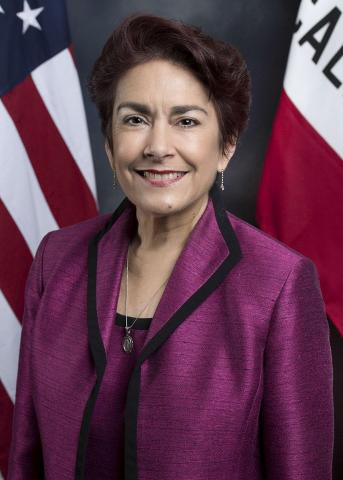
Photo of Anna Caballero
D California Senate · District 14

Sen. Anna Caballero

Compare
Total votes
35,964
all sessions
Attendance
93%
1,819 missed
Near the chamber average
With party
99%
of cast votes
Near the chamber average
Bipartisan score
1%
crosses aisle rarely
Near the chamber average
Sponsored
645
bills & resolutions
Near the chamber average
Committees
14
assignments
645 bills and resolutions

Sponsored bills

Total
645
Primary
181
Co-sponsor
464
This page
645
matching current filters
Co-sponsor SB 1062
Passed · California Senate · Co-sponsor
The Fixing the Firefighter Shortage Act of 2022.

Existing law establishes the Department of Forestry and Fire Protection in the Natural Resources Agency to provide fire protection and prevention services, as specified. This bill would require the department to maintain a standard minimum level of staffing for each of its engines, as specified, without the regular practice of forcing overtime on its personnel. The bill would require the department to increase its existing firefighter fuel crews, as specified. The bill would require the department, on or before January 1, 2024, to provide to the Legislature a long-term staffing plan to meet the new era of wildfire firefighting.

Passed Aug 11, 2022 1 co-sponsor
Primary SB 625
Passed · California Senate · Lead sponsor
California Pollution Control Financing Authority: community development financial institutions: grant program.

Existing law, the California Pollution Control Financing Authority Act, establishes the California Pollution Control Financing Authority (authority) , with specified powers and duties, and authorizes the authority to approve financing for projects or pollution control facilities to prevent or reduce environmental pollution. Existing federal law establishes the Capital Magnet Fund and makes moneys in that fund available to the United States Secretary of the Treasury to carry out a competitive grant program to attract private capital for, and increase investment in, certain affordable housing and economic development projects by providing grants, as provided, to Treasury-certified community development financial institutions or nonprofit organizations that meet specified criteria. Existing federal law, the federal Community Development Financial Institutions Program, provides financial and technical assistance to specified recipients to enhance their ability to provide specified financial products, financial services, and development services to, and in, their target markets in order to promote economic revitalization and community development through investment in, and assistance to, community development financial institutions, as defined and specified. This bill would authorize the authority to establish the California Investment and Innovation Program for the purpose of providing grants to enhance the capacity of specified community development financial institutions to provide technical assistance and capital access to economically disadvantaged communities in the state. The bill would establish the California Investment and Innovation Fund and, upon appropriation and the authority's establishment of the program, require the authority to award grants to eligible applicants, defined as community development financial institutions that meet specified criteria under the program, as provided. The bill would require eligible applicants, prior to receiving any grant funds, to enter into a grant agreement with the authority containing specified requirements. The bill would specify authorized uses of grant funds, including increasing working capital for the purpose of funding services and operations that contribute to the overall community development mission of the eligible applicant. The bill would require the authority to adopt, amend, or repeal guidelines for the operation of the program, as specified. The bill would make the authority's duties under these provisions contingent on the authority establishing the program. The bill would also, beginning on January 1, 2024, change the name of the authority to the California Community Development Financing Authority, as specified.

Passed Jul 29, 2022 0 co-sponsors
Co-sponsor AB 1746
Passed · California Assembly · Co-sponsor
Student financial aid: Cal Grant Reform Act.

(1) Existing law establishes the Cal Grant A and B Entitlement awards, the California Community College Transfer Entitlement awards, the Competitive Cal Grant A and B awards, the Cal Grant C awards, and the Cal Grant T awards under the administration of the Student Aid Commission, and establishes eligibility requirements for these awards for participating students attending qualifying institutions. This bill would enact the Cal Grant Reform Act, which would revise and recast the provisions establishing and governing the existing Cal Grant Program into a new Cal Grant Program. The bill would specify that the Cal Grant Reform Act would only become operative upon the appropriation by the Legislature, in the annual Budget Act or another statute, of sufficient funds to fully implement its provisions. The bill would authorize the commission to adopt emergency regulations to implement the Cal Grant Reform Act. The new Cal Grant Program would also include a Cal Grant 2 Program and a Cal Grant 4 Program, with eligibility requirements as specified. The provisions rendering several existing provisions of the Cal Grant Program inoperative would take effect on July 1, 2024, or on a date determined in the annual Budget Act, whichever date is later. The Cal Grant Reform Act would become operative for students to apply for aid beginning October 1, 2023, and to receive aid for the 2024–25 academic year. The bill would require the Trustees of the California State University, and request the Regents of the University of California, to adopt a statement of policy on or before June 30, 2023, on how their institutional aid programs address student basic needs and how these institutional funds are prioritized for disbursement. The bill would require the University of California, the California State University, private nonprofit and for-profit institutions of higher education, and community college districts whose students receive Cal Grant aid to report specified data to the Department of Finance, the Legislative Analyst's Office, and the higher education policy and fiscal committees of the Legislature for each academic year, starting with the 2022–23 academic year, by March 31 of the subsequent academic year. To the extent that this provision would impose new duties on community college districts, it would constitute a state-mandated local program. (2) The California Constitution requires the state to reimburse local agencies and school districts for certain costs mandated by the state. Statutory provisions establish procedures for making that reimbursement. This bill would provide that, if the Commission on State Mandates determines that the bill contains costs mandated by the state, reimbursement for those costs shall be made pursuant to the statutory provisions noted above.

Passed Jul 13, 2022 1 co-sponsor
Primary SB 382
Signed into law · California Senate · Lead sponsor
Human trafficking: restraining orders.

Existing law, as amended by the Californians Against Sexual Exploitation Act (CASE Act) , an initiative measure enacted by the approval of Proposition 35 at the November 6, 2012, statewide general election, makes it a felony to cause, induce, or persuade, or attempt to cause, induce, or persuade, a person who is a minor at the time of commission of the offense to engage in a commercial sex act, with the intent to effect or maintain a violation of specified crimes. Existing law allows a court to issue various protective orders to protect victims of, and witnesses to, a crime, as specified. Existing law requires a person who violates the CASE Act by causing a minor to engage in a commercial sex act to register as a sex offender. If a case involves a crime that requires the defendant to register as a sex offender, existing law requires a court to consider issuing these protective orders on its own motion. This bill would require the prosecutor, in cases involving human trafficking, to consider whether to seek protective orders.

Signed into law Jul 1, 2022 0 co-sponsors
Co-sponsor SCA 10
Signed into law · California Senate · Co-sponsor
A resolution to propose to the people of the State of California an amendment to the Constitution of the State, by adding Section 1.1 to Article I thereof, relating to fundamental rights.

The California Constitution declares that defending life and liberty, acquiring, possessing, and protecting property, and pursuing and obtaining safety, happiness, and privacy are inalienable rights, and that a person may not be deprived of life, liberty, or property without due process of law or equal protection of the laws. Existing law, the Reproductive Privacy Act, declares that every individual possesses a fundamental right of privacy with respect to personal reproductive decisions and prohibits the state from denying or interfering with a person's right to choose or obtain an abortion before viability of the fetus, or when the abortion is necessary to protect the life or health of the person. This measure would amend the California Constitution to prohibit the state from denying or interfering with an individual's reproductive freedom in their most intimate decisions, which includes their fundamental right to choose to have an abortion and their fundamental right to choose or refuse contraceptives.

Signed into law Jun 29, 2022 1 co-sponsor
Co-sponsor SB 387
Passed · California Senate · Co-sponsor
Pupil health: school employee and pupil training: youth mental and behavioral health.

Existing law, contingent on an appropriation made for these purposes, requires the State Department of Education, on or before January 1, 2023, to recommend best practices and identify training programs for use by local educational agencies to address youth behavioral health, including, but not necessarily limited to, staff and pupil training, as specified. Existing law requires the department to ensure that each identified training program, among other requirements, provides instruction on how school staff can best provide referrals to youth behavioral health services or other support to individuals in the early stages of developing a youth behavioral health disorder. Existing law defines a local educational agency for purposes of these provisions to mean a county office of education, school district, state special school, or charter school that serves pupils in any of grades 7 to 12, inclusive. This bill would include referrals to special education services in that instruction requirement for identified training programs. The bill would require, on or before January 1, 2025, those local educational agencies to certify to the department that 75% of both its classified and certificated employees have received that youth behavioral health training, as specified. The bill would prohibit the training in youth behavioral health to be a condition of employment or hiring. By imposing training certification duties on local educational agencies, the bill would impose a state-mandated local program. The California Constitution requires the state to reimburse local agencies and school districts for certain costs mandated by the state. Statutory provisions establish procedures for making that reimbursement. This bill would provide that, if the Commission on State Mandates determines that the bill contains costs mandated by the state, reimbursement for those costs shall be made pursuant to the statutory provisions noted above.

Passed Jun 28, 2022 1 co-sponsor
Co-sponsor SB 976
Passed · California Senate · Co-sponsor
Universal Preschool Act.

Existing law, the Early Education Act, requires the Superintendent of Public Instruction, to, among other things, provide an inclusive and cost-effective preschool program. Existing law requires the Superintendent to develop standards for the implementation of high-quality preschool programs. This bill would rename the Early Education Act as the Universal Preschool Act, and would revise and recast the act to, among other things, require the State Department of Education, in consultation with the State Department of Social Services, to administer the universal preschool program. The bill would require the Superintendent and the Director of Social Services to convene a statewide coordination council to develop, among other things, goals, guidelines, and best practices to be used at a local level to implement a universal preschool program, as provided. The bill would require the Superintendent, in consultation with the Director of Social Services, to develop standards for the implementation of high-quality preschool programs in all settings, including, among other settings, transitional kindergarten. The act establishes a standard reimbursement rate for both the part- and full-day preschool programs, as provided. The act defines the term "attendance" for purposes of this reimbursement to include excused absences by children because of illness, quarantine, illness or quarantine of their parent, family emergency, or to spend time with a parent or other relative as required by court of law or that is clearly in the best interest of the child. This bill would require the State Department of Education, in consultation with the State Department of Social Services, to instead ensure the standard reimbursement rate provides at least a living wage for all universal preschool site supervisors, teachers, and staff. The bill would delete the definition of "attendance" for purposes of this reimbursement. The Early Education Act establishes eligibility requirements, including income eligibility requirements, for the part- and full-day preschool programs. The act establishes a fee schedule for families receiving preschool services. This bill would delete the requirements relating to eligibility and the fee schedule, and instead would provide that the universal preschool program shall be free, inclusive, and available to all 3- and 4-year-olds. The Early Education Act provides that the same fee as that prescribed for a credential shall be charged for either the issuance or renewal of each child development permit authorizing service in the supervision and instruction of children in child development programs or authorizing service as a supervisor in a program. This bill would instead provide that no fees shall be charged for either the issuance or renewal of each child development permit authorizing service in the supervision and instruction of children in child development programs or authorizing service as a supervisor in a program. The bill would require the State Department of Education, in consultation with the State Department of Social Services, to offer financial support to current and aspiring universal preschool site supervisors, teachers, and other support staff in obtaining required credentials and degrees to work in the preschool classroom or setting, as provided. This bill would make other related changes to the administration of the newly named Universal Preschool Act. Existing law requires childcare resource and referral programs to provide specified services, including the establishment of a referral process that responds to parental need for information, as provided. This bill would require the Director of Social Services, in partnership with the Superintendent, to expand existing childcare resource and referral services to include navigation, referral, and enrollment services for the universal preschool program, as provided. This bill would provide that the above described changes to law would become operative only upon an appropriation of funds by the Legislature for these purposes in the annual Budget Act or another statute.


Passed Jun 28, 2022 1 co-sponsor
Primary SB 1308
Passed · California Senate · Lead sponsor
Public educational institutions: purchase of nondomestic agricultural food products.

Existing law requires all California state-owned or state-run institutions, except public universities and colleges and school districts, to purchase an agricultural product grown in California when the bid or price of the California-grown agricultural product does not exceed by more than 5% the lowest bid or price for an agricultural product produced outside the state and the quality of the California-grown agricultural product is comparable. Existing law also requires the institutions, when they solicit or intend to accept a bid or price for agricultural products grown outside the state, to accept the bid or price from a vendor that packs or processes these agricultural products in the state before accepting a bid or price from a vendor that packs or processes these agricultural products outside of the state when specified conditions are met. Existing law requires a school district that solicits bids for the purchase of an agricultural product to accept a bid or price for that agricultural product when it is grown in California before accepting a bid or price for an agricultural product that is grown outside the state when the bid or price of the California-grown agricultural product does not exceed the lowest bid or price for an agricultural product produced outside the state and the quality of the California-grown agricultural product is comparable. Under existing law, these provisions only apply to a contract to purchase agricultural products for a value that is less than the value of the threshold for supplies and services for which California has obligated itself under the Agreement on Government Procurement of the World Trade Organization. This bill would change the above-described requirement for school districts to apply to the purchase of a domestic agricultural product that is grown outside the state, instead of an agricultural product that is grown outside of the state. The bill would also prohibit the California Community Colleges, the California State University, and all local educational agencies that solicit bids for the purchase of an agricultural food product from purchasing, and would request the University of California not to purchase, agricultural food products grown, packed, or processed nondomestically, unless the bid or price of the nondomestic agricultural food product is more than 25% lower than the bid or price of the domestic agricultural food product, the quality of the domestic agricultural food product is inferior to the quality of the agricultural food product grown, packed, or produced nondomestically, or the agricultural food product is not produced or manufactured domestically in sufficient and reasonably available quantities of a satisfactory quality to meet the needs of meals provided under the school meal program of the public postsecondary educational institution or local educational agency. The bill would provide that the bill's provisions neither limit nor expand California's obligations under the Agreement on Government Procurement of the World Trade Organization. The bill would define the term "agricultural food product" for purposes of the prohibition to mean a fresh or processed product, as specified. The bill would provide that this prohibition does not apply to agricultural food products purchased by or provided to a public postsecondary educational institution or local educational agency through the United States Department of Agriculture. The bill would make these provisions operative on January 1, 2024. To the extent that this bill would impose additional duties for school districts and community colleges, this bill would impose a state-mandated local program. The California Constitution requires the state to reimburse local agencies and school districts for certain costs mandated by the state. Statutory provisions establish procedures for making that reimbursement. This bill would provide that, if the Commission on State Mandates determines that the bill contains costs mandated by the state, reimbursement for those costs shall be made pursuant to the statutory provisions noted above.

Passed Jun 28, 2022 0 co-sponsors
Co-sponsor SB 777
Passed · California Senate · Co-sponsor
Insurance taxation: credit: California Jumpstart Act.

Existing statutory law imposes taxes on the gross premiums of an insurer, as defined, and allows various credits against those taxes. The California Constitution imposes exactions against insurers from another state or country under specified conditions. This bill would establish the California Jumpstart Act. The act would allow a credit against those taxes for each taxable year beginning on or after January 1, 2025, until January 1, 2030, in an amount equal to the amount of a relief contribution, as defined, that meets specified requirements. The bill would prohibit a taxpayer allowed a credit under the act for a qualified relief investment from being eligible for any other credit, as specified, with respect to that investment. The bill would require the California Pollution Control Financing Authority (CPCFA) to, among other things, accept applications for approval as a relief fund that meet specified requirements, including that the application include a signed certification from the chief executive officer or another similar officer of each investor committing to make a relief contribution and stating the amount of that commitment, among other attestations. The bill also would authorize the CPCFA to recover any tax credit allowed and revoke the tax credit certificates issued to a taxpayer if the taxpayer engages in specified behavior, including, failing to invest 100% of its investment authority in relief investments within 2 years of the closing date. The bill would require the CPCFA to act in consultation with the Department of Insurance to accomplish these responsibilities where specified. This bill would require, among other things, the CPCFA to undertake outreach activities to encourage investment in impact businesses, including, but not limited to, partnering with organizations representing persons and business enterprises from small businesses more than 50% owned by minorities, women, disabled veterans, lesbian, gay, bisexual or transgender persons, as described. The bill would also establish the Treasury Relief Investment Fund in the State Treasury, and would continuously appropriate the fund for purposes of these provisions. The bill would authorize CPCFA to direct the Treasurer to invest moneys in the fund, as specified, and would authorize CPCFA to use proceeds in the fund for administrative purposes. By continuously appropriating moneys in the fund, this bill would make an appropriation. This bill would provide that the California Jumpstart Act is only operative for taxable years for which an appropriation is made for its purposes in the annual Budget Act or other statute. This bill would require various certifications by officers of an investor and would require a relief fund that has not decertified to annually certify under penalty of perjury that the relief fund has not violated any of the grounds for recovery and revocation of credits. By expanding the crime of perjury, this bill would impose a state-mandated local program. The California Constitution requires the state to reimburse local agencies and school districts for certain costs mandated by the state. Statutory provisions establish procedures for making that reimbursement. This bill would provide that no reimbursement is required by this act for a specified reason.

Passed Jun 27, 2022 1 co-sponsor
Showing 371 to 380 of 645 bills
Previous 1 … 37 38 39 … 65 Next