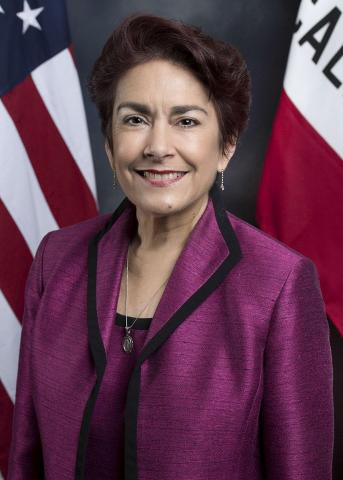
Photo of Anna Caballero
D California Senate · District 14

Sen. Anna Caballero

Compare
Total votes
35,964
all sessions
Attendance
93%
1,819 missed
Near the chamber average
With party
99%
of cast votes
Near the chamber average
Bipartisan score
1%
crosses aisle rarely
Near the chamber average
Sponsored
645
bills & resolutions
Near the chamber average
Committees
14
assignments
645 bills and resolutions

Sponsored bills

Total
645
Primary
181
Co-sponsor
464
This page
645
matching current filters
Co-sponsor SR 28
Passed · California Senate · Co-sponsor
Relative to California Agriculture Day.

Maddy summarySenate Resolution 28 designates March 19, 2025, as California Agriculture Day and March 18, 2025, as National Agriculture Day. The resolution formally recognizes the agricultural industry's vital contributions to California's economy, food supply, and community - highlighting its status as the nation's top agricultural producer and global exporter of key commodities like almonds, dairy, and produce. This ceremonial resolution does not create new laws, impose obligations, or alter policies; it serves solely as a symbolic tribute to farmers, ranchers, and farmworkers. The resolution was unanimously adopted by the California Senate on March 13, 2025.

Passed Mar 13, 2025 1 co-sponsor
Co-sponsor SR 15
Passed · California Senate · Co-sponsor
Relative to the "2-1-1" information and referral service.

Maddy summarySenate Resolution 15 designates February 2025 as "2-1-1 Month" and February 11, 2025 as "2-1-1 Day" to recognize and promote California's 2-1-1 information and referral service. The resolution does not create new laws or funding but formally encourages public awareness of the free, confidential service that connects residents to community, health, housing, disaster, and other support resources. It acknowledges 2-1-1's role in handling over 2 million annual referrals and supporting emergency response, but the resolution itself has no binding effect on service operations or funding. The measure was unanimously adopted by the Senate on February 27, 2025.

Passed Feb 27, 2025 1 co-sponsor
Co-sponsor SR 17
Passed · California Senate · Co-sponsor
Relative to Teen Dating Violence Awareness and Prevention Month.

Maddy summarySenate Resolution 17 designates February 2025 as Teen Dating Violence Awareness and Prevention Month in California. It encourages schools, communities, families, and youth to hold programs that raise awareness about teen dating violence and teach skills for healthy relationships. The resolution references CDC data showing one in three adolescents experiences dating abuse but does not create new laws or funding. It is a symbolic, non-binding resolution to promote awareness and community action.

Passed Feb 27, 2025 1 co-sponsor
Primary SCR 14
Signed into law · California Senate · Lead sponsor
Relative to CalEITC Awareness Week.

Maddy summarySenate Concurrent Resolution 14 designates January 31-February 7, 2025, as CalEITC Awareness Week in California. This procedural resolution does not create new policy or alter the CalEITC program itself; it solely aims to raise public awareness about the existing California Earned Income Tax Credit (CalEITC). The CalEITC is a refundable tax credit for low-income working individuals and families, with benefits reaching nearly 3.5 million filers annually. The resolution follows context about the credit's role in reducing poverty and supporting households, but the resolution itself only serves as a symbolic recognition.

Signed into law Feb 21, 2025 0 co-sponsors
Primary SR 16
Passed · California Senate · Lead sponsor
Relative to President Jimmy Carter Day.

Maddy summaryThis Senate Resolution (SR 16) designates December 29 as "President Jimmy Carter Day" in California to honor his humanitarian legacy, particularly his 35-year partnership with Habitat for Humanity building affordable housing. It commemorates his work with the Carter Work Project, which helped construct over 4,400 homes globally and inspired volunteerism. The resolution has no legal effect or policy changes - it is a ceremonial recognition of Carter's contributions to housing and community service. It was unanimously adopted by the California Senate on February 20, 2025.

Passed Feb 20, 2025 0 co-sponsors
Co-sponsor SR 11
Passed · California Senate · Co-sponsor
Relative to Cervical Cancer Awareness Month.

Maddy summarySenate Resolution 11 designates January 2025 as Cervical Cancer Awareness Month in California. It encourages the State Department of Public Health, the State Department of Health Care Services, and all Californians to promote cervical cancer prevention, screening, and education through activities during that month. The resolution specifically urges efforts to raise awareness about HPV (the leading cause of cervical cancer), the importance of regular screenings, and prevention measures for at-risk communities. It does not create new laws or funding but serves as a symbolic recognition to support existing public health outreach.

Passed Jan 27, 2025 1 co-sponsor
Co-sponsor SR 8
In committee · California Senate · Co-sponsor
Relative to Jim Plunkett.

Maddy summarySenate Resolution 8 is a symbolic resolution by the California Senate urging the Pro Football Hall of Fame Selection Committee to induct NFL quarterback Jim Plunkett into the Pro Football Hall of Fame for the 2025 class. The resolution highlights Plunkett's career achievements, including winning two Super Bowls (with the Raiders in 1981 and 1984), being the first Latino to win the Heisman Trophy (1970), and being the only starting quarterback with two Super Bowl rings not yet inducted. It does not create new policy or affect any group through legislation, as it is a non-binding expression of support addressed to the Hall of Fame committee. The resolution specifically notes Plunkett's historic significance as a trailblazing Latino athlete and his 17-year NFL career.

In committee Dec 2, 2024 1 co-sponsor
Primary SB 1386
Signed into law · California Senate · Lead sponsor
Evidence: sexual assault.

Under existing law, in any civil action that contains allegations of sexual harassment, sexual assault, or sexual battery, opinion evidence, reputation evidence, and evidence of specific instances of a plaintiff's sexual conduct with someone other than the alleged perpetrator, is not admissible by the defendant in order to prove consent by the plaintiff or the absence of injury to the plaintiff. This bill would also make the specified types of evidence inadmissible in such civil actions when being used to attack the credibility of the plaintiff's testimony on consent or absence of injury. Under existing law, in any sexual battery civil action involving a minor and an adult who is in a position of authority, as specified, evidence of the plaintiff minor's sexual conduct with the defendant adult is not admissible to prove consent by the plaintiff or the absence of injury to the plaintiff. Existing law authorizes evidence of the minor plaintiff's sexual conduct to be introduced only to attack the credibility of the plaintiff or to prove something other than consent by the plaintiff if, upon a hearing of the court out of the presence of the jury, the defendant proves that the probative value of that evidence outweighs the prejudice to the plaintiff, as specified. This bill would remove the requirement, in cases involving a minor and an adult who is in a position of authority, that prior to the introduction of specified types of evidence, a court hold a hearing out of the presence of the jury, where the defendant bears the burden to prove that the probative value of the evidence outweighs the prejudice. The introduction of evidence relating to the sexual conduct of the minor in such cases would be evaluated under procedures already in place under existing law.

Signed into law Sep 29, 2024 0 co-sponsors
Primary SB 1303
Signed into law · California Senate · Lead sponsor
Public works.

Existing law requires that, except as specified, not less than the general prevailing rate of per diem wages, determined by the Director of Industrial Relations, be paid to workers employed on public works projects. Existing law defines the term "public works" for purposes of requirements regarding the payment of prevailing wages to include construction, alteration, demolition, installation, or repair work done under contract and paid for using public funds, except as specified. Existing law requires an awarding body, as part of a labor compliance program, to withhold contract payments when, among other things, payroll records are delinquent or inadequate. Existing law requires an awarding body, as specified, to provide notice of withholding of contract payments to the contractor or subcontractor. Existing law requires the notice to be in writing, and describe the nature of the violation and the amount of wages, penalties, and forfeitures withheld. This bill would require a private labor compliance entity, prior to withholding funds for an alleged violation, to confer with the negotiating parties to review relevant public works law, and would prohibit the entity from withholding an amount that exceeds the alleged underpayments and penalty assessments. The bill would require a private labor compliance entity seeking to withhold funds to provide a venue for a public works contractor or subcontractor to review and respond to evidence of alleged violations, as specified. This bill would also provide that a violation of the conflict of interest provisions by a private labor compliance entity, as defined, would void a contract between the parties and subject the entity to specified civil fines and fees. The bill would require a private labor compliance entity to submit a signed declaration under penalty of perjury verifying that it has no conflicts of interest, as specified. By requiring private labor compliance entities to declare under penalty of perjury that they have no conflicts of interest, the bill would expand the crime of perjury and impose a state-mandated local program. Existing law authorizes a joint labor-management committee established pursuant to the federal Labor Management Cooperation Act of 1978 to bring an action against an employer who fails to pay the prevailing wage, or who fails to provide payroll records, as specified. This bill would authorize, among others, a joint labor-management committee to initiate a private right of action against certain entities, when the court is required to award reasonable attorney's fees and costs, as specified. This bill would exempt certain awarding bodies operating labor compliance programs that are approved and monitored by the Department of Industrial Relations from the above-described provisions. The California Constitution requires the state to reimburse local agencies and school districts for certain costs mandated by the state. Statutory provisions establish procedures for making that reimbursement. This bill would provide that no reimbursement is required by this act for a specified reason.

Signed into law Sep 29, 2024 0 co-sponsors
Co-sponsor AB 869
Signed into law · California Assembly · Co-sponsor
Hospitals: seismic safety compliance.

(1) Existing law requires, no later than January 1, 2030, owners of all acute care inpatient hospitals to either demolish, replace, or change to nonacute care use all hospital buildings not in substantial compliance with specified seismic safety standards or to seismically retrofit all acute care inpatient hospital buildings so that they are in substantial compliance with those seismic safety standards. Existing law requires the Department of Health Care Access and Information to issue a written notice upon compliance with those requirements. This bill would authorize a Distressed Hospital Loan Program recipient, a small hospital, a rural hospital, a critical access hospital, or a health care district hospital, as defined, and except as specified, to seek approval from the Department of Health Care Access and Information for a delay to the January 1, 2030, compliance deadline described above by up to 3 years. The bill would require hospitals seeking a delay to submit a seismic compliance plan, as specified, and, if necessary, a Nonstructural Performance Category-5 evaluation report. The bill would also require the hospital and department to identify least 2 major milestones relating to the seismic compliance plan that will be used as the basis for determining whether a hospital is making adequate progress toward meeting the subject hospital's seismic compliance deadline. The bill would subject the submitted seismic compliance plans to departmental review for reasonableness and require the hospital seeking the delay to submit any documentation requested by the department to assist its review. The bill would require the department to approve or deny a seismic compliance plan and any delay to the seismic compliance deadline within 120 days. The bill would also authorize the department to additionally delay the deadline for compliance by 2 years, up to a maximum of January 1, 2035, as necessary, for hospitals that continue to experience financial distress or that need to deal with contractor, labor, or material delays, acts of God, governmental entitlements, or other circumstances beyond the hospital's control. The bill would require hospitals eligible to delay compliance under these provisions to comply with the seismic safety standards described above by no later than January 1, 2035. The bill would impose a fine of $5,000 per calendar day for a hospital's failure to comply with a revised construction schedule or to meet any major milestone established by the department until the requirements or milestones, respectively, are met. The bill would also prohibit these hospitals from being issued a building permit for any building in the facility except those required for seismic compliance, maintenance, and emergency repairs until the milestone is met and the hospital is adequately progressing toward meeting the subject hospitals seismic compliance, as determined by the department. The bill would require the department to implement the above-described provisions by regulation, as specified. The bill would require the department to support a hospital requesting a delay under the above-described provisions to explore the opportunities under the Small and Rural Hospital Relief Program to assist with seismic compliance and to annually post a list of hospitals that have been granted a delay on its internet website, as specified. (2) Existing law establishes the Small and Rural Hospital Relief Program for the purpose of funding seismic safety compliance with respect to small hospitals, rural hospitals, and critical access hospitals in the state. Existing law requires the department to provide grants to small, rural, and critical access hospital applicants that meet certain criteria, including that seismic safety compliance, as defined, imposes a financial burden on the applicant that may result in hospital closure. Existing law also creates the Small and Rural Hospital Relief Fund and continuously appropriates the moneys in the fund for purposes of administering and funding the grant program. This bill would require the department to expand eligibility for grants for single- and 2-story general acute care hospitals located in remote or rural areas with fewer than 80 general acute care beds and general acute care hospital revenue of $75 million or less. The bill would require grants under the program to provide general acute care hospitals with funds to secure an SPC-4D assessment for purposes of planning for, and estimating the costs of, compliance with certain seismic safety standards, as specified. The bill would authorize specified general acute care hospitals to apply for a grant for purposes of complying with those seismic safety standards. If state funds are appropriated to the Small and Rural Hospital Relief Fund in the future for the purpose of complying with the seismic safety standards described in paragraph (1) , the bill would require a hospital that qualifies for assessment grants under the program to submit specified financial information relating to, among other things, the accuracy of the hospital's SPC-4D cost estimates to the department before being awarded state funds.


Signed into law Sep 28, 2024 1 co-sponsor
Showing 161 to 170 of 645 bills
Previous 1 … 16 17 18 … 65 Next