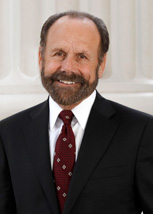
Photo of Jerry Hill
D California Senate · District 13 · Former member

Sen. Jerry Hill

Compare
Total votes
34,484
all sessions
Attendance
99%
121 missed
Higher than 94% of chamber peers
With party
99%
of cast votes
Near the chamber average
Bipartisan score
0%
crosses aisle rarely
Near the chamber average
Sponsored
1,209
bills & resolutions
Near the chamber average
Committees
0
assignments
1,209 bills and resolutions

Sponsored bills

Total
1,209
Primary
295
Co-sponsor
914
This page
1,209
matching current filters
Co-sponsor SJR 2
Signed into law · California Senate · Co-sponsor
Relative to violence against women.

This measure would call on the United States Congress to pass the Violence Against Women Reauthorization Act of 2013, Senate Bill No. 47, authored by Senator Leahy, and ensure the sustainability of vital programs designed to keep women and families safe from violence and abuse.

Signed into law Feb 28, 2013 1 co-sponsor
Co-sponsor AB 1532
Signed into law · California Assembly · Co-sponsor
California Global Warming Solutions Act of 2006: Greenhouse Gas Reduction Fund.

The California Global Warming Solutions Act of 2006 designates the State Air Resources Board as the state agency charged with monitoring and regulating sources of emissions of greenhouse gases. The state board is required to adopt a statewide greenhouse gas emissions limit equivalent to the statewide greenhouse gas emissions level in 1990 to be achieved by 2020, and to adopt rules and regulations in an open public process to achieve the maximum, technologically feasible, and cost-effective greenhouse gas emissions reductions. The act authorizes the state board to include use of market-based compliance mechanisms. Existing law imposes limitations on any link, as defined, between the state and another state, province, or country for purposes of a market-based compliance mechanism by, among other things, prohibiting any state agency, including the state board, from taking any action to create such a link unless the state agency notifies the Governor, and the Governor issues specified written findings on the proposed link that consider the advice of the Attorney General. This bill would prohibit the Governor's written findings on the proposed link from being subject to judicial review. Existing law requires all moneys, except for fines and penalties, collected by the state board from the auction or sale of allowances as part of a market-based compliance mechanism to be deposited in the Greenhouse Gas Reduction Fund and to be available upon appropriation by the Legislature. This bill would require the moneys in the Greenhouse Gas Reduction Fund to be used for specified purposes. The bill would require the Department of Finance, in consultation with the state board and any other relevant state entity, to develop, as specified, a 3-year investment plan that includes specified analysis and information and to submit the plan to the Legislature, as specified. The bill would require the Department of Finance to submit a report no later than March 1, 2014, and annually thereafter, to the appropriate committees of the Legislature containing specified information. This bill would make its provisions contingent on the enactment of other legislation, as specified.

Signed into law Sep 30, 2012 1 co-sponsor
Co-sponsor SB 970
Vetoed · California Senate · Co-sponsor
Health Care Reform Eligibility, Enrollment, and Retention Planning Act: coordination with other programs.

Existing law, the Health Care Reform Eligibility, Enrollment, and Retention Planning Act, requires the State Department of Health Care Services, in consultation with specified entities, to establish standardized single, accessible application forms and related renewal procedures for state health subsidy programs, as defined, in accordance with specified requirements. This bill would provide for the transmittal to a county human services department of information about an applicant initially applying for, or renewing, health care coverage using the single state application developed pursuant to the act, if the applicant consents to have his or her application information used to simultaneously initiate applications for CalWORKs and CalFresh, for initiation of the application. This bill would authorize the Secretary of California Health and Human Services to phase in implementation of these provisions under certain circumstances. The bill would require the California Health and Human Services Agency to convene a workgroup of human services and health care advocates, legislative staff, and other specified representatives, to consider the feasibility, costs, and benefits of integrating application and renewal processes for additional human services and work support programs with the single state application described in the bill, and to provide, by July 1, 2013, specified details regarding the workgroup to the appropriate fiscal and policy committees of the Legislature. This bill would require that the functionality necessary to implement the cross-application process be achieved by the expiration of a specified federal waiver. This bill would provide that those provisions would become inoperative under certain circumstances. By imposing new duties on counties, this bill would impose a state-mandated local program. The California Constitution requires the state to reimburse local agencies and school districts for certain costs mandated by the state. Statutory provisions establish procedures for making that reimbursement. This bill would provide that, if the Commission on State Mandates determines that the bill contains costs mandated by the state, reimbursement for those costs shall be made pursuant to these statutory provisions.

Vetoed Sep 30, 2012 1 co-sponsor
Co-sponsor AB 1852
Vetoed · California Assembly · Co-sponsor
Vital records: fees.

Existing law requires the collection of fees for providing certified copies of vital records, including marriage certificates, birth certificates, fetal death records, and death records. Existing law provides for the establishment of county domestic violence program special funds for the purpose of funding local domestic violence programs. Certain fees payable at the time a certified copy of any of the above-referenced vital records is issued may be collected by the county clerks for deposit into these funds. Additionally, existing law authorizes certain counties, upon making certain findings and declarations, to authorize an increase in fees for certified copies of certain vital records, as specified. Existing law requires the revenue from the fee increase to be allocated for purposes relating to domestic violence prevention, intervention, and prosecution. Existing law authorizes a county board of supervisors to designate a local voluntary commission, whose duties primarily relate to services for children or human services, and requires the county board of supervisors, if the local voluntary commission is designated, to establish a county children's trust fund. Existing law establishes the State Children's Trust Fund, of which money may be allocated, upon appropriation by the Legislature, to the State Department of Social Services for the purpose of funding child abuse and neglect prevention and intervention programs. This bill would authorize a county board of supervisors and certain city councils, upon making findings and declarations regarding the need for governmental oversight and coordination of the multiple agencies dealing with domestic violence and child abuse, to authorize an increase in the fees for certified copies of certain vital records up to a maximum of $5 per license or record and to annually adjust that amount for inflation, as specified. This bill would require the fees to be allocated, as specified, by the county or city for purposes relating to the prevention and intervention of domestic violence and child abuse. This bill would require proceeds from the fee increase from birth certificates to be deposited into the county children's trust fund or the State Children's Trust Fund, as specified.

Vetoed Sep 30, 2012 1 co-sponsor
Co-sponsor AB 1585
Signed into law · California Assembly · Co-sponsor
Community development.

(1) Existing law dissolved redevelopment agencies and community development agencies. Existing law authorizes the city, county, or city and county that authorized the creation of a redevelopment agency to retain the housing assets, functions, and powers previously performed by the redevelopment agency, excluding amounts on deposit in the Low and Moderate Income Housing Fund. Existing law creates the Low and Moderate Income Housing Asset Fund to be used for these purposes, and provides that funds in that account shall be used in accordance with applicable housing-related provisions of the Community Redevelopment Law. This bill would make conforming changes to clarify that specified provisions of the Community Redevelopment Law relating to the Low and Moderate Income Housing Fund apply for purposes of funding administrative and planning costs associated with the implementation of the provisions described above. (2) Under existing law, the Housing and Emergency Shelter Trust Fund Act of 2006, authorizes the issuance of bonds in the amount of $2,850,000,000 pursuant to the State General Obligation Bond Law. Proceeds from the sale of these bonds are used to finance various existing housing programs, capital outlay related to infill development, brownfield cleanup that promotes infill development, housing-related parks, and transit-oriented development administered by the Department of Housing and Community Development. This bill would appropriate $50,000,000, and additional moneys, as specified, of bond revenues to the Department of Housing and Community Development. From that amount, the bill would allocate $25,000,000, and additional moneys, as specified, from the Regional Planning, Housing, and Infill Incentive Account for infill incentive grants, and $25,000,000, and additional moneys, as specified, from the Transit-Oriented Development Implementation Fund for transit-oriented grants and loans, thereby making an appropriation.

Signed into law Sep 29, 2012 1 co-sponsor
Co-sponsor AB 2114
Signed into law · California Assembly · Co-sponsor
Swimming pool safety.

(1) The Swimming Pool Safety Act generally requires, whenever a building permit is issued for the construction of a new swimming pool or spa, the pool or spa to be equipped with specified safety features, including that the swimming pool or spa have at least 2 circulation drains per pump that are hydraulically balanced, and symmetrically plumbed through one or more "T" fittings, and that are separated by a distance of at least 3 feet in any dimension between the drains. Existing law also requires a public wading pool to have at least 2 circulation drains per pump, as specified, that are separated by a distance of at least 3 feet in any dimension between the drains. This bill would instead require a swimming pool, spa, or public wading pool that is subject to the above safety provisions to have at least 2 circulation suction outlets, as defined, per pump, and be separated by a distance of at least 3 feet in any dimension between the suction outlets, or be designed to use alternatives to suction outlets, including, but not limited to, skimmers or perimeter overflow systems to conduct water to the recirculation pump. The bill would also require the circulation system to have the capacity to provide a complete turnover of pool water, as specified. (2) Existing law requires a building permit issued for the remodel or modification of an existing swimming pool, toddler pool, or spa to require the suction outlet of the pool or spa to be upgraded with an antientrapment cover meeting ASTM or ASME standards. This bill would instead require those building permits to require all outlets for a swimming pool, toddler pool, or spa to be upgraded with an antientrapment cover meeting ANSI/APSP performance standards, as defined. (3) Existing law requires public swimming pools, as defined, to be equipped with antientrapment devices or systems that meet ASME/ANSI or ASTM performance standards, as defined. Existing law further requires every public swimming pool with a single main drain that is not an unblockable drain to be equipped with at least one or more safety devices designed to prevent physical entrapment by pool drains. Existing law also requires public wading pool main drain suction outlets to be covered with grates, antivortex plates, or similar protective devices, as specified. This bill would instead require every public swimming pool with a single suction outlet, as defined, that is not an unblockable suction outlet to be equipped with at least one or more safety devices that meet ANSI/APSP performance standards. The bill would also require all public wading pool suction outlets to be covered with grates, antivortex plates, or similar protective devices, as specified. The bill would additionally require a public swimming pool that has a suction outlet in any location other than on the bottom of the pool to be designed so that the recirculation system has a capacity to provide a complete turnover of pool water within prescribed times based on the pool type, as specified. (4) Existing law requires the State Department of Public Health to issue a form for use by an owner of a public swimming pool to indicate compliance with specified safety provisions. Under existing law, the form is required to be completed by the owner of a public swimming pool prior to filing the form with the appropriate city, county, or city and county department of environmental health, and is required to include specified information. This information includes a statement of whether the pool operates with a single or split main drain. This bill would require that form to instead include a statement of whether the pool operates with a single suction outlet or multiple suction outlets. The bill would make other related changes. By imposing new duties on local government officials, the bill would impose a state-mandated local program. Under existing law, violation of these swimming pool safety requirements constitutes a misdemeanor. This bill, by expanding the definition of an existing crime, would impose a state-mandated local program. (5) This bill would incorporate additional changes to Section 116064 of the Health and Safety Code proposed by SB 1099, that would become operative only if SB 1099 and this bill are both enacted, both bills become effective on or before January 1, 2012 and this bill is enacted last. (6) The California Constitution requires the state to reimburse local agencies and school districts for certain costs mandated by the state. Statutory provisions establish procedures for making that reimbursement. This bill would provide that no reimbursement is required by this act for specified reasons.


Signed into law Sep 28, 2012 1 co-sponsor
Primary AB 1782
Signed into law · California Assembly · Lead sponsor
Weighmasters: exemptions.

Existing law defines a weighmaster as any person, who, for hire or otherwise, weighs, measures, or counts any commodity and issues a statement or memorandum of the weight, measure, or count which is used as the basis for either the purchase or sale of that commodity or charge for service. Existing law requires weighmasters to obtain a license. Existing law specifies certain persons who weigh and measure commodities but are not weighmasters, such as retailers weighing commodities for sale in retail stores in the presence of consumers, newspaper publishers weighing newspapers for sale to dealers, and recycling centers weighing salvage materials for specified purposes. This bill, until January 1, 2017, would provide that facilities handling medical waste and that report net weights, and not estimates, to the generator of the medical waste and to the State Department of Public Health, are not weighmasters, as specified.

Signed into law Sep 28, 2012 0 co-sponsors
Primary AB 1277
Signed into law · California Assembly · Lead sponsor
Sherman Food, Drug, and Cosmetic Law.

The Sherman Food, Drug, and Cosmetic Law regulates the packaging, labeling, and advertising of drugs and devices, and is administered by the State Department of Public Health. The law prohibits the sale, delivery, or giving away of any new drug or new device unless either the department has approved a new drug or device application for that new drug or new device and that approval has not been withdrawn, terminated, or suspended or a new drug application has been approved for it and that approval has not been withdrawn, terminated, or suspended under specified provisions of the Federal Food, Drug, and Cosmetic Act, or it is a new device for which a premarket approval application has been approved, and that approval has not been withdrawn, terminated, or suspended under the federal act. The Sherman Food, Drug, and Cosmetic Law requires the department to adopt regulations to establish the application form and set the fee for licensure and renewal of a drug or device license. This bill would revise the above-described prohibition to exempt a new biologic product for which a license has been issued under federal law. Existing law also requires the department to inspect the place of business of each licensed manufacturer of a drug or device in the state prior to issuance of the license and, thereafter, once every 2 years, unless the United States Food and Drug Administration inspected the place of business within the previous 2 years. This bill would, instead, require each place of business to submit to the department documentation that evidences ownership and that the place of business is operating pursuant to a valid biologics license, establishment registration, or approved investigational new drug or investigational device exemption issued by the United States Food and Drug Administration, as prescribed, or is in compliance with audits conducted pursuant to specified standards, prior to the department issuing the place of business a license. If the business does not provide this documentation, the bill would require the department to inspect the place of business prior to licensure. This bill would authorize the business to request an official copy of the valid license. Existing law authorizes any authorized agent of the department to enter and inspect specified locations, as prescribed, for purposes of enforcement of the Sherman Food, Drug, and Cosmetic Law. This bill would require, for any place of business where a drug or device is manufactured and its manufacturer has received a license, the department to make investigations or inspections only under specified circumstances, including when the department makes a determination that the health and safety of the public is at risk, notification has been sent by the United States Food and Drug Administration to the department requesting assistance regarding a specified recall action, or when the United States Food and Drug Administration has requested assistance for enforcement activities.

Signed into law Sep 28, 2012 0 co-sponsors
Co-sponsor SB 1228
Signed into law · California Senate · Co-sponsor
Small house skilled nursing facilities.

Existing law provides for the licensure and regulation of health facilities, including skilled nursing facilities, as defined, by the State Department of Public Health. Violation of these provisions is a crime. This bill, until January 1, 2020, would establish the Small House Skilled Nursing Facilities Pilot Program within the department for the purposes of providing skilled nursing care in a homelike, noninstitutional setting. The bill would require that pilot facilities, as defined, meet specified requirements and pay specified fees. The bill would require the department to submit a report to the Legislature on the results of the pilot program at least 24 months prior to the termination of the pilot program. By expanding the scope of a crime, this bill would impose a state-mandated local program. This bill would incorporate additional changes in Section 1250 of the Health and Safety Code, proposed by SB 135 to be operative only if SB 135, and this bill are both chaptered and become effective on or before January 1, 2013, and this bill is chaptered last. The California Constitution requires the state to reimburse local agencies and school districts for certain costs mandated by the state. Statutory provisions establish procedures for making that reimbursement. This bill would provide that no reimbursement is required by this act for a specified reason.

Signed into law Sep 27, 2012 1 co-sponsor
Primary AB 2019
Signed into law · California Assembly · Lead sponsor
Foster care.

Existing law establishes within the State Department of Social Services the Foster Family Home and Small Family Home Insurance Fund, consisting of moneys appropriated by the Legislature, for the purposes of paying, on behalf of foster family homes and small family homes, as defined, claims of foster children, their parents, guardians, or guardians ad litem resulting from occurrences peculiar to the foster care relationship and the provision of foster care services. Existing law requires the department to approve or reject a claim within 180 days after it is presented and requires the department, or a designated agency, to notify the claimant of its decision. This bill would provide that any applicable statute of limitations for a cause of action that arises from the same occurrence for which a claim has been filed with the fund shall be tolled from the date the claim against the fund has been filed until the date the person has been notified that his or her claim with the fund has been approved or rejected. Existing law states the intent of the Legislature to maintain the Foster Family Home and Small Family Home Insurance Fund at an adequate level to meet anticipated liabilities. This bill would instead require that the fund be maintained at an adequate level to meet anticipated liabilities. Existing law prohibits an admitted insurer, as specified, from, among other things, refusing to accept an application for, or canceling, certain insurance policies solely on the basis that an applicant or policyholder is engaged in foster home activities in a licensed foster family home or licensed small family home, as defined. This bill would also prohibit an admitted insurer from, among other things, refusing to accept an application for, or canceling, certain insurance policies solely on the basis that an applicant or policyholder is engaged in foster home activities in a certified family home, as defined, and make related changes.

Signed into law Sep 27, 2012 0 co-sponsors
Showing 541 to 550 of 1,209 bills
Previous 1 … 54 55 56 … 121 Next