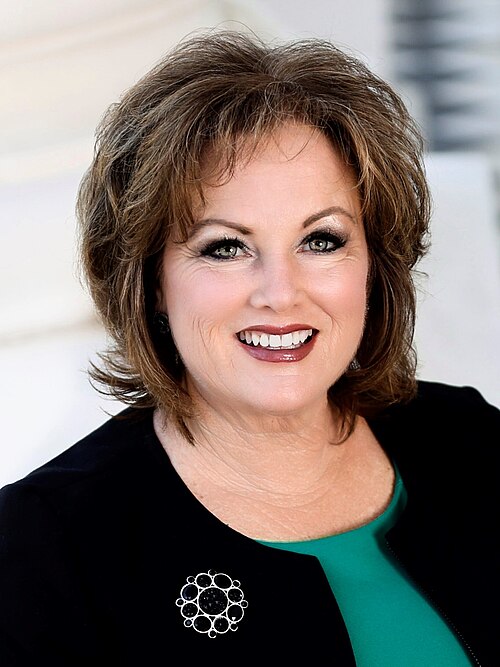
Photo of Shannon Grove
R California Senate · District 12

Sen. Shannon Grove

Compare
Total votes
28,348
all sessions
Attendance
91%
2,262 missed
Near the chamber average
With party
97%
of cast votes
Near the chamber average
Bipartisan score
2%
crosses aisle rarely
Near the chamber average
Sponsored
1,126
bills & resolutions
Near the chamber average
Committees
9
assignments
1,126 bills and resolutions

Sponsored bills

Total
1,126
Primary
249
Co-sponsor
877
This page
1,126
matching current filters
Primary SCR 112
Signed into law · California Senate · Lead sponsor
Relative to National Human Trafficking Awareness Month.

Maddy summarySCR 112 designates January 2026 as National Human Trafficking Awareness Month within the state. This symbolic resolution, adopted unanimously by the Senate on January 29, 2026, does not create new laws or alter existing policies. It formally recognizes the month for public awareness purposes but has no direct effect on individuals, programs, or legal obligations. The measure serves solely to acknowledge and promote awareness of human trafficking issues during that time period.

Signed into law Jun 24, 2026 0 co-sponsors
Co-sponsor SCR 163
Signed into law · California Senate · Co-sponsor
Relative to California Tourism Month.

This measure would proclaim the month of May 2026 as California Tourism Month and would urge the citizens of this great state to support tourism and local businesses by traveling in the state as an act of civic pride.

Signed into law Jun 5, 2026 1 co-sponsor
Co-sponsor SCR 167
Signed into law · California Senate · Co-sponsor
Relative to Mother's Day.

This measure would recognize May 10, 2026, as the 119th annual Mother's Day and would urge all Californians to recognize, appreciate, and be grateful for the gifts and good works of mothers on that day.

Signed into law May 29, 2026 1 co-sponsor
Co-sponsor SCR 168
Signed into law · California Senate · Co-sponsor
Relative to Motorcycle Safety Awareness Month in California.

Maddy summaryThis bill designates May 2026 as Motorcycle Safety Awareness Month in California. It affects state agencies and organizations that typically host public awareness campaigns or educational events. The measure requires no changes to existing laws or regulations; it simply establishes a specific timeframe for promoting motorcycle safety. By creating this designated month, the state provides a formal opportunity to focus public attention on rider safety without altering current legal requirements.

Signed into law May 29, 2026 1 co-sponsor
Primary SCR 130
Signed into law · California Senate · Lead sponsor
Relative to Child Abuse Prevention Month.

Maddy summaryThis bill designates April 2026 as Child Abuse Prevention Month to raise awareness about preventing child abuse. The measure does not change laws or allocate funding but instead directs state agencies to acknowledge the month through official proclamations. By recognizing this period, the legislature aims to highlight the importance of child safety without altering existing policies.

Signed into law May 21, 2026 0 co-sponsors
Primary SB 1217
died · California Senate · Lead sponsor
Nonconsensual Intimate Image Clearinghouse.

Existing law requires the Attorney General to establish and maintain various databases and information centers relating to the identification, apprehension, and prevention of crimes, including the Violent Crime Information Center and the Automated Firearms System, among others. Existing law requires a business that controls the collection of a consumer's personal information to delete that information upon the request of the consumer and provides for administrative penalties if the business fails to act on the consumer's request. This bill would, beginning January 1, 2029, require the Department of Justice to establish the Nonconsensual Intimate Image Clearinghouse to allow individuals who were exploited in California to submit a request for the removal of nonconsensual intimate images from covered platforms. The bill would define nonconsensual intimate images to include an authentic image depicting a person nude or engaging in sexual conduct distributed without consent or an image digitally altered or generated by artificial intelligence realistically depicting a person nude or engaged in sexual conduct without consent. The bill would require the department to transmit verified identifiers of images to covered platforms and require those platforms to remove verified matches within 48 hours of receipt and to prevent the images from being uploaded again. The bill would require the department to enforce these provisions and would impose civil penalties for violations. The bill would require a peace officer in the investigation of a specified offense to advise a victim that they may make a request to the clearinghouse pursuant to these provisions and would require a peace officer to provide certain information to the clearinghouse, as specified. By increasing duties for peace officers, this bill would impose a state-mandated local program. The California Constitution requires the state to reimburse local agencies and school districts for certain costs mandated by the state. Statutory provisions establish procedures for making that reimbursement. This bill would provide that, if the Commission on State Mandates determines that the bill contains costs mandated by the state, reimbursement for those costs shall be made pursuant to the statutory provisions noted above.


died May 14, 2026 0 co-sponsors
Primary SB 1018
In committee · California Senate · Lead sponsor
Human trafficking: specialized license plates.

Existing law authorizes the Department of Motor Vehicles (DMV) to issue specialized license plates. Under existing law, a state agency is authorized to apply to the DMV to sponsor a specialized license plate program, and the DMV is required to issue those license plates if the agency meets certain requirements. The DMV is required to charge specified fees for certain services related to the issuance of those plates. Existing law requires the Office of Emergency Services (OES) to apply to the DMV to sponsor a domestic violence and sexual assault awareness license plate program, and establishes the California Domestic Violence Prevention Fund in the State Treasury for the deposit of the revenue derived from these license plates. These funds are allocated, upon appropriation by the Legislature, to OES for purposes of funding the Family Violence Prevention Program. This bill would establish the survivors of human trafficking grant program administered by OES to benefit survivors of human trafficking and would require the OES to apply to the DMV to sponsor a human trafficking awareness license plate program. The bill would establish the Survivors of Human Trafficking License Plate Fund for the deposit of revenue derived from these license plates and would require that funds from these license plates be allocated, upon an appropriation by the Legislature, to the OES for the purpose of funding the survivors of human trafficking grant program. The bill would require the OES to provide grants to community-based organizations, as specified, that provide direct services to vulnerable individuals in areas with high concentrations of human trafficking, and would require OES to submit a report annually to the Legislature, as specified. The bill would state that this act may be cited as Blair and Kendra's Law.

In committee May 14, 2026 0 co-sponsors
Co-sponsor SB 1071
In committee · California Senate · Co-sponsor
Death certificates.

Existing law requires that each death be registered with the local registrar of births and deaths in the district in which the death was officially pronounced or the body was found. Existing law establishes the required contents of the death certificate, including, but not limited to, the decedent's name, sex, race, and the disease or conditions leading directly to death and antecedent causes, among other relevant identifying and medical information. When the facts are incorrectly stated in a certificate of death, including a typographical error, existing law authorizes a person to make an affidavit under oath stating the changes necessary to make the record correct. Existing law requires that specified information be filed with the state or local registrar, and if the amendments are accepted, the State Registrar is required to transmit copies of the amendment to the county recorder in whose offices the copies of the original record and information are on file. Existing law requires the amendment to be filed with and become a part of the record to which it pertains. This bill would authorize a family member of the deceased, when a judicial determination is made on the manner of a deceased person's death, to submit a written request to the State Registrar for a new death certificate reflecting the newly determined manner of death. This bill would require the request to be supported by a certified copy of the plea, verdict, statement of decision, or a judgment showing that the manner of death was determined by a finder of fact to be different than stated on the existing certificate. The bill would require the State Registrar to review the request and issue a new death certificate if specified conditions are met, including, but not limited to, that the request identifies the determination of manner of death in the certified court record. The bill would require the State Registrar to transmit copies of the new death certificate and the new certificate will supplant any previously issued certificate for the deceased person. The bill would require the local registrar to transmit any copies of the previously issued death certificate to the State Registrar if it is practical to do so and if it is not practical to do so, seal a cover over the copy, as specified. The bill would specify that a plea, verdict, statement of decision, or judgment reflects a judicial determination that the manner of death was homicide if it shows criminal responsibility or civil liability for the death of the deceased person. The bill would authorize a family member of the deceased to include additional certified court records with their request to permit the State Registrar to determine the manner of death. The bill would require a determination by the State Registrar to be based solely on the request and the submitted certified court documents. By imposing new duties on local registrars, this bill would impose a state-mandated program. The California Constitution requires the state to reimburse local agencies and school districts for certain costs mandated by the state. Statutory provisions establish procedures for making that reimbursement. This bill would provide that, if the Commission on State Mandates determines that the bill contains costs mandated by the state, reimbursement for those costs shall be made pursuant to the statutory provisions noted above.
In committee May 14, 2026 1 co-sponsor
Primary SB 1019
In committee · California Senate · Lead sponsor
California Cargo Theft Task Force.

Existing law establishes various programs to prevent crime, coordinate the efforts of law enforcement, and collect and analyze criminal statistics. Existing law specifically establishes a regional property crimes task force to assist local law enforcement and railroad police in counties identified as having elevated levels of property crime, including, but not limited to, organized retail theft, cargo theft, vehicle burglary, and theft of vehicle parts and accessories. Under existing law, the Attorney General is the chief law officer of the state and the head of the Department of Justice. This bill would require the Attorney General to establish the California Cargo Theft Task Force to combat crimes involving the theft, diversion, embezzlement, unlawful taking, or fraudulent acquisition of cargo or freight. The bill would prescribe the membership of the task force. The bill would require the task force, among other duties, to investigate, apprehend, and recommend for prosecution, as appropriate, individuals or entities that engage in cargo theft or related offenses. The bill would require the Attorney General, on or before January 1, 2028, and each year thereafter, to submit a report to the Governor, Legislature, and Secretary of State on the activities of the task force, as specified. The bill would define terms for its purposes.

In committee May 14, 2026 0 co-sponsors
Primary SB 1039
In committee · California Senate · Lead sponsor
Air resources: refinery-related community air monitoring system.

Existing law requires a refinery-related community air monitoring system to be installed near each refinery, as provided, and requires the monitoring system to include equipment capable of measuring compounds emitted to the atmosphere from refinery processes. Existing law requires owners or operators of petroleum refineries to develop, install, operate, and maintain a fence-line monitoring system in accordance with guidance developed by the appropriate regional air pollution control district or regional air quality management district. This bill would require guidance adopted to implement the fence-line monitoring system to include a process for a petroleum refinery to provide substantial evidence to the appropriate air district to exclude a pollutant for monitoring in a fence-line monitoring system and would authorize the air district to exclude a pollutant for monitoring at a petroleum refinery fence-line monitoring system if the air district determines that substantial evidence supports certain considerations. Because the bill would require air districts to revise their guidance related to the fence-line monitoring system, this bill would impose a state-mandated local program. The California Constitution requires the state to reimburse local agencies and school districts for certain costs mandated by the state. Statutory provisions establish procedures for making that reimbursement. This bill would provide that no reimbursement is required by this act for a specified reason.

In committee May 14, 2026 0 co-sponsors
Showing 41 to 50 of 1,126 bills
Previous 1 4 5 6 113 Next