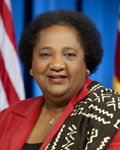
Photo of Shirley N. Weber
D California Assembly · District 79

Asm. Shirley N. Weber

Compare
Total votes
19,803
all sessions
Attendance
98%
299 missed
Among the lowest in the chamber
With party
99%
of cast votes
Higher than 96% of chamber peers
Bipartisan score
0%
crosses aisle rarely
Lower than 99% of chamber peers
Sponsored
1,254
bills & resolutions
Lower than 98% of chamber peers
Committees
0
assignments
1,254 bills and resolutions

Sponsored bills

Total
1,254
Primary
184
Co-sponsor
1,070
This page
1,254
matching current filters
Co-sponsor ACR 252
Signed into law · California Assembly · Co-sponsor
Relative to the 4th of July.

This measure would state the intent of the Legislature to take the opportunity preceding the 4th of July holiday to recognize and celebrate July 4, 2018, and the 242nd anniversary of the birth of our great nation and the signing of the Declaration of Independence that this day represents.

Signed into law Aug 30, 2018 1 co-sponsor
Co-sponsor ACR 264
Signed into law · California Assembly · Co-sponsor
Relative to India's Independence Day.

This measure would recognize August 15, 2018, as India's Independence Day, and urge all Californians to join in celebrating India's independence.

Signed into law Aug 30, 2018 1 co-sponsor
Primary ACR 257
Signed into law · California Assembly · Lead sponsor
Relative to Uterine Fibroids Awareness Month.

This measure would proclaim the month of July 2018 as Uterine Fibroids Awareness Month in California and would recognize the need for greater research, treatment, and care options regarding uterine fibroids.

Signed into law Aug 30, 2018 0 co-sponsors
Co-sponsor AJR 34
Signed into law · California Assembly · Co-sponsor
Relative to agricultural labor shortages.

This measure would urge the Congress of the United States to acknowledge the problem of a labor shortage in the agricultural industry in California and to work together with California to solve the issue.

Signed into law Aug 28, 2018 1 co-sponsor
Primary AB 1215
Signed into law · California Assembly · Lead sponsor
Mental Health Services Act: innovative programs: research.

Existing law, the Mental Health Services Act (MHSA) , an initiative measure enacted by the voters as Proposition 63 at the November 2, 2004, statewide general election, establishes the continuously appropriated Mental Health Services Fund to fund various county mental health programs. Existing law establishes the Mental Health Services Oversight and Accountability Commission to oversee various parts of the act, as specified. Existing law authorizes the act to be amended by a 23 vote of the Legislature if the amendments are consistent with, and further the intent of, the act. Existing law authorizes the Legislature to add provisions to clarify procedures and terms of the act by majority vote. Existing law requires county mental health programs to develop plans for innovative programs, to be funded as provided, and requires the innovative programs to have specified purposes, including increasing access to services and underserved groups, increasing the quality of services, and promoting interagency collaboration. Existing law requires all projects included in the innovative program portion of a county plan to meet specified requirements. Existing law provides that an innovative project may affect virtually any aspect of mental health practices or assess a new or changed application of a promising approach to solving persistent, seemingly intractable mental health challenges, including, but not limited to, education and training for service providers, advocacy, services and interventions, or research, among other things. Existing law requires county mental health programs to expend funds for their innovation programs upon approval by the commission. Existing law, the California Blueprint for Research to Advance Innovations in Neuroscience (Cal-BRAIN) Act of 2014, requests the Regents of the University of California to establish the Cal-BRAIN program to leverage California's research assets and the federal Brain Research through Advancing Innovative Neurotechnologies (BRAIN) Initiative's funding opportunities to accelerate the development of brain mapping techniques to achieve certain goals, including, among others, the development of a dynamic map of the human brain that provides researchers, physicians, and engineers with the knowledge necessary to develop new treatments and technologies that will improve lives and reduce the costs of providing health care. This bill would, if research is chosen for an innovative project, require a county mental health program to consider, but not require a county to implement, research of the brain and its physical and biochemical processes that may have broad applications, but that have specific potential for understanding, treating, and managing mental illness, including, but not limited to, research through the Cal-BRAIN program or other collaborative, public-private initiatives designed to map the dynamics of neuron activity.


Signed into law Aug 28, 2018 0 co-sponsors
Primary AB 2172
Signed into law · California Assembly · Lead sponsor
Redistricting: inmates.

(1) The California Constitution establishes the Citizens Redistricting Commission and charges it with various responsibilities in connection with redistricting Assembly, Senate, State Board of Equalization, and congressional districts. Existing law requires the Department of Corrections and Rehabilitation to furnish to the Citizens Redistricting Commission specified information regarding the last known place of residence of each inmate incarcerated in a state adult correctional facility on April 1, 2020, and on each decennial Census Day thereafter, except an inmate in federal custody or whose last known place of residence is outside of California or unknown. Existing law requires the information furnished by the Department of Corrections and Rehabilitation to be sufficiently specific, or as specific as feasible, depending on whether the department's Statewide Offender Management System is fully operational on or before April 1, 2020. This bill would require the Department of Corrections and Rehabilitation to furnish both the Legislature and the Citizens Redistricting Commission residential address and other information, as specified, for each inmate incarcerated in a facility under the Department's control on the dates specified above, including an inmate whose last place of residence is outside of California or unknown, but excluding an inmate who has been transferred to a facility outside of California. The bill would delete the provision described above that is contingent upon the Statewide Offender Management System being fully operational on or before April 1, 2020. The bill would also direct the Legislature to ensure that the information furnished by the Department of Corrections and Rehabilitation is included in a specified computerized database, but would prohibit publishing information regarding specific inmates. (2) Existing law requests that the Citizens Redistricting Commission use the information furnished by the Department of Corrections and Rehabilitation in carrying out its redistricting responsibilities, and that the Commission deem each incarcerated person as residing at his or her last known place of residence rather than the institution of his or her incarceration. This bill would provide that an inmate's "last known place of residence" means the most recent residential address that is sufficiently specific to be assigned a census block or, if the address information is not sufficiently specific, a randomly-determined census block located within the smallest geographical area that can be identified based on the information provided by the Department of Corrections and Rehabilitation.

Signed into law Aug 28, 2018 0 co-sponsors
Co-sponsor AB 1787
Signed into law · California Assembly · Co-sponsor
Reporting: Valley Fever.

Existing law requires the State Department of Public Health to establish a list of reportable communicable and noncommunicable diseases and conditions and specify the timeliness requirements related to the reporting of each disease and condition. Existing law also supports research into the development of a vaccine to protect against coccidioidomycosis, also known as Valley Fever. This bill would require the department, when it receives a report of a case of coccidioidomycosis after the department's reporting deadline for a specified year, to include the case in its data collection for the next year and attribute it to the year of diagnosis in future data reporting. This bill would require the department to collect data on coccidioidomycosis cases by April 15 of each year, as specified. The bill would require the department, if it collects data on coccidioidomycosis cases and removes discrepant data from its internal dataset, to timely report sufficient information about its removal of the discrepant data to a local health officer and the local health officer may remove the discrepant data from the county's dataset. The bill would also require the department, if it publishes provisional data on coccidioidomycosis cases, to publish an explanation of data changes likely to occur and of discrepancies between data reported by a local health officer and data reported by the department. The bill would require the department to publish the date range of a dataset and the date on which the dataset was updated if the department publishes data on coccidioidomycosis cases.

Signed into law Aug 28, 2018 1 co-sponsor
Showing 311 to 320 of 1,254 bills
Previous 1 … 31 32 33 … 126 Next