

Existing law establishes within the Natural Resources Agency, the State Lands Commission consisting of the Controller, the Lieutenant Governor, and the Director of Finance. Existing law vests in the commission exclusive jurisdiction over all ungranted tidelands and submerged lands owned by the state, and of the beds of navigable rivers, streams, lakes, bays, estuaries, inlets, and straits, including tidelands and submerged lands. Existing law authorizes the commission to take immediate action to remove from areas under its jurisdiction a vessel that is left unattended and is moored, docked, beached, or made fast to land in a position as to obstruct the normal movement of traffic or in a condition as to create a hazard to navigation, other vessels using a waterway, or the property of another. Existing law requires the commission, by July 1, 2019, and in consultation with other relevant state and local agencies directly involved in the removal of abandoned vessels, to develop a plan for the removal of abandoned commercial vessels. This bill would establish the California Abandoned and Derelict Commercial Vessel Program within the Natural Resources Agency, to be administered by the commission, upon appropriation by the Legislature, to bring federal, state, and local agencies together to identify, prioritize, and fund the removal and proper disposal of abandoned and derelict commercial vessels and other debris from commercially navigable waters, as defined. The bill would require the commission, upon appropriation by the Legislature, on or before July 1, 2025, to create, and regularly update and maintain thereafter, an inventory of abandoned and derelict commercial vessels on or in commercially navigable waters, as provided, and, on or before July 1, 2026, to develop a plan to prevent or reduce abandoned and derelict commercial vessels on or in commercially navigable waters, as provided. This bill would establish the California Abandoned and Derelict Commercial Vessel Program Task Force as an advisory body within the Natural Resources Agency, consisting of specified members. The bill would require the task force to, among other things, provide policy guidance for the program and advise on the prevention, removal, destruction, and disposal of abandoned and derelict commercial vessels, as provided. The bill would require the task force, in consultation with impacted local governments, to develop a system for prioritizing the removal of the abandoned and derelict commercial vessels identified by the commission, as provided. This bill would require the commission, on or before December 1, 2024, to enter into a memorandum of agreement with specified state agencies, and other relevant federal, state, or local agencies, as provided, for the purposes of abandoned and derelict commercial vessel and other debris cleanup and removal from commercially navigable waters. The bill would require, upon execution of the memorandum of agreement and the availability of funds, the commission to immediately authorize and execute the removal of abandoned and derelict commercial vessels and other debris, as specified. This bill would establish the California Abandoned and Derelict Commercial Vessel Program Trust Fund in the State Treasury and would require that, upon appropriation by the Legislature, moneys in the fund be used by the commission to fund the removal of abandoned and derelict commercial vessels and other debris pursuant to the program, as provided. This bill would prohibit, except as specified, a commercial vessel, as defined, that is at risk of becoming derelict from occupying, or anchoring, mooring, or otherwise being secured in or on, the waters of the state. The bill would provide that a commercial vessel is at risk of becoming derelict if certain conditions exist, including that the commercial vessel is taking on or has taken on water without an effective means to dewater. The bill would authorize a peace officer, as defined, to find that a commercial vessel is at risk of becoming derelict if these conditions exist. The bill would subject a person who violates this prohibition to a civil penalty of not less than $1,000 and not more than $5,000 per day of violation, and would prescribe other requirements related to a civil action, including the assessment of a civil penalty and the recovery of other specified costs, brought for a violation of this prohibition. The bill would also authorize a peace officer to seize or order the removal of a commercial vessel that is at risk of becoming derelict, as provided. The bill would require 75% of civil penalties and other costs collected be deposited into the California Abandoned and Derelict Commercial Vessel Program Trust Fund and, upon appropriation by the Legislature, 25% distributed to the Attorney General, district attorney, or city attorney prosecuting the action, as specified.
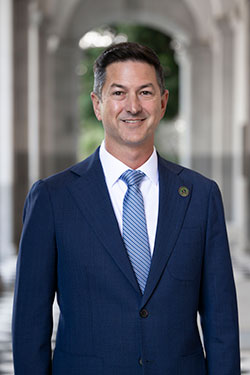
Asm. Chris Ward
Sponsored bills
Existing law, the Planning and Zoning Law, authorizes a development proponent to submit an application for a multifamily housing development that is subject to a streamlined, ministerial approval process, as provided, and not subject to a conditional use permit, if the development satisfies specified objective planning standards. This bill would require a local government to approve a proposed housing development pursuant to a streamlined, ministerial approval process if the development meets certain objective planning standards, including, but not limited to, a requirement that the proposed parcel for the development be a climate-smart parcel, as described, or be included in the applicable region's sustainable communities strategy as a priority development area. The bill would set forth procedures for approving these developments and would set forth various limitations for these developments. The bill would authorize the Department of Housing and Community Development to review, adopt, amend, and repeal guidelines, rules, and regulations to implement uniform standards or criteria that supplement or clarify the terms, references, or standards set forth by this process. Existing law requires the department to notify a city, county, or city and county, and authorizes the department to notify the office of the Attorney General, that the city, county, or city and county is in violation of state law if the department finds that the housing element or an amendment to the housing element does not substantially comply with specified provisions of the Planning and Zoning Law, or that the local government has taken action in violation of specified provisions of law relating to housing, including, among others, the Housing Accountability Act, the Density Bonus Law, and the Housing Crisis Act of 2019. This bill would add the streamlining procedures added by the bill to the list of laws subject to this notification requirement. The Planning and Zoning Law requires a city or county to adopt a general plan for land use development within its boundaries that includes, among other things, a housing element. Existing law also sets forth various procedures related to land use actions and utility service in local jurisdictions, including, but not limited to, a requirement that a tentative a final map be made for certain housing projects, including all subdivisions creating 5 or more parcels. This bill would prohibit a county, or city if certain conditions are met, from increasing the planned density on climate resilient lands, as defined, from approving any tentative, final, or parcel maps for the subdivision of property within climate risk lands or climate refugia lands, as defined, and from approving an extension of water or sewer services on climate resilient lands unless specified planning requirements or conditions are met. The bill would require, as part of those requirements or conditions, the county or city to make certain findings that are confirmed by the Office of Planning and Research. The bill would set forth procedures for requesting those findings from the office. The bill would make conforming changes. By imposing additional duties on local officials, the bill would impose a state-mandated local program. The bill would include findings that changes proposed by this bill address a matter of statewide concern rather than a municipal affair and, therefore, apply to all cities, including charter cities. The California Constitution requires the state to reimburse local agencies and school districts for certain costs mandated by the state. Statutory provisions establish procedures for making that reimbursement. This bill would provide that no reimbursement is required by this act for a specified reason.
Under existing law, a grand jury is a body of the required number of persons chosen from the citizens of the county to serve before a court of competent jurisdiction, and sworn to inquire of public offenses that are committed or triable within the county. Existing law permits a grand jury to inquire into all public offenses committed or triable within the county and present them to the court by indictment. Existing law requires the fees for grand jurors to be $15 per each day's attendance as a grand juror. This bill would require that fee to be equal to 70% of the county median daily income for each day's attendance. By increasing the fee for grand jurors, this bill would impose a state-mandated local program. Existing law requires the superior court of each county to select grand jurors, as specified, and create a list of the persons selected to serve as grand jurors. Existing law requires the jury commissioner to file this list in the jury commissioner's office and have the list published one time in a newspaper of general circulation. Existing law requires grand juries to be impaneled from this list. Existing law authorizes the presiding judge to name up to 10 jurors not previously named, who served on the previous grand jury and who consent to serve for a 2nd year on the grand jury. This bill would require the list of grand jurors to contain the person's gender, age, race or ethnicity, and residential ZIP Code or supervisorial district of the respective counties. The bill would require a separate list to be published in a newspaper containing each person's name and the name of the judge who selected the jurors. The bill would require a list of specified prospective and impaneled jurors containing each person's gender, age, race or ethnicity, and residential ZIP Code or supervisorial district to be published on an internet website, and would require that version of the list to not contain the person's name. The bill would authorize the presiding judge to add up to 10 jurors from among the list of qualified jurors not selected in an effort to balance demographic diversity to reflect the general population of the county. The bill would require each court, on or before March 15, 2024, and on or before March 15 of each year thereafter, to provide the Judicial Council with the list and aggregate data of specified prospective and impaneled jurors containing the person's gender, age, race or ethnicity, and residential ZIP Code or supervisorial district of the respective counties, as well as the name of the judge who selected each person. The bill would require the Judicial Council to, on or before June 15, 2024, and on or before June 15 of each year thereafter, report that information to the Legislature. The bill would additionally authorize summons for prospective jurors to include information on how to become a juror on a grand jury. The California Constitution requires the state to reimburse local agencies and school districts for certain costs mandated by the state. Statutory provisions establish procedures for making that reimbursement. This bill would provide that, if the Commission on State Mandates determines that the bill contains costs mandated by the state, reimbursement for those costs shall be made pursuant to the statutory provisions noted above.
Existing law, the Pharmacy Law, establishes the California State Board of Pharmacy within the Department of Consumer Affairs to license and regulate pharmacists. Existing law provides for the licensure and regulation of health care service plans by the Department of Managed Health Care and for the regulation of health insurers by the Department of Insurance. Existing law, the Knox-Keene Health Care Service Plan Act of 1975, requires a pharmacy benefit manager under contract with a health care service plan to, among other things, register with the Department of Managed Health Care. This bill would require the California State Board of Pharmacy to license and regulate pharmacy benefit managers that manage the prescription drug coverage provided by a health care service plan or health insurer, except as specified. The bill would set forth various duties of pharmacy benefit managers, including requirements to file a report with the board. The bill would prohibit a pharmacy benefit manager from, among other things, contracting after January 1, 2024, to prohibit or restrict a pharmacy or pharmacist from disclosing to an enrollee or insured health care information that the pharmacy or pharmacist considers appropriate. This bill would require the board to promulgate necessary regulations and to prepare a report to the Legislature on or before August 1, 2025, and on or before each August 1 thereafter, with aggregate data received from pharmacy benefit managers, establish a data retention schedule, and protect proprietary and confidential information, as specified. Existing constitutional provisions require that a statute that limits the right of access to the meetings of public bodies or the writings of public officials and agencies be adopted with findings demonstrating the interest protected by the limitation and the need for protecting that interest. This bill would make legislative findings to that effect.
Existing law creates the Department of Housing and Community Development and requires the department to administer various programs relating to housing. This bill would establish, subject to appropriation by the Legislature, the State Partnership for Affordable Housing Registries in California Grant Program to provide technical assistance to eligible entities, as defined, for the purpose of creating a state-managed online platform of affordable housing listings, information, and applications. The bill would require the department to administer the program and to adopt guidelines for this purpose. The bill would require the department to develop a housing preapplication to standardize applications for affordable housing and to solicit participation of eligible entities no later than January 1, 2026, and to launch the platform no later than July 1, 2027. The bill would require the department to provide technical assistance to participating entities and to ensure equitable access to database users, as specified. The bill would authorize the department to coordinate with the Office of Data and Innovation to carry out the requirements of the program and to contract with vendors pursuant to existing provisions of state contract law, as specified. The bill would establish minimum requirements for the platform and would require a vendor selected to create and maintain the platform to demonstrate specified capabilities and implement those requirements. The bill would exempt from disclosure as a public record any personally identifiable information collected by the platform or shared between eligible entities and the department in administering the program. Existing constitutional provisions require that a statute that limits the right of access to the meetings of public bodies or the writings of public officials and agencies be adopted with findings demonstrating the interest protected by the limitation and the need for protecting that interest. This bill would make legislative findings to that effect.
Existing law establishes the procedure for a person to change their name. When a proceeding for a change of name is commenced by the filing of a petition, existing law requires the court to issue an order reciting the filing of the petition, the name of the person by whom it is filed, and the name proposed. Existing law requires that the fee for certifying a copy of any paper, record, or proceeding on file in the office of the clerk of any court is $40. Existing law requires that the fee for preparing a copy of any paper, record, or proceeding on file is $.50 per page. This bill would require that up to 3 copies of the order granting the petition for change of name be provided at no charge to the petitioner at the time the petition is granted.
Existing law establishes a workers' compensation system, administered by the Administrative Director of the Division of Workers' Compensation, to compensate an employee for injuries sustained in the course of employment. Existing law creates a rebuttable presumption that specified injuries, such as meningitis, tuberculosis, or hernia, sustained in the course of employment of a specified member of law enforcement or a specified first responder arose out of and in the course of employment. Existing law creates a rebuttable presumption that skin cancer that develops or manifests in the course of employment of a lifeguard, as specified, arose out of and in the course of employment. Existing law authorizes a lifeguard to file a claim for skin cancer after employment has terminated for a specified period based on years of employment, not to exceed 60 months. This bill would expand presumptions for hernia, pneumonia, heart trouble, cancer, tuberculosis, bloodborne infectious disease, methicillin-resistant Staphylococcus aureus skin infection, and meningitis-related illnesses and injuries to a lifeguard employed on a year-round, full-time basis in the Boating Safety Unit by the City of San Diego Fire-Rescue Department. The bill would increase the period of time after termination of employment that a lifeguard employed on a year-round, full-time basis in the Boating Safety Unit by the City of San Diego Fire-Rescue Department can file a claim for skin cancer. The bill would expand the presumptions for illness or injury related to post-traumatic stress disorder or exposure to biochemical substances, as defined, to a lifeguard employed in the Boating Safety Unit by the City of San Diego Fire-Rescue Department. This bill would make legislative findings and declarations as to the necessity of a special statute for the City of San Diego. This bill would incorporate additional changes to Section 3212.11 of the Labor Code proposed by SB 391 to be operative only if this bill and SB 391 are enacted and this bill is enacted last.
Existing law establishes the Department of General Services to provide centralized services, including, but not limited to, planning, acquisition, construction and maintenance of state buildings and property. Existing law authorizes the Director of General Services, with the consent of the state agency concerned, to lease state-owned real property when the Director of General Services deems that leasing serves a beneficial public purpose limited to the development of housing. This bill would enact the Social Housing Act and would create, in the Department of General Services, the Social Housing Program, the mission of which would be to ensure that qualified social housing developments are produced on leased state property to help address the housing crisis, as specified. The bill would authorize the program to identify and develop up to 3 qualified social housing projects, as specified, with the intent to use the results to inform public policy related to developing an independent public entity to develop statewide qualified social housing. The bill would require the program to solicit bids to develop qualified social housing units, and prioritize bids that demonstrate long-term revenue neutrality or a cost rent model, as those terms are defined. The bill would require the program to employ 2 different leasing models, the rental model and the ownership model, as specified, in creating social housing. The bill would prohibit a city or county from denying a social housing development authorized under the program. The bill would authorize a city or county to propose objective design review standards, as specified, and authorize a city or county to propose modifications to mitigate any specific, adverse impacts on public health or safety, as specified.