

Existing law establishes the California Border Environmental and Public Health Protection Fund in the State Treasury to receive funds appropriated in the annual Budget Act, including, but not limited to, proceeds of bonds sold as specified, and other sources, such as from the North American Development Bank (NADBank) , and makes money in the fund available, upon appropriation, to the California-Mexico Border Relations Council, a state entity. Money in the fund is used to assist local governments in implementation of projects to identify and resolve environmental and public health problems that directly threaten the health or environmental quality of California residents or sensitive natural resources of the California border region, among other purposes. This bill would authorize, upon appropriation by the Legislature in the annual Budget Act or another statute, funds to be made available to the California Environmental Protection Agency (CalEPA) for NADBank for loans, grants, and direct expenditures to address water quality problems arising in the California-Mexico cross-border watersheds. The bill would require the funding to be available for specified purposes, as provided, including water quality projects for the Tijuana River, and would make 10% of the funding available for the administrative costs of implementing these provisions. The bill would authorize funding provided for activities or projects in the State of Baja California to be provided through direct expenditures and for grants to an eligible funding recipient authorized to work in Mexico under a specified circumstance. The bill would require grant funding to be conditioned upon the enforceability and accountability requirements mutually agreed upon by CalEPA and NADBank, and would authorize CalEPA to withhold funding if the requirements of the applicable funding agreement are not met. The bill would also authorize grant funding to be conditioned on enforceability and accountability mechanisms agreed upon by CalEPA, NADBank, and the recipient. The bill would require CalEPA to notify the leadership office in each house of the Legislature on cross-border collaboration and the expenditure of the funding, as provided. This bill would make legislative findings and declarations as to the necessity of a special statute for the North American Development Bank.
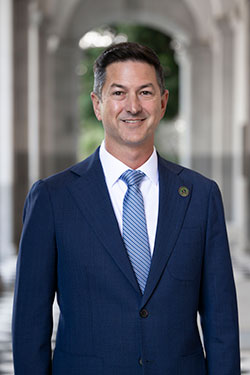
Asm. Chris Ward
Sponsored bills
The Personal Income Tax Law imposes a tax on individual taxpayers measured by the taxpayer's taxable income for the taxable year, but excludes certain items of income from the computation of tax, including an exclusion for combat-related special compensation. This bill, for taxable years beginning on or after January 1, 2024, and before January 1, 2034, would exclude from gross income retirement pay received by a taxpayer from the federal government for service performed in the uniformed services, as defined, during the taxable year. The bill, for taxable years beginning on or after January 1, 2024, and before January 1, 2034, would also exclude from gross income annuity payments received by a qualified taxpayer, as defined, pursuant to a United States Department of Defense Survivor Benefit Plan during the taxable year. The bill would make related findings and declarations. Existing law requires any bill authorizing a new tax expenditure to contain, among other things, specific goals, purposes, and objectives that the tax expenditure will achieve, detailed performance indicators, and data collection requirements. This bill also would include additional information required for any bill authorizing a new tax expenditure. The bill would require the Franchise Tax Board and the Department of Veterans Affairs to provide any data requested by the Legislative Analyst to write the report, as provided, and would make taxpayer information received by the Legislative Analyst subject to limitation on the collection and use of that information. By expanding the scope of a crime, this bill would impose a state-mandated local program. The California Constitution requires the state to reimburse local agencies and school districts for certain costs mandated by the state. Statutory provisions establish procedures for making that reimbursement. This bill would provide that no reimbursement is required by this act for a specified reason. This bill would take effect immediately as a tax levy.
Existing law, the California Building Standards Law, establishes the California Building Standards Commission (commission) within the Department of General Services and sets forth its powers and duties, including approval and adoption of building standards and codification of those standards into the California Building Standards Code (code) . Existing law requires the commission to publish, or cause to be published, editions of the code in its entirety once every 3 years. Existing law establishes the Department of Housing and Community Development (department) in the Business, Consumer Services, and Housing Agency and requires the department to submit an annual report to the Governor and both houses of the Legislature on the operations and accomplishments during the previous fiscal year of the housing programs administered by the department. This bill would require the department to convene a working group no later than December 31, 2025, to research and consider identifying and recommending amendments to state building standards allowing residential developments to be built, as specified. The bill would require the department, no later than December 31, 2026, to provide a one-time report of its findings to the Legislature in the annual report described above. The bill, if the report identifies and recommends amendments to building standards, would require the department to research, develop, and consider proposing such standards for adoption by the commission, as specified.
Existing law, the Zenovich-Moscone-Chacon Housing and Home Finance Act, among other things, establishes the Department of Housing and Community Development and requires it to administer various programs intended to promote the development of housing and to provide housing assistance and home loans. Existing law sets forth various general powers of the department in implementing these programs, including authorizing the department to enter into long-term contracts or agreements of up to 30 years for the purpose of servicing loans or grants or enforcing regulatory agreements or other security documents. Existing law, unless an extension of a department loan, the reinstatement of a qualifying unpaid matured loan, the subordination of a department loan to new debt, or an investment of tax credit equity would result in a rent increase for tenants of a development, authorizes the Department of Housing and Community Development to approve an extension, reinstatement, subordination, payoff, extraction, or investment pursuant to specified rental housing finance programs, as specified, or if the department determines that a project has, or will have after rehabilitation or repairs, a potential remaining useful life equal to or greater than the term of the restructured loan. Existing law authorizes the department to charge a monitoring fee to cover the aggregate monitoring costs in years the loan is extended and a transaction fee to cover its costs for processing restructuring transactions, and requires developer fee limitations to be consistent with specified laws and regulations, including regulations by the California Tax Credit Allocation Committee. This bill would revise and recast these provisions, including additionally authorizing the department to approve the payoff of a department loan in whole or part before the end of its term and the extraction of equity from a development for purposes approved by the department. The bill would specify eligible uses of loan and equity sources, if the department determines that a project has, or will have after rehabilitation or repairs, a potential remaining useful life equal to or greater than the term of the department's regulatory agreement for purposes of approving an extension, reinstatement, subordination, payoff, extraction, or investment, as described above. The bill would prohibit the extension, reinstatement, subordination, payoff, extraction, or investment, as described above, if it would result in a rent increase for tenants of a development over and above the annual adjustment to the tenants' rents under the department's regulatory agreement. This bill would recast certain provisions related to regulatory agreements, including authorizing the department to add another regulatory agreement and authorizing the department to waive specified requirements in the regulatory agreement if the loan is paid off, including requiring occupancy and financial reports. The bill would authorize the department to charge additional fees as necessary to cover its costs for processing restructuring transactions, and would provide that the monitoring fees continue until the end of the term of the department's regulatory agreement, as specified. The bill would limit developer fees to the amount allowed by the California Tax Credit Allocation Committee or to 25% of actual rehabilitation costs, as applicable. Existing law, known as the No Place Like Home Program, requires the department to award up to $2,000,000,000 among counties to finance capital costs, including, but not limited to, acquisition, design, construction, rehabilitation, or preservation, and to capitalize operating reserves, of permanent supportive housing for the target population, as specified. This bill would define "capitalized operating reserves" for purposes of the Zenovich-Moscone-Chacon Housing and Home Finance Act and the No Place Like Home Program. This bill would declare that it is to take effect immediately as an urgency statute.
Existing law establishes the California Interagency Council on Homelessness to oversee the implementation of Housing First guidelines and regulations, and, among other things, identify resources, benefits, and services that can be accessed to prevent and end homelessness in California. Existing law requires a state agency or department that funds, implements, or administers a state program that provides housing or housing-related services to people experiencing homelessness or who are at risk of homelessness to revise or adopt guidelines and regulations to include enumerated Housing First policies. Existing law specifies the core components of Housing First, including services that are informed by a harm-reduction philosophy that recognizes drug and alcohol use and addiction as a part of tenants' lives and where tenants are engaged in nonjudgmental communication regarding drug and alcohol use. This bill would authorize state programs to fund supportive recovery residences, as defined, that emphasize abstinence under these provisions as long as the state program meets specified criteria, including using at least 90% of its funds in each county for housing or housing-based services using a harm-reduction model. The bill would specify requirements for applicants seeking funds under these programs and would require the state to perform periodic monitoring of select supportive recovery residence programs to ensure that the supportive recovery residences meet certain requirements, including that core outcomes of the supportive recovery housing emphasize long-term housing stability and minimize returns to homelessness. The bill would also prohibit eviction on the basis of relapse, as specified. The bill would require, if a tenant is no longer interested in living in a supportive recovery residence or is at risk of eviction, that the supportive recovery residence secure the tenant a permanent housing unit at a partner or other housing program operated with harm-reduction principles. Existing law requires the State Department of Health Care Services to license and regulate facilities that provide residential nonmedical services to adults who are recovering from problems related to alcohol, drug, or alcohol and drug misuse or abuse, and who need alcohol, drug, or alcohol and drug recovery treatment or detoxification services. Existing law also requires the department to certify alcohol and other drug treatment recovery services, as specified. This bill would require the department to adopt the most recent standards approved by the National Alliance for Recovery Residences, the Substance Abuse and Mental Health Services Administration, or other equivalent standards as the minimum standard for supportive recovery residences that receive public funds under these provisions. The bill would require the department to establish a separate process for determining if the supportive recovery residence complies with the core components of Housing First. The bill would authorize the department to charge a fee for certification of a supportive recovery residence in an amount not to exceed the reasonable cost of administering the program, not to exceed $1,000, and would establish the Supportive Recovery Residency Program Fund for collection of the fee.
Maddy summaryThis California Assembly resolution encourages the U.S. Congress to pass legislation creating a National Infrastructure Bank to fund critical repairs and upgrades for roads, bridges, dams, and other public works. The bill cites reports from the American Society of Civil Engineers highlighting billions of dollars in investment gaps and poor conditions affecting California's transportation and water systems. It advocates for a financing model that uses existing federal debt rather than new taxes, aiming to stimulate the economy, create jobs, and prioritize projects in disadvantaged communities. The resolution formally requests that federal leaders adopt this approach to address the state's urgent infrastructure needs.
Maddy summaryThis California House Resolution condemns the July 13, 2024, assassination attempt on former President Donald J. Trump and calls for an end to political violence. The measure highlights the event where Trump was wounded while speaking at a rally in Butler, Pennsylvania, and notes that one attendee died and others were injured while trying to protect him. It urges the state to foster a political environment based on respectful discourse and nonviolence. The resolution is a formal statement of the Assembly's stance and does not create new laws or change existing policies.
This measure would recognize the importance of California Native American Day, celebrated this year on September 27, 2024, and the annual California Indian Cultural Awareness Conference, to the enhancement of awareness of California Indian culture.
Maddy summaryThis bill establishes Filipino American History Month to recognize the long-standing contributions of Filipinos to California and the United States. It directly affects state officials and the public by designating a specific month for commemoration and education. The resolution highlights historical milestones, including early Spanish-era interactions, the development of Filipino communities in cities like Stockton and San Francisco, and the significant roles Filipinos played in agriculture, shipbuilding, and military service during World War II. By formally acknowledging these events, the bill aims to promote awareness of Filipino American heritage within the state.
Maddy summaryThis bill designates November 22, 2024, as Kimchee Day in California to honor the traditional Korean dish and its cultural significance. It acknowledges the long history of kimchee, the contributions of Korean Americans, and the dish's recognized health benefits and growing popularity in the United States. The resolution directs the Assembly's Chief Clerk to send copies of the document to the author for distribution.