

Existing law establishes the Climate Ready Program in the State Coastal Conservancy to address the impacts and potential impacts of climate change on resources within the conservancy's jurisdiction. Existing law authorizes the conservancy to undertake projects within its jurisdiction, including projects related to beach and bluff erosion and other coastal hazards that threaten coastal communities, infrastructure, and natural resources. Existing law requires the Office of Emergency Services, in collaboration with the California Institute of Technology, the California Geological Survey, the University of California, the United States Geological Survey, the Alfred E. Alquist Seismic Safety Commission, and other stakeholders, to develop a comprehensive statewide earthquake early warning system in California through a public-private partnership, which is required to include, among other things, the installation of field sensors. Existing law establishes the University of California, under the administration of the Regents of the University of California, as one of the segments of public postsecondary education in this state. The University of California comprises 10 institutions of higher education, which are located at Berkeley, Davis, Irvine, Los Angeles, Merced, Riverside, San Diego, San Francisco, Santa Barbara, and Santa Cruz. This bill would, upon appropriation by the Legislature, require the Scripps Institution of Oceanography at the University of California, San Diego, to conduct research on coastal cliff landslides and erosion in the County of San Diego, as provided. The bill would require the research to be completed by January 1, 2025. The bill would require by no later than March 15, 2025, the institution to provide a report to the Legislature with recommendations for developing a coastal cliff landslide and erosion early warning system based on available research. The bill would exempt the Regents of the University of California and its employees, acting in good faith, from civil liability for any harm resulting from measurements, predictions, or warnings regarding bluff failure, cliff landslides, or erosion contained in the report or from the research or related to the recommendations, unless those damages are the result of acts or omissions constituting gross negligence or willful or wanton misconduct.
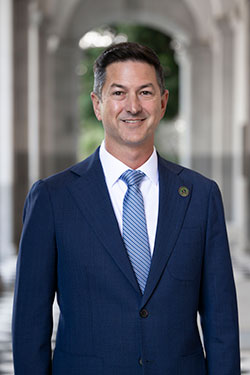
Asm. Chris Ward
Sponsored bills
Existing law generally requires the licensure and regulation of various health care facilities, including, among others, a hospice facility. The Compassionate Use Act of 1996, an initiative measure enacted by the approval of Proposition 215 at the November 5, 1996, statewide general election, prohibits specified criminal penalties from being imposed on a patient or a patient's primary caregiver who possesses or cultivates cannabis for the personal medical purposes of the patient upon the written or oral recommendation or approval of a physician. Existing law, known as the Medical Marijuana Program, requires counties to administer an identification card program for qualified patients and provides immunity from arrest to qualified patients with a valid identification card or designated primary caregivers, within prescribed limits. This bill, the Compassionate Access to Medical Cannabis Act or Ryan's Law, would require specified types of health care facilities to allow a terminally ill patient's use of medicinal cannabis within the health care facility, subject to certain restrictions. The bill would require a patient to provide the health care facility with a copy of their medical marijuana card or written documentation that the use of medicinal cannabis is recommended by a physician. The bill would require a health care facility to reasonably restrict the manner in which a patient stores and uses medicinal cannabis to ensure the safety of other patients, guests, and employees of the health care facility, compliance with other state laws, and the safe operations of the health care facility. The bill would provide that compliance with the bill would not be a condition for obtaining, retaining, or renewing a license as a health care facility. The bill would require that health care facilities permitting patient use of medical cannabis comply with other drug and medication requirements, as specified, and would make those facilities subject to enforcement actions by the State Department of Public Health. The bill would authorize a health care facility to suspend compliance with these provisions if a regulatory agency, the United States Department of Justice, or the federal Centers for Medicare and Medicaid Services takes specified actions, including initiating an enforcement action against a health care facility related to the facility's compliance with a state-regulated medical marijuana program.
The State Housing Law, among other things, requires the Department of Housing and Community Development to adopt, amend, or repeal rules and regulations for the protection of the health, safety, and general welfare of the occupant and the public relating to specified residential structures, as provided, which apply throughout the state. Existing law requires the housing or building department of every city or county, or the health department if there is no building department, to enforce within its jurisdiction the provisions of the State Housing Law, building standards, and the other rules and regulations adopted by the department pertaining to the maintenance, sanitation, ventilation, use, or occupancy of apartment houses, hotels, or dwellings. A violation of the State Housing Law, or of the building standards or rules and regulations adopted pursuant to that law, is a misdemeanor. This bill would require that a mixed-income multifamily structure provide the same access to the common entrances, common areas, and amenities of the structure to occupants of the affordable housing units in the structure as is provided to occupants of the market-rate housing units. The bill would also prohibit a mixed-income multifamily structure from isolating the affordable housing units within the structure to a specific floor or an area on a specific floor. The bill would define various terms for these purposes. The bill would state that these additions do not constitute a change in, but are declaratory of, existing law. By adding to the duties of local officials with respect to enforcement of the State Housing Law, the violation of which is a crime, this bill would impose a state-mandated local program. The California Constitution requires the state to reimburse local agencies and school districts for certain costs mandated by the state. Statutory provisions establish procedures for making that reimbursement. This bill would provide that with regard to certain mandates no reimbursement is required by this act for a specified reason. With regard to any other mandates, this bill would provide that, if the Commission on State Mandates determines that the bill contains costs so mandated by the state, reimbursement for those costs shall be made pursuant to the statutory provisions noted above.
The California Endangered Species Act requires the Fish and Game Commission to establish a list of endangered species and a list of threatened species and to add or remove species from either list if it finds, upon the receipt of sufficient scientific information, as specified, and based solely upon the best available scientific information, that the action is warranted. The commission has listed certain species of dudleya as threatened or endangered under the act. Existing law prohibits a person or public agency from importing into the state, exporting out of the state, or taking, possessing, purchasing, or selling within the state any endangered or threatened species, except as provided, and imposes specified penalties for a violation of this provision. This bill would make it unlawful to uproot, remove, harvest, or cut dudleya, as defined, from land owned by the state or a local government or from property not their own without written permission from the landowner in their immediate possession, except as provided, and would make it unlawful to sell, offer for sale, possess with intent to sell, transport for sale, export for sale, or purchase dudleya uprooted, removed, harvested, or cut in violation of that provision. The bill would require a violation of those provisions, or any rule, regulation, or order adopted pursuant to those provisions, to be a misdemeanor punishable by a specified fine, imprisonment in a county jail for not more than 6 months, or both the fine and imprisonment. By creating a new crime, the bill would impose a state-mandated local program. Upon conviction or other entry of judgment for a violation of these provisions, the bill would require any seized dudleya to be forfeited to the Department of Fish and Wildlife, and would authorize the court to impose, in addition to, and separate from, any criminal penalty, the cost of replanting any dudleya forfeited to the department. The bill would require the prosecution of an offense punishable under these provisions to be commenced within 3 years after commission of the offense. The bill would also set forth legislative findings and declarations relating to dudleya poaching. The California Constitution requires the state to reimburse local agencies and school districts for certain costs mandated by the state. Statutory provisions establish procedures for making that reimbursement. This bill would provide that no reimbursement is required by this act for a specified reason.
This measure would proclaim November 3, 2021, as One Health Day, to celebrate and bring attention to the need for a One Health approach to address shared health threats at the human-animal-environmental interface.
This measure would designate the month of September 2021 as Leukemia, Lymphoma, and Myeloma Awareness Month and Blood Cancer Awareness Month and the first week of September 2021 as Blood Donation Week.
This measure would declare August 2021 as Valley Fever Awareness Month.
This measure would designate a specified portion of Westside Parkway on State Route 58 in the County of Kern as the Harvey L. Hall Memorial Highway. The measure would request that the Department of Transportation determine the costs of appropriate signs showing this special designation and, upon receiving donations from nonstate sources covering those costs, erect those signs.
This measure would request that the Congress of the United States and the United States Environmental Protection Agency take all measures necessary to prevent further damage to California's citizens, wildlife, and natural resources by the dichloro-diphenyl-trichloroethane waste dumped in the waters near Santa Catalina Island.
This measure would proclaim May 2021 as Sea Level Rise Awareness Month in California in order to recognize the devastating effects of climate change and encourage local governments to take action.