

Existing law, until January 1, 2030, prohibits an owner, as defined, of residential real property from terminating a tenancy without just cause, stated in the written notice to terminate the tenancy, after a tenant has continuously and lawfully occupied a residential real property for 12 months. Existing law defines "just cause" to mean certain at-fault just causes, including default in the payment of rent, and certain no-fault just causes, including intent to occupy the residential real property by the owner or the owner's spouse, domestic partner, children, grandchildren, parents, or grandparents, as prescribed, withdrawal of the residential real property from the rental market, and intent to demolish or to substantially remodel the residential real property. This bill would revise the intent to occupy just-cause provision described above to mean a good faith intent to occupy the residential real property by the owner or the owner's spouse, domestic partner, children, grandchildren, parents, or grandparents for at least 3 consecutive years. The bill would, among other things, prohibit an owner from terminating a tenancy under that provision if the same owner or relative already occupies a unit on the residential real property or if there is a vacancy on the residential real property. The bill would define the term "owner" for purposes of that provision to mean an owner who is a natural person who has at least a 51% recorded ownership interest in the property. This bill would revise the withdrawal of the residential real property from the rental market just-cause provision described above to mean withdrawal of all of the rental units at the residential real property from the rental market for the purpose of changing the property's use from residential use to nonresidential use or for the purpose of selling each unit on the property for owner-occupancy, only if both of certain criteria are true and described with particularity in a notice to the tenant required to terminate the tenancy, including the owner has previously provided the tenant with a written notice of intent to withdraw the unit from the rental market and describing the intended use of the property 180 days before serving the notice to terminate the tenancy. This bill would revise the intent to demolish or to substantially remodel the residential real property just-cause provision described above by, among other things, requiring an owner to, before issuing a notice to terminate a tenancy based on that just cause, obtain any necessary permits for the demolition or substantial remodel from the applicable governmental agencies. Existing law, until January 1, 2030, prohibits an owner of residential real property from, over the course of any 12-month period, increasing the gross rental rate for a dwelling or a unit more than 5% plus the percentage change in the cost of living, or 10%, whichever is lower, of the lowest gross rental rate charged for that dwelling or unit at any time during the 12 months before the effective date of the increase, as prescribed. This bill would make unenforceable any lease provision that would result in an increase in the gross rental rate for a dwelling unit that exceeds those limits, as specified.
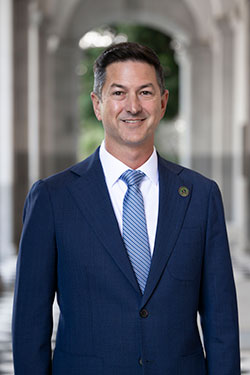
Asm. Chris Ward
Sponsored bills
Under existing law, the purpose of the Bridge Reconstruction and Replacement Act is to implement the federal Special Bridge Replacement Program in California. The act authorizes boards of supervisors, city councils, and the Department of Transportation to do all things necessary and proper to secure federal aid under that federal program. The act authorizes the department to allocate to counties and cities federal funds received for approved bridge reconstruction or replacement projects in accordance with procedures promulgated by the Director of Transportation, as specified. Existing law requires the California Transportation Commission, in allocating funds, and the department, in expending funds, for bridge replacement projects, to follow federal design standards, except as specified. This bill would instead provide that the purpose of the act is to implement the federal Highway Infrastructure Program. The bill would authorize the above-described entities to do all things necessary and proper to secure federal funds instead under the federal Highway Infrastructure Program. The bill would instead require that the division and allocation of federal Highway Infrastructure Program funds occur pursuant to a specified formula approved by the commission, and authorize the department to revise the other procedures for allocating federal bridge funding and selecting projects, as specified. The bill would require the commission to annually allocate, at minimum, certain amounts of federal National Highway Performance Program funds and federal Surface Transportation Block Grant Program funds to the department for local bridge repair and replacement projects, as specified. The bill would delete the requirement that federal design standards be followed, and would instead authorize federal Highway Infrastructure Program funds, federal National Highway Performance Program funds, and federal Surface Transportation Block Grant Program funds allocated pursuant to the act to be used for local bridge project costs only if the local bridge project is consistent with the most recent edition of specified design standards.
Existing law grants the Division of Occupational Safety and Health, which is within the Department of Industrial Relations, jurisdiction over all employment and places of employment, with the power necessary to enforce and administer all occupational health and safety laws and standards. The Occupational Safety and Health Standards Board, an independent entity within the department, has the exclusive authority to adopt occupational safety and health standards within the state. Existing law, the California Occupational Safety and Health Act of 1973, requires employers to comply with certain standards ensuring healthy and safe working conditions, as specified, and charges the division with enforcement of the act. Other existing law relating to occupational safety imposes special provisions on certain industries and charges the division with enforcement of these provisions. This bill would require a motion picture production employer to hire a qualified set safety supervisor for all motion picture productions to perform a risk assessment, as specified, to be completed prior to the first day of production on a feature, an episode of a series, or a program, and to be on set daily to ensure cast and crew are not engaged in or exposed to an environment or activity that puts workers' health and safety at risk. The bill would allow the use of a firearm and blank ammunition containing gunpowder or other explosive charge on motion picture productions only for specified purposes and under specified safety conditions. The bill would require a qualified armorer, property master, or designee handling a firearm in the course of the motion picture production to have a specified state permit, to have completed certain training in firearms, and to have a specified federal document for the possession and custody of the firearm. The bill would require an employer to document and report to certain entities any incident involving a firearm or blank ammunition that occurs during a film or television production, as prescribed. This bill would prohibit ammunition on film, television, and commercial sets, except in prescribed circumstances, subject to certain safety rules and laws. The bill would require an employer to ensure that any employee responsible for handling, or in proximity to, firearms on set completes a specific firearm training or equivalent training, as prescribed. The bill would require an employer to comply with the bill and all safety standards adopted by the standards board. The bill would establish exemptions from its provisions for specified registered security guards and peace officers when they are on the perimeter of a set where motion picture production is happening. This bill would require the division to enforce its provisions and, before July 1, 2023, to propose to the standards board, for its review and adoption on or before January 1, 2024, a standard that protects the health and safety of motion picture production employees with regard to the storage, handling, and use of firearms and blanks on set and for use of ammunition. The bill would require the division, in the development of the proposed safety standard, to consider and incorporate, to the extent feasible and consistent with the bill, the provisions of specified joint industry-labor safety bulletins. The bill would also require the division to consider certain other safety standards as it determines to be relevant. The bill would establish civil penalties for specified violations. The bill would define terms for its purposes.
The Personal Income Tax Law and the Corporation Tax Law allow various credits against the taxes imposed by those laws. This bill, for taxable years beginning on or after January 1, 2023, and before January 1, 2028, would allow a credit against those taxes to a taxpayer that is transferred, and allocated, credits pursuant to the sale of a specified multifamily rental housing development to a qualified developer, that has received a credit reservation from the California Tax Credit Allocation Committee, in specified amounts. The bill would define a qualified developer for purposes of this bill, in part, as a specified entity that commits, at application to the committee and under penalty of perjury, to employing a tax credit reservation allowed by the bill in the acquisition of a qualified development. By expanding the crime of perjury, this bill would impose a state-mandated local program. The bill would require the credits to be reserved on a first-come-first-served basis. The bill would limit the aggregate amount of credit that may be allocated by the committee, as provided. The bill would also provide that the credit amount shall be $0 for each taxable year beginning on or after January 1, 2023, and before January 1, 2028, unless otherwise specified in a bill providing for appropriations related to the Budget Act. Existing law requires that any bill introduced on or after January 1, 2020, that would authorize certain tax expenditures, as defined, or tax exemptions contain, among other things, specific goals, purposes, and objectives that the tax expenditure or exemption will achieve, detailed performance indicators, and data collection requirements. This bill would include additional information required for any bill authorizing a new tax expenditure. The California Constitution requires the state to reimburse local agencies and school districts for certain costs mandated by the state. Statutory provisions establish procedures for making that reimbursement. This bill would provide that no reimbursement is required by this act for a specified reason. This bill would take effect immediately as a tax levy.
This measure would respectfully memorialize the President of the United States and the Congress of the United States to take action to restore honor to Bernard B. James, and to take the necessary actions to ensure the treatment of Bernard B. James is rectified by a full exoneration, including having the military record of Bernard B. James cleared of any court judgment and less-than-honorable discharge.
This measure would designate a specified portion of Interstate Highway Route 405 in the County of Los Angeles as the Officer Tommy Scott Memorial Highway. The measure would request that the Department of Transportation determine the cost of appropriate signs showing this special designation and, upon receiving donations from nonstate sources covering that cost, erect those signs.
This measure would declare March 13, 2022, to April 15, 2022, as Deaf History Month.
This measure would proclaim the month of April 2022 as Black April Memorial Month.